Faculty of Chemistry, Biotechnology and Food Sciences, Norwegian University of Life Sciences, P. O. Box 5003, N-1432, Ås, Norway.
Healthy Life Centre, Municipality of Nes, Norway.
BMC Med. 2024 Sep 4;22(1):358. doi: 10.1186/s12916-024-03562-1.
Individuals with non-celiac gluten/wheat sensitivity (NCGWS) experience improvement in gastrointestinal symptoms following a gluten-free diet. Although previous results have indicated that fructo-oligosaccharides (FOS), a type of short-chain fructans, were more likely to induce symptoms than gluten in self-reported NCGWS patients, the underlying mechanisms are unresolved.
Our main objective was therefore to investigate whether FOS-fructans and gluten affect the composition and diversity of the faecal microbiota (16S rRNA gene sequencing), faecal metabolites of microbial fermentation (short-chain fatty acids [SCFA]; gas chromatography with flame ionization detector), and a faecal biomarker of gut inflammation (neutrophil gelatinase-associated lipocalin, also known as lipocalin 2, NGAL/LCN2; ELISA). In the randomised double-blind placebo-controlled crossover study, 59 participants with self-reported NCGWS underwent three different 7-day diet challenges with gluten (5.7 g/day), FOS-fructans (2.1 g/day), and placebo separately (three periods, six challenge sequences).
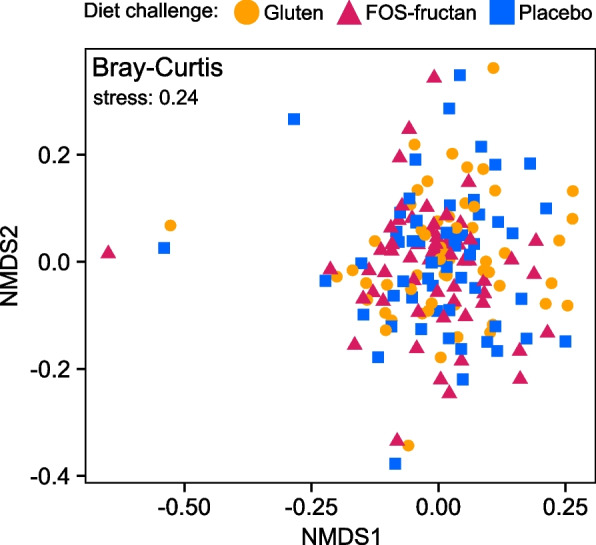
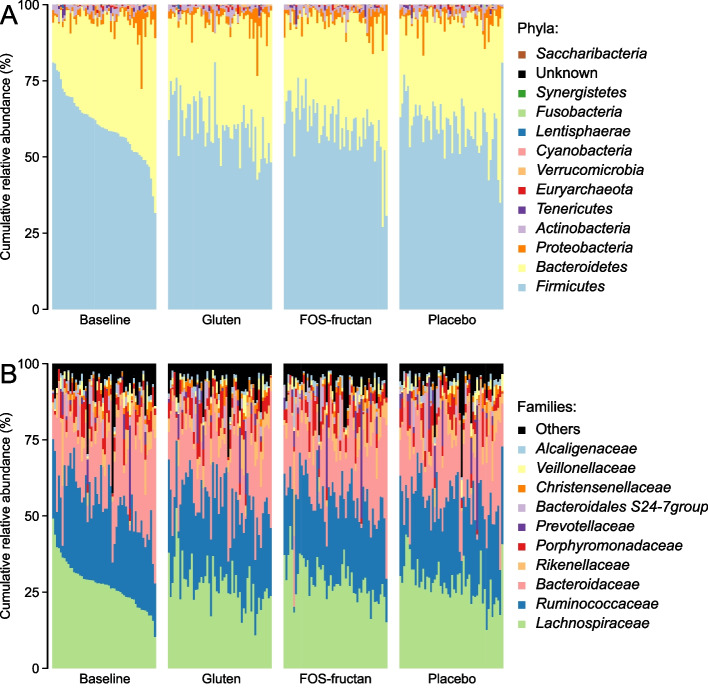
The relative abundances of certain bacterial taxa were affected differently by the diet challenges. After the FOS-fructan challenge, Fusicatenibacter increased, while Eubacterium (E.) coprostanoligenes group, Anaerotruncus, and unknown Ruminococcaceae genera decreased. The gluten challenge was primarily characterized by increased abundance of Eubacterium xylanophilum group. However, no differences were found for bacterial diversity (α-diversity), overall bacterial community structure (β-diversity), faecal metabolites (SCFA), or NGAL/LCN2. Furthermore, gastrointestinal symptoms in response to FOS-fructans were generally not linked to substantial shifts in the gut bacterial community. However, the reduction in E. coprostanoligenes group following the FOS-fructan challenge was associated with increased gastrointestinal pain. Finally, correlation analysis revealed that changes in gastrointestinal symptoms following the FOS-fructan and gluten challenges were linked to varying bacterial abundances at baseline.
In conclusion, while FOS-fructans induced more gastrointestinal symptoms than gluten in the NCGWS patients, we did not find that substantial shifts in the composition nor function of the faecal microbiota could explain these differences in the current study. However, our results indicate that individual variations in baseline bacterial composition/function may influence the gastrointestinal symptom response to both FOS-fructans and gluten. Additionally, the change in E. coprostanoligenes group, which was associated with increased symptoms, implies that attention should be given to these bacteria in future trials investigating the impact of dietary treatments on gastrointestinal symptoms.
Clinicaltrials.gov as NCT02464150.
非乳糜泻麸质/小麦敏感(NCGWS)个体在遵循无麸质饮食后,胃肠道症状得到改善。尽管先前的结果表明,在自我报告的 NCGWS 患者中,相比于麸质,短链果糖(FOS)更有可能引起症状,但潜在的机制仍未得到解决。
因此,我们的主要目的是研究 FOS-果聚糖和麸质是否会影响粪便微生物群(16S rRNA 基因测序)的组成和多样性、微生物发酵的粪便代谢物(短链脂肪酸[SCFA];火焰离子化检测器气相色谱法)以及粪便中肠道炎症的生物标志物(中性粒细胞明胶酶相关脂质运载蛋白,也称为脂钙素 2,NGAL/LCN2;酶联免疫吸附试验)。在这项随机、双盲、安慰剂对照的交叉研究中,59 名自我报告的 NCGWS 参与者分别进行了 3 种不同的为期 7 天的饮食挑战,即麸质(5.7g/天)、FOS-果聚糖(2.1g/天)和安慰剂(3 个周期,6 个挑战序列)。
饮食挑战对某些细菌类群的相对丰度有不同的影响。在 FOS-果聚糖挑战后,Fusicatenibacter 增加,而 Eubacterium(E.)coprostanoligenes 组、Anaerotruncus 和未知的 Ruminococcaceae 属减少。麸质挑战的主要特征是 Eubacterium xylanophilum 组的丰度增加。然而,细菌多样性(α-多样性)、整体细菌群落结构(β-多样性)、粪便代谢物(SCFA)或 NGAL/LCN2 均无差异。此外,FOS-果聚糖引起的胃肠道症状通常与肠道细菌群落的实质性变化无关。然而,FOS-果聚糖挑战后 E. coprostanoligenes 组的减少与胃肠道疼痛增加有关。最后,相关性分析显示,FOS-果聚糖和麸质挑战后胃肠道症状的变化与基线时细菌丰度的变化有关。
总之,尽管 FOS-果聚糖在 NCGWS 患者中引起的胃肠道症状比麸质多,但在本研究中,我们没有发现粪便微生物群的组成和功能的实质性变化可以解释这些差异。然而,我们的结果表明,基线时细菌组成/功能的个体差异可能会影响对 FOS-果聚糖和麸质的胃肠道症状反应。此外,与症状增加相关的 E. coprostanoligenes 组的变化表明,在未来研究饮食治疗对胃肠道症状的影响时,应关注这些细菌。
Clinicaltrials.gov 登记号为 NCT02464150。