Center for Innovative and Translational Medicine, Kochi Medical School, Kochi University, Kochi, Japan.
Department of Environmental Medicine, Kochi Medical School, Kochi University, Kochi, Japan.
Stem Cells Transl Med. 2017 Mar;6(3):713-719. doi: 10.5966/sctm.2016-0289. Epub 2016 Oct 11.
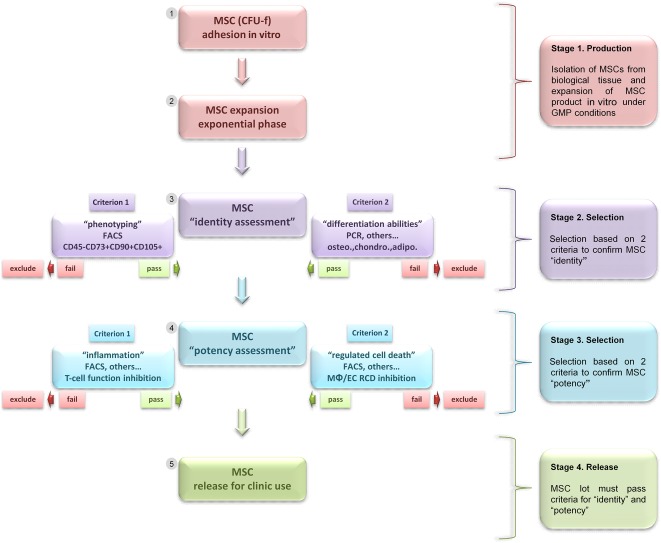
Mesenchymal stem (stromal) cells (MSCs) are being investigated for treating degenerative and inflammatory disorders because of their reparative and immunomodulatory properties. Intricate mechanisms relate cell death processes with immune responses, which have implications for degenerative and inflammatory conditions. We review the therapeutic value of MSCs in terms of preventing regulated cell death (RCD). When cells identify an insult, specific intracellular pathways are elicited for execution of RCD processes, such as apoptosis, necroptosis, and pyroptosis. To some extent, exacerbated RCD can provoke an intense inflammatory response and vice versa. Emerging studies are focusing on the molecular mechanisms deployed by MSCs to ameliorate the survival, bioenergetics, and functions of unfit immune or nonimmune cells. Given these aspects, and in light of MSC actions in modulating cell death processes, we suggest the use of novel functional in vitro assays to ensure the potency of MSCs for preventing RCD. Such analyses should be associated with existing functional assays measuring the anti-inflammatory capabilities of MSCs in vitro. MSCs selected on the basis of two in vitro functional criteria (i.e., prevention of inflammation and RCD) could possess optimal therapeutic efficacy in vivo. In addition, we underline the implications of these perspectives in clinical studies of MSC therapy, with particular focus on acute respiratory distress syndrome. Stem Cells Translational Medicine 2017;6:713-719.
间充质干细胞(基质细胞)因其具有修复和免疫调节特性,目前正在被研究用于治疗退行性和炎症性疾病。细胞死亡过程与免疫反应之间存在复杂的机制,这些机制对退行性和炎症性疾病具有重要意义。我们回顾了间充质干细胞在预防调控性细胞死亡(RCD)方面的治疗价值。当细胞识别到损伤时,会引发特定的细胞内途径来执行 RCD 过程,如细胞凋亡、坏死性凋亡和细胞焦亡。在某种程度上,过度的 RCD 会引发强烈的炎症反应,反之亦然。新兴的研究集中在间充质干细胞用来改善不适宜的免疫或非免疫细胞的存活、生物能量和功能的分子机制上。鉴于这些方面,以及间充质干细胞在调节细胞死亡过程中的作用,我们建议使用新型的功能性体外检测来确保间充质干细胞预防 RCD 的效力。这些分析应与现有的功能性检测相结合,以测量间充质干细胞在体外的抗炎能力。基于两种体外功能标准(即预防炎症和 RCD)选择的间充质干细胞在体内可能具有最佳的治疗效果。此外,我们还强调了这些观点在间充质干细胞治疗的临床研究中的意义,特别关注急性呼吸窘迫综合征。《干细胞转化医学》2017 年;6:713-719。