Panneer Manohar, Murugaiyan Prakash, Rao Sufala Viswas
Department of Anesthesia, Karpaga Vinayaga Institute of Medical Sciences, Kancheepuram, Tamil Nadu, India.
Anesth Essays Res. 2017 Jan-Mar;11(1):151-154. doi: 10.4103/0259-1162.183157.
Dexmedetomidine and clonidine have been used for the prevention and treatment of shivering following spinal blockade. A prospective randomized, double-blinded study was conducted to compare the efficacy and safety of dexmedetomidine and clonidine in controlling postspinal shivering.
A total of sixty participants of equal sex, aged between 18 and 60 years of American Society of Anesthesiologists (ASA) I/II Class, who underwent orthopedic lower limb surgeries under spinal anesthesia with ≥Grade III shivering were randomly divided into two groups, Group D ( = 30) received injection dexmedetomidine 0.5 μg/kg and Group C ( = 30) received injection clonidine 1 μg/kg when they experienced shivering. Time taken to control shivering, response rate, recurrence rate, and side effects such as nausea, vomiting, dry mouth, respiratory depression, and deep sedation were observed.
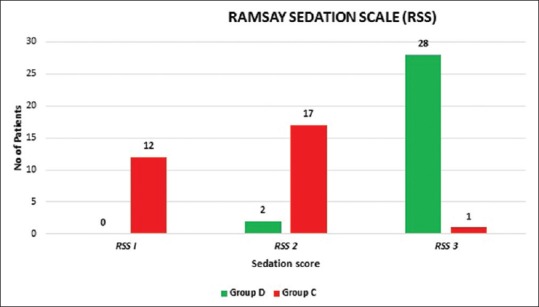
The demographic profile, ASA Class, duration of surgery, duration of anesthesia, temperature, onset and grade of shivering were all comparable between the two groups. Time taken to control shivering and recurrence rate were significantly lower in Group D when compared with Group C. Level of sedation was adequate with Group D, and the incidence of hypotension and bradycardia were significantly higher in Group C. The other side effects profiles were comparable between the two groups.
Dexmedetomidine 0.5 μg/kg is more efficient than clonidine 1 μg/kg in controlling postspinal blockade shivering. Dexmedetomidine has early onset of effect, high response rate, and less recurrence rate with added advantage of good sedation and stable cardiorespiratory parameters.
右美托咪定和可乐定已被用于预防和治疗脊髓阻滞术后寒战。本研究进行了一项前瞻性随机双盲研究,比较右美托咪定和可乐定控制脊髓麻醉后寒战的疗效和安全性。
选取60例年龄在18至60岁之间、美国麻醉医师协会(ASA)分级为I/II级、在脊髓麻醉下行骨科下肢手术且出现≥III级寒战的患者,将其随机分为两组,D组(n = 30)在出现寒战时静脉注射右美托咪定0.5 μg/kg,C组(n = 30)在出现寒战时静脉注射可乐定1 μg/kg。观察控制寒战所需时间、有效率、复发率以及恶心、呕吐、口干、呼吸抑制和深度镇静等副作用。
两组患者的人口统计学特征、ASA分级、手术时间、麻醉时间、体温、寒战发作时间及程度均具有可比性。与C组相比,D组控制寒战所需时间和复发率显著降低。D组镇静程度适宜,C组低血压和心动过缓发生率显著更高。两组其他副作用情况相当。
0.5 μg/kg右美托咪定在控制脊髓阻滞后寒战方面比1 μg/kg可乐定更有效。右美托咪定起效早、有效率高、复发率低,且具有良好的镇静效果和稳定的心肺参数等优势。