Spataro Rossella, Chella Antonio, Allison Brendan, Giardina Marcello, Sorbello Rosario, Tramonte Salvatore, Guger Christoph, La Bella Vincenzo
Department of Experimental Biomedicine and Clinical Neurosciences, ALS Clinical Research Center, University of Palermo Palermo, Italy.
Department of Chemical, Management, Computer, Mechanical Engineering, University of PalermoPalermo, Italy; Instituto di Calcolo e Reti ad Alte Prestazioni (ICAR-CNR)Palermo, Italy.
Front Hum Neurosci. 2017 Mar 1;11:68. doi: 10.3389/fnhum.2017.00068. eCollection 2017.
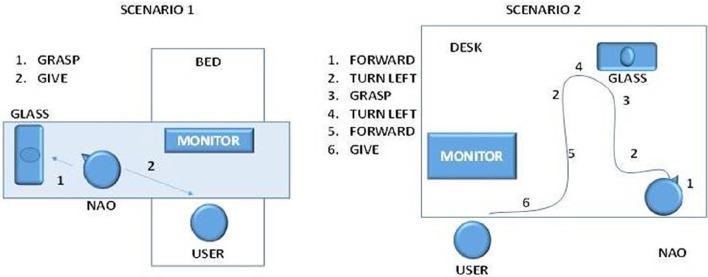
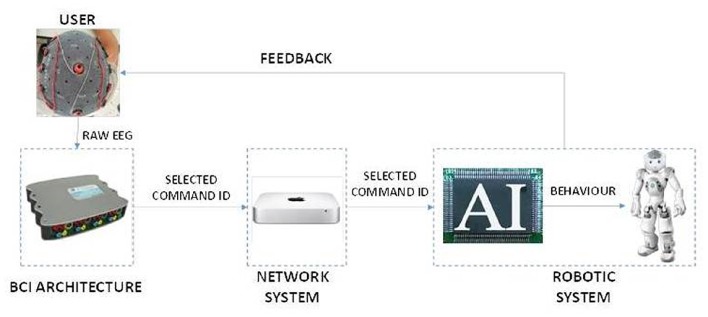
Locked-in Amyotrophic Lateral Sclerosis (ALS) patients are fully dependent on caregivers for any daily need. At this stage, basic communication and environmental control may not be possible even with commonly used augmentative and alternative communication devices. Brain Computer Interface (BCI) technology allows users to modulate brain activity for communication and control of machines and devices, without requiring a motor control. In the last several years, numerous articles have described how persons with ALS could effectively use BCIs for different goals, usually spelling. In the present study, locked-in ALS patients used a BCI system to directly control the humanoid robot NAO (Aldebaran Robotics, France) with the aim of reaching and grasping a glass of water. Four ALS patients and four healthy controls were recruited and trained to operate this humanoid robot through a P300-based BCI. A few minutes training was sufficient to efficiently operate the system in different environments. Three out of the four ALS patients and all controls successfully performed the task with a high level of accuracy. These results suggest that BCI-operated robots can be used by locked-in ALS patients as an artificial alter-ego, the machine being able to move, speak and act in his/her place.
闭锁综合征型肌萎缩侧索硬化症(ALS)患者的任何日常需求都完全依赖于照料者。在这个阶段,即使使用常用的辅助和替代沟通设备,基本的沟通和环境控制也可能无法实现。脑机接口(BCI)技术允许用户调节大脑活动以进行沟通和控制机器及设备,而无需运动控制。在过去几年中,大量文章描述了ALS患者如何能够有效地将BCI用于不同目的,通常是拼写。在本研究中,闭锁综合征型ALS患者使用BCI系统直接控制人形机器人NAO(法国奥尔德巴伦机器人公司),目的是伸手去拿并握住一杯水。招募了四名ALS患者和四名健康对照者,并训练他们通过基于P300的BCI操作这个人形机器人。几分钟的训练就足以在不同环境中高效操作该系统。四名ALS患者中有三名以及所有对照者都以高准确率成功完成了任务。这些结果表明,闭锁综合征型ALS患者可以将由BCI操作的机器人用作人工替身,该机器能够在其位置上移动、说话和行动。