Fobil Julius N, Aryee Eunice, Bilson Francis, May Juergen, Kraemer Alexander
School of Public Health, College of Health Sciences, University of Ghana;; Bernhard-Notch Institute for Tropical Medicine, Hamburg, Germany;; School of Public Health, Department of Public Health Medicine, Bielefeld University, Germany.
School of Public Health, College of Health Sciences, University of Ghana.
J Public Health Afr. 2011 Mar 4;2(1):e5. doi: 10.4081/jphia.2011.e5. eCollection 2011 Mar 1.
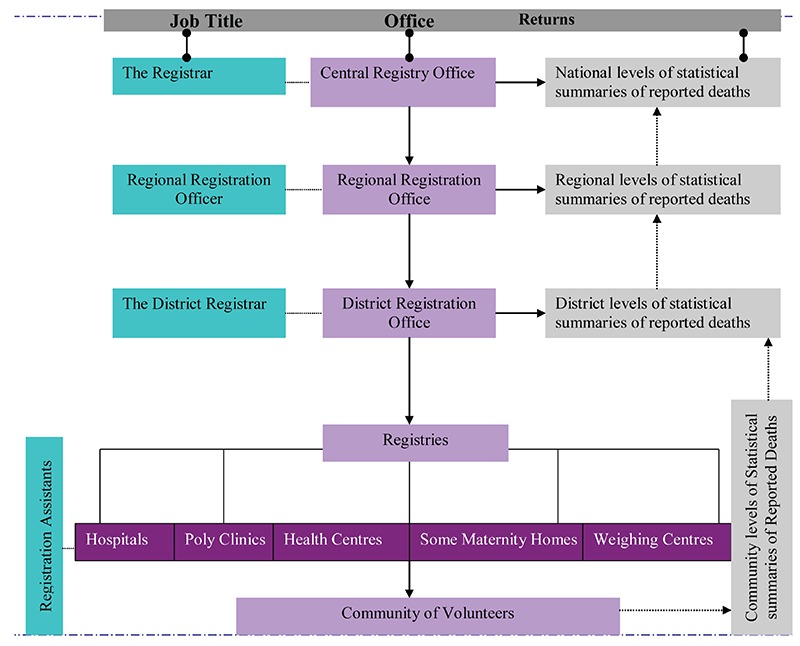
Vital registration systems (VRS) are important in the collection of routine data on indicators of development. These are particularly useful if they are properly built to address weaknesses in the system leading to poor data quality. For instance, routine data on health events (e.g. morbidity, mortality etc.) are crucial for rapid assessment of disease burden and mortality trends in the population. They are also useful in the identification of vulnerable groups in populations. Despite their usefulness, VRS in many developing countries including Ghana are poorly structured raising questions about the quality of the output data from these systems. The present study aimed at assessing and documenting the structure and function of the VRS in Ghana, as well as at identifying the structural features that potentially compromise the reliability and validity of the output data from the Ghanaian VRS. To perform this study, collection and review of policy and legal documents establishing the VRS, documentation and evaluation of component structures of the system, assessment of procedural protocols guiding data collection processes and in-depth interviews with staff at the Ghana Births and Deaths Registry were performed. The assessment of the structure of the Ghana VRS, policy documents setting it up and the operational procedures reveals important lapses (e.g. presence of outmoded practices, imperfections in Births and Deaths Registry Act, 1965, Act 301 and imperfect system design) in the system that could compromise validity and reliability of the data generated from the VRS in Ghana.
生命登记系统(VRS)在收集有关发展指标的常规数据方面很重要。如果这些系统构建得当,能够解决导致数据质量差的系统弱点,那么它们就特别有用。例如,关于健康事件(如发病率、死亡率等)的常规数据对于快速评估人群中的疾病负担和死亡率趋势至关重要。它们在识别人群中的弱势群体方面也很有用。尽管生命登记系统很有用,但包括加纳在内的许多发展中国家的生命登记系统结构不佳,这引发了对这些系统输出数据质量的质疑。本研究旨在评估和记录加纳生命登记系统的结构和功能,并识别可能损害加纳生命登记系统输出数据可靠性和有效性的结构特征。为了进行这项研究,我们收集并审查了建立生命登记系统的政策和法律文件,记录并评估了该系统的组成结构,评估了指导数据收集过程的程序协议,并对加纳出生和死亡登记处的工作人员进行了深入访谈。对加纳生命登记系统的结构、设立该系统的政策文件以及操作程序的评估揭示了该系统中存在的重要缺陷(如存在过时的做法、1965年第301号《出生和死亡登记法》存在瑕疵以及系统设计不完善),这些缺陷可能会损害加纳生命登记系统生成的数据的有效性和可靠性。