Dmitriev Alexey A, Kudryavtseva Anna V, Bolsheva Nadezhda L, Zyablitsin Alexander V, Rozhmina Tatiana A, Kishlyan Natalya V, Krasnov George S, Speranskaya Anna S, Krinitsina Anastasia A, Sadritdinova Asiya F, Snezhkina Anastasiya V, Fedorova Maria S, Yurkevich Olga Yu, Muravenko Olga V, Belenikin Maxim S, Melnikova Nataliya V
Engelhardt Institute of Molecular Biology, Russian Academy of Sciences, Moscow 119991, Russia.
Engelhardt Institute of Molecular Biology, Russian Academy of Sciences, Moscow 119991, Russia; All-Russian Research Institute for Flax, Torzhok 172002, Russia.
Biomed Res Int. 2017;2017:4975146. doi: 10.1155/2017/4975146. Epub 2017 Feb 19.
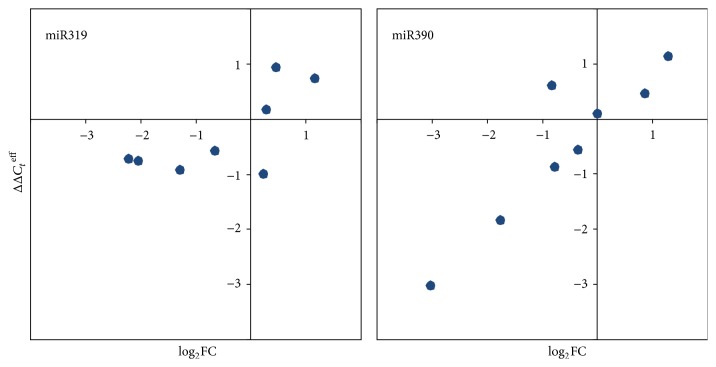
Acid soils limit agricultural production worldwide. Major reason of crop losses in acid soils is the toxicity of aluminum (Al). In the present work, we investigated expression alterations of microRNAs in flax ( L.) plants under Al stress. Flax seedlings of resistant (TMP1919 and G1071/4_k) and sensitive (Lira and G1071/4_o) to Al cultivars and lines were exposed to AlCl solution for 4 and 24 hours. Twelve small RNA libraries were constructed and sequenced using Illumina platform. In total, 97 microRNAs from 18 conserved families were identified. miR319, miR390, and miR393 revealed expression alterations associated with Al treatment of flax plants. Moreover, for miR390 and miR393, the alterations were distinct in sensitive and resistant to Al genotypes. Expression level changes of miR319 and miR390 were confirmed using qPCR analysis. In flax, potential targets of miR319 are TCPs, miR390-TAS3 and GRF5, and miR393-AFB2-coding transcripts. TCPs, TAS3, GRF5, and AFB2 participate in regulation of plant growth and development. The involvement of miR319, miR390, and miR393 in response to Al stress in flax was shown here for the first time. We speculate that these microRNAs play an important role in Al response regulation of growth processes in flax plants.
酸性土壤限制了全球的农业生产。酸性土壤中作物减产的主要原因是铝(Al)的毒性。在本研究中,我们调查了铝胁迫下亚麻(L.)植株中微小RNA的表达变化。将对铝具有抗性(TMP1919和G1071/4_k)和敏感性(Lira和G1071/4_o)的亚麻品种和品系的幼苗暴露于AlCl溶液中4小时和24小时。构建了12个小RNA文库,并使用Illumina平台进行测序。总共鉴定出了来自18个保守家族的97个微小RNA。miR319、miR390和miR393显示出与亚麻植株铝处理相关的表达变化。此外,对于miR390和miR393,在对铝敏感和抗性的基因型中变化是不同的。使用qPCR分析证实了miR319和miR390的表达水平变化。在亚麻中,miR319的潜在靶标是TCPs、miR390-TAS3和GRF5,以及miR393-AFB2编码转录本。TCPs、TAS3、GRF5和AFB2参与植物生长和发育的调控。这里首次展示了miR319、miR390和miR393参与亚麻对铝胁迫的响应。我们推测这些微小RNA在亚麻植株铝响应生长过程的调控中起重要作用。