• 文献检索
  • 文档翻译
  • 深度研究
  • 学术资讯
  • Suppr Zotero 插件Zotero 插件
  • 邀请有礼
  • 套餐&价格
  • 历史记录
应用&插件
Suppr Zotero 插件Zotero 插件浏览器插件Mac 客户端Windows 客户端微信小程序
定价
高级版会员购买积分包购买API积分包
服务
文献检索文档翻译深度研究API 文档MCP 服务
关于我们
关于 Suppr公司介绍联系我们用户协议隐私条款
关注我们

Suppr 超能文献

核心技术专利:CN118964589B侵权必究
粤ICP备2023148730 号-1Suppr @ 2026

文献检索

告别复杂PubMed语法,用中文像聊天一样搜索,搜遍4000万医学文献。AI智能推荐,让科研检索更轻松。

立即免费搜索

文件翻译

保留排版,准确专业,支持PDF/Word/PPT等文件格式,支持 12+语言互译。

免费翻译文档

深度研究

AI帮你快速写综述,25分钟生成高质量综述,智能提取关键信息,辅助科研写作。

立即免费体验

社交媒体在糖尿病管理中的应用:基于 Facebook、Twitter 和 Instagram 的用户参与因素观察性研究

Factors Engaging Users of Diabetes Social Media Channels on Facebook, Twitter, and Instagram: Observational Study.

机构信息

Norwegian Centre for E-health Research, University Hospital of North Norway, Tromsø, Norway.

Department of Electronic Technology, University of Seville, Seville, Spain.

出版信息

J Med Internet Res. 2020 Sep 29;22(9):e21204. doi: 10.2196/21204.

DOI:10.2196/21204
PMID:32990632
原文链接:https://pmc.ncbi.nlm.nih.gov/articles/PMC7556374/
Abstract

BACKGROUND

Diabetes patient associations and diabetes-specific patient groups around the world are present on social media. Although active participation and engagement in these diabetes social media groups has been mostly linked to positive effects, very little is known about the content that is shared on these channels or the post features that engage their users the most.

OBJECTIVE

The objective of this study was to analyze (1) the content and features of posts shared over a 3-year period on 3 diabetes social media channels (Facebook, Twitter, and Instagram) of a diabetes association, and (2) users' engagement with these posts (likes, comments, and shares).

METHODS

All social media posts published from the Norwegian Diabetes Association between January 1, 2017, and December 31, 2019, were extracted. Two independent reviewers classified the posts into 7 categories based on their content. The interrater reliability was calculated using Cohen kappa. Regression analyses were carried out to analyze the effects of content topic, social media channel, and post features on users' engagement (likes, comments, and shares).

RESULTS

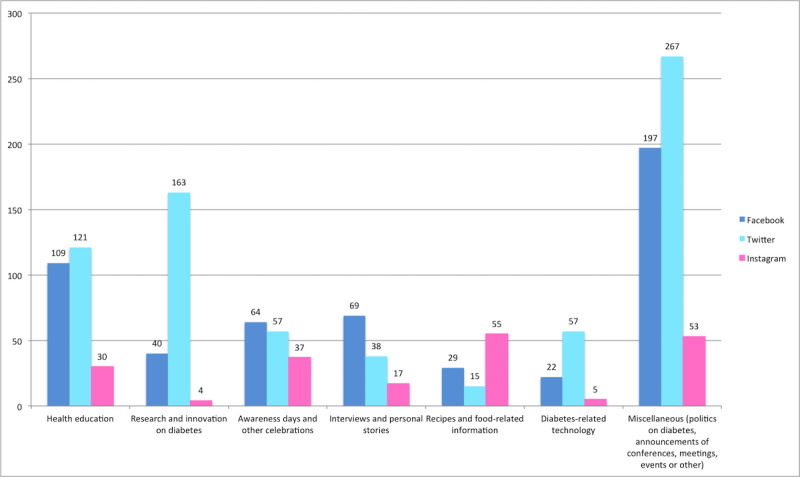
A total of 1449 messages were posted. Posts of interviews and personal stories received 111% more likes, 106% more comments, and 112% more shares than miscellaneous posts (all P<.001). Messages posted about awareness days and other celebrations were 41% more likely to receive likes than miscellaneous posts (P<.001). Conversely, posts on research and innovation received 31% less likes (P<.001), 35% less comments (P=.02), and 25% less shares (P=.03) than miscellaneous posts. Health education posts received 38% less comments (P=.003) but were shared 39% more than miscellaneous posts (P=.007). With regard to social media channel, Facebook and Instagram posts were both 35 times more likely than Twitter posts to receive likes, and 60 times and almost 10 times more likely to receive comments, respectively (P<.001). Compared to text-only posts, those with videos had 3 times greater chance of receiving likes, almost 4 times greater chance of receiving comments, and 2.5 times greater chance of being shared (all P<.001). Including both videos and emoji in posts increased the chances of receiving likes by almost 7 times (P<.001). Adding an emoji to posts increased their chances of receiving likes and being shared by 71% and 144%, respectively (P<.001).

CONCLUSIONS

Diabetes social media users seem to be least engaged in posts with content topics that a priori could be linked to greater empowerment: research and innovation on diabetes, and health education. Diabetes social media groups, public health authorities, and other stakeholders interested in sharing research and innovation content and promoting health education on social media should consider including videos and emoji in their posts, and publish on popular and visual-based social media channels, such as Facebook and Instagram, to increase user engagement.

INTERNATIONAL REGISTERED REPORT IDENTIFIER (IRRID): RR2-10.1186/s12913-018-3178-7.
https://cdn.ncbi.nlm.nih.gov/pmc/blobs/ad7a/7556374/8a7e9f66362a/jmir_v22i9e21204_fig1.jpg
摘要

背景

世界各地的糖尿病患者协会和糖尿病特定患者群体都活跃在社交媒体上。尽管参与这些糖尿病社交媒体群组的活动大多与积极影响相关,但关于这些渠道上分享的内容或最能吸引用户的帖子特征,我们知之甚少。

目的

本研究旨在分析(1)糖尿病协会在 3 个社交媒体渠道(Facebook、Twitter 和 Instagram)上发布的帖子的内容和特征,这些帖子是在 3 年内发布的;(2)用户对这些帖子的参与度(点赞、评论和分享)。

方法

提取 2017 年 1 月 1 日至 2019 年 12 月 31 日期间挪威糖尿病协会在社交媒体上发布的所有帖子。两名独立的审阅者根据帖子的内容将其分为 7 个类别。使用 Cohen kappa 计算组内一致性。进行回归分析以分析内容主题、社交媒体渠道和帖子特征对用户参与度(点赞、评论和分享)的影响。

结果

共发布了 1449 条消息。采访和个人故事类帖子比杂项帖子获得了 111%的点赞、106%的评论和 112%的分享(均 P<.001)。关于意识日和其他庆祝活动的消息比杂项帖子获得点赞的可能性高 41%(P<.001)。相反,关于研究和创新的帖子比杂项帖子获得点赞(P<.001)、评论(P=.02)和分享(P=.03)的次数分别少 31%、35%和 25%。健康教育帖子的评论少了 38%(P=.003),但比杂项帖子分享的次数多了 39%(P=.007)。就社交媒体渠道而言,Facebook 和 Instagram 帖子获得点赞的可能性是 Twitter 帖子的 35 倍,获得评论的可能性是 Twitter 帖子的 60 倍和近 10 倍(均 P<.001)。与纯文本帖子相比,包含视频的帖子获得点赞的几率增加了 3 倍,获得评论的几率增加了近 4 倍,获得分享的几率增加了 2.5 倍(均 P<.001)。在帖子中同时包含视频和表情符号,获得点赞的几率增加了近 7 倍(P<.001)。在帖子中添加表情符号可使获得点赞和分享的几率分别增加 71%和 144%(均 P<.001)。

结论

糖尿病社交媒体用户似乎对那些从理论上可以与更大的赋权相关的内容主题的帖子参与度最低:与糖尿病相关的研究和创新,以及健康教育。对社交媒体上分享研究和创新内容以及促进健康教育感兴趣的糖尿病社交媒体群组、公共卫生当局和其他利益相关者,应考虑在帖子中包含视频和表情符号,并在受欢迎和基于视觉的社交媒体渠道(如 Facebook 和 Instagram)上发布,以增加用户参与度。

国际标准化组织报告标识符(IRRID):RR2-10.1186/s12913-018-3178-7.

相似文献

1
Factors Engaging Users of Diabetes Social Media Channels on Facebook, Twitter, and Instagram: Observational Study.社交媒体在糖尿病管理中的应用:基于 Facebook、Twitter 和 Instagram 的用户参与因素观察性研究
J Med Internet Res. 2020 Sep 29;22(9):e21204. doi: 10.2196/21204.
2
Engaging Social Media Users with Health Education and Physical Activity Promotion.通过健康教育和促进体育活动来吸引社交媒体用户。
Stud Health Technol Inform. 2021 May 27;281:789-793. doi: 10.3233/SHTI210283.
3
Examining the Influence on Perceptions of Endometriosis via Analysis of Social Media Posts: Cross-sectional Study.通过社交媒体帖子分析探讨对子宫内膜异位症认知的影响:横断面研究
JMIR Form Res. 2022 Mar 18;6(3):e31135. doi: 10.2196/31135.
4
Visual Cancer Communication on Social Media: An Examination of Content and Effects of #Melanomasucks.社交媒体上的视觉癌症传播:对#黑色素瘤糟透了#的内容与影响的考察
J Med Internet Res. 2018 Sep 5;20(9):e10501. doi: 10.2196/10501.
5
Platform Effects on Public Health Communication: A Comparative and National Study of Message Design and Audience Engagement Across Twitter and Facebook.平台对公共卫生传播的影响:一项关于推特和脸书上信息设计与受众参与度的比较性全国研究。
JMIR Infodemiology. 2022 Dec 20;2(2):e40198. doi: 10.2196/40198. eCollection 2022 Jul-Dec.
6
Body Positivity, Physical Health, and Emotional Well-Being Discourse on Social Media: Content Analysis of Lizzo's Instagram.社交媒体上的身体积极性、身体健康和情绪幸福感话语:莉佐 Instagram 的内容分析。
JMIR Form Res. 2024 Nov 4;8:e60541. doi: 10.2196/60541.
7
Evaluation of a Social Media Campaign in Saskatchewan to Promote Healthy Eating During the COVID-19 Pandemic: Social Media Analysis and Qualitative Interview Study.萨斯喀彻温省一项在新冠疫情期间促进健康饮食的社交媒体活动评估:社交媒体分析与定性访谈研究
J Med Internet Res. 2021 Jul 21;23(7):e27448. doi: 10.2196/27448.
8
Characteristics of and User Engagement With Antivaping Posts on Instagram: Observational Study.Instagram 反电子烟帖子的特点和用户参与度:观察性研究。
JMIR Public Health Surveill. 2021 Nov 25;7(11):e29600. doi: 10.2196/29600.
9
Plastic Surgery Faces the Web: Analysis of the Popular Social Media for Plastic Surgeons.整形手术与网络:整形外科医生常用社交媒体分析
Plast Reconstr Surg Glob Open. 2018 Dec 13;6(12):e1958. doi: 10.1097/GOX.0000000000001958. eCollection 2018 Dec.
10
Radiology on Instagram: Analysis of Public Accounts and Identified Areas for Content Creation.放射科在 Instagram 上:公共账户分析和内容创作领域。
Acad Radiol. 2022 Jan;29(1):77-83. doi: 10.1016/j.acra.2020.08.024. Epub 2020 Sep 23.

引用本文的文献

1
Engaging with patients with diabetes: the role of social media in low-income healthcare organisations.与糖尿病患者互动:社交媒体在低收入医疗保健机构中的作用。
BMJ Health Care Inform. 2025 Feb 4;32(1):e101193. doi: 10.1136/bmjhci-2024-101193.
2
Analyzing Engagement: A Study of Teething-Related Discussions and Trends on Facebook.分析参与度:一项关于脸书上与出牙相关的讨论及趋势的研究。
Cureus. 2024 Sep 10;16(9):e69107. doi: 10.7759/cureus.69107. eCollection 2024 Sep.
3
Designing for caregiving networks: a case study of primary caregivers of children with medical complexity.

本文引用的文献

1
Patients' Use of Social Media for Diabetes Self-Care: Systematic Review.患者使用社交媒体进行糖尿病自我护理:系统评价
J Med Internet Res. 2020 Apr 24;22(4):e14209. doi: 10.2196/14209.
2
Social Media Use By People With Diabetes In Saudi Arabia: A Survey About Purposes, Benefits And Risks.沙特阿拉伯糖尿病患者的社交媒体使用情况:一项关于目的、益处和风险的调查
Diabetes Metab Syndr Obes. 2019 Nov 13;12:2363-2372. doi: 10.2147/DMSO.S208141. eCollection 2019.
3
Desire to Belong Affects Instagram Behavior and Perceived Social Support.归属感影响 Instagram 行为和感知到的社会支持。
为照护网络设计:以患有复杂疾病儿童的主要照护者为例
J Am Med Inform Assoc. 2024 Apr 19;31(5):1151-1162. doi: 10.1093/jamia/ocae026.
4
Supporting and Incentivizing Peer Leaders for an Internet-Based Private Peer Community for Youths With Type 1 Diabetes: Social Network and Directed Content Analysis.支持和激励基于互联网的 1 型糖尿病青少年私人同伴社区中的同伴领袖:社会网络和定向内容分析。
J Med Internet Res. 2023 Dec 12;25:e48267. doi: 10.2196/48267.
5
WeChat official accounts' posts on medication use of 251 community healthcare centers in Shanghai, China: content analysis and quality assessment.中国上海251家社区卫生服务中心微信公众号用药相关推文:内容分析与质量评估
Front Med (Lausanne). 2023 Jun 12;10:1155428. doi: 10.3389/fmed.2023.1155428. eCollection 2023.
6
What are IBD Patients Talking About on Twitter? Using Natural Language Understanding to Investigate Patients' Tweets.炎症性肠病患者在推特上都在谈论什么?运用自然语言理解来研究患者的推文。
SN Comput Sci. 2023;4(4):343. doi: 10.1007/s42979-023-01772-7. Epub 2023 Apr 20.
7
A mixed-methods exploration of attitudes towards pregnant Facebook fitness influencers.对孕妇 Facebook 健身影响者态度的混合方法探索。
BMC Public Health. 2023 Mar 27;23(1):569. doi: 10.1186/s12889-023-15457-6.
8
Introducing AI to the molecular tumor board: one direction toward the establishment of precision medicine using large-scale cancer clinical and biological information.将人工智能引入分子肿瘤专家委员会:利用大规模癌症临床和生物学信息建立精准医学的一个方向。
Exp Hematol Oncol. 2022 Oct 31;11(1):82. doi: 10.1186/s40164-022-00333-7.
9
Online Food Security Discussion Before and During the COVID-19 Pandemic in Native Hawaiian and Pacific Islander Community Groups and Organizations: Content Analysis of Facebook Posts.夏威夷原住民和太平洋岛民社区团体及组织在新冠疫情之前及期间的在线食品安全讨论:脸书帖子内容分析
Asian Pac Isl Nurs J. 2022 Sep 30;6(1):e40436. doi: 10.2196/40436. eCollection 2022 Jan-Dec.
10
Navigating Diabetes Online Communities in Clinical Practice.在临床实践中驾驭糖尿病在线社区。
J Diabetes Sci Technol. 2022 Jul;16(4):874-886. doi: 10.1177/19322968211069409. Epub 2022 Feb 5.
Cyberpsychol Behav Soc Netw. 2019 Jul;22(7):465-471. doi: 10.1089/cyber.2018.0533.
4
Social Media Content Analysis of Public Diabetes Facebook Groups.糖尿病公共脸书群组的社交媒体内容分析
J Diabetes Sci Technol. 2019 May;13(3):428-438. doi: 10.1177/1932296819839099. Epub 2019 Mar 31.
5
What Are Diabetes Patients Versus Health Care Personnel Discussing on Social Media?糖尿病患者与医护人员在社交媒体上讨论些什么?
J Diabetes Sci Technol. 2019 Mar;13(2):198-205. doi: 10.1177/1932296818821649. Epub 2019 Jan 13.
6
The association between use of online social networks sites and perceived social isolation among individuals in the second half of life: results based on a nationally representative sample in Germany.使用在线社交网络与中年及以上人群感知到的社交孤立之间的关联:基于德国全国代表性样本的结果。
BMC Public Health. 2019 Jan 9;19(1):40. doi: 10.1186/s12889-018-6369-6.
7
Peer Support Through a Diabetes Social Media Community.通过糖尿病社交媒体社区提供同伴支持。
J Diabetes Sci Technol. 2019 May;13(3):493-497. doi: 10.1177/1932296818818828. Epub 2019 Jan 2.
8
Preferences and interests of diabetes social media users regarding a health-promotion intervention.糖尿病社交媒体用户对健康促进干预措施的偏好和兴趣。
Patient Prefer Adherence. 2018 Nov 23;12:2499-2506. doi: 10.2147/PPA.S184369. eCollection 2018.
9
What Are PWDs (People With Diabetes) Doing Online? A Netnographic Analysis.糖尿病患者在网上做什么?一项网络民族志分析。
J Diabetes Sci Technol. 2019 Mar;13(2):187-197. doi: 10.1177/1932296818813192. Epub 2018 Nov 27.
10
Diabetes on Twitter: A Sentiment Analysis.推特上的糖尿病:一项情感分析。
J Diabetes Sci Technol. 2019 May;13(3):439-444. doi: 10.1177/1932296818811679. Epub 2018 Nov 19.