• 文献检索
  • 文档翻译
  • 深度研究
  • 学术资讯
  • Suppr Zotero 插件Zotero 插件
  • 邀请有礼
  • 套餐&价格
  • 历史记录
应用&插件
Suppr Zotero 插件Zotero 插件浏览器插件Mac 客户端Windows 客户端微信小程序
定价
高级版会员购买积分包购买API积分包
服务
文献检索文档翻译深度研究API 文档MCP 服务
关于我们
关于 Suppr公司介绍联系我们用户协议隐私条款
关注我们

Suppr 超能文献

核心技术专利:CN118964589B侵权必究
粤ICP备2023148730 号-1Suppr @ 2026

文献检索

告别复杂PubMed语法,用中文像聊天一样搜索,搜遍4000万医学文献。AI智能推荐,让科研检索更轻松。

立即免费搜索

文件翻译

保留排版,准确专业,支持PDF/Word/PPT等文件格式,支持 12+语言互译。

免费翻译文档

深度研究

AI帮你快速写综述,25分钟生成高质量综述,智能提取关键信息,辅助科研写作。

立即免费体验

用于传播考克兰儿童健康证据的社交媒体:评估研究

Social Media for the Dissemination of Cochrane Child Health Evidence: Evaluation Study.

作者信息

Dyson Michele P, Newton Amanda S, Shave Kassi, Featherstone Robin M, Thomson Denise, Wingert Aireen, Fernandes Ricardo M, Hartling Lisa

机构信息

Alberta Research Centre for Health Evidence, University of Alberta, Edmonton, AB, Canada.

Department of Pediatrics, University of Alberta, Edmonton, AB, Canada.

出版信息

J Med Internet Res. 2017 Sep 1;19(9):e308. doi: 10.2196/jmir.7819.

DOI:10.2196/jmir.7819
PMID:28864427
原文链接:https://pmc.ncbi.nlm.nih.gov/articles/PMC5600964/
Abstract

BACKGROUND

Health care providers value ready access to reliable synthesized information to support point-of-care decision making. Web-based communities, facilitated by the adoption of social media tools such as Facebook, Twitter, and YouTube, are increasingly being used for knowledge dissemination, bridging the gap between knowledge generation and synthesis and knowledge implementation.

OBJECTIVE

Our objective was to implement and evaluate a structured social media strategy, using multiple platforms, to disseminate Cochrane Child Health evidence to health care providers caring for children.

METHODS

Our social media strategy had three components: daily "tweets" using the Cochrane Child Health Twitter account, weekly WordPress blog posts, and a monthly journal club on Twitter ("tweet chat"). Each tweet, blog, and journal club shared Cochrane evidence on a child health topic. We evaluated the strategy through (1) Twitter and blog site analytics, (2) traceable link (Bitly) statistics, (3) Altmetric.com scores for promoted evidence, and (4) participant feedback. We also tracked the resources required to write the blog, tweet content, and manage the strategy.

RESULTS

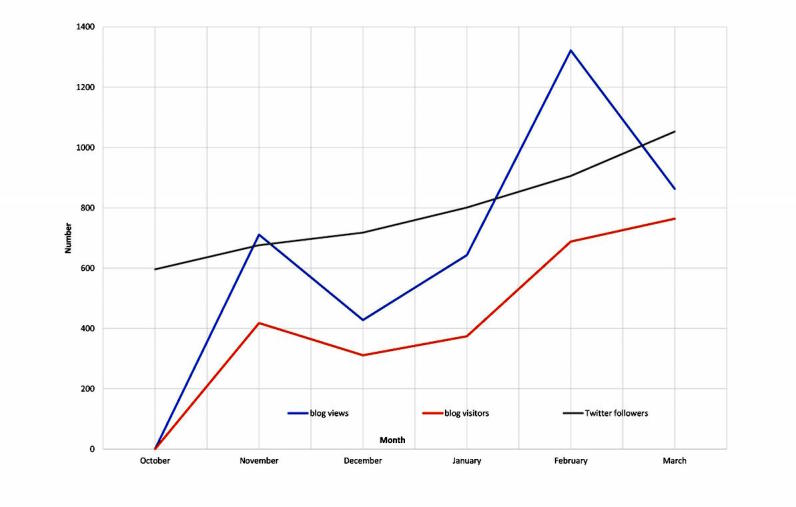
The 22-week social media strategy ran between November 2014 and April 2015. We created 25 blog posts, sent 585 tweets, and hosted 3 tweet chats. Monthly blog visits and views and Twitter account followers increased over time. During the study period, the blog received 2555 visitors and 3967 page views from a geographically diverse audience of health care providers, academics, and health care organizations. In total, 183 traceable Bitly links received 3463 clicks, and the Twitter account gained 469 new followers. The most visited and viewed blog posts included gastrointestinal topics (lactose avoidance), research on respiratory conditions (honey for cough and treatments for asthma), and maternal newborn care (skin-to-skin contact). On Twitter, popular topics were related to public health (vaccination) and pain management. We collected Altmetric.com scores for 61 studies promoted during the study period and recorded an average increase of 11 points. Research staff (n=3) contributed approximately 433 hours to promotion activities and planning (6.5 hours each per week) to implement the social media strategy, and study investigators reviewed all content (blog posts and tweets).

CONCLUSIONS

This study provides empirical evidence on the use of a coordinated social media strategy for the dissemination of evidence to professionals providing health services to children and youth. The results and lessons learned from our study provide guidance for future knowledge dissemination activities using social media tools.

摘要

背景

医疗保健提供者重视能够随时获取可靠的综合信息,以支持即时医疗决策。借助Facebook、Twitter和YouTube等社交媒体工具推动的网络社区,正越来越多地用于知识传播,弥合知识生成与综合以及知识实施之间的差距。

目的

我们的目标是实施并评估一项结构化社交媒体策略,利用多个平台,向照顾儿童的医疗保健提供者传播考科蓝儿童健康证据。

方法

我们的社交媒体策略包括三个部分:使用考科蓝儿童健康Twitter账户每日发布“推文”,每周发布WordPress博客文章,以及每月在Twitter上举办一次期刊俱乐部(“推文聊天”)。每条推文、博客文章和期刊俱乐部都分享一个儿童健康主题的考科蓝证据。我们通过以下方式评估该策略:(1)Twitter和博客网站分析,(2)可追踪链接(Bitly)统计数据,(3)Altmetric.com对所推广证据的评分,以及(4)参与者反馈。我们还跟踪了撰写博客、推文内容以及管理该策略所需的资源。

结果

为期22周的社交媒体策略于2014年11月至2015年4月实施。我们创建了25篇博客文章,发送了585条推文,并举办了3次推文聊天。每月的博客访问量、浏览量以及Twitter账户的关注者数量随时间增加。在研究期间,博客收到来自医疗保健提供者、学者和医疗保健组织等地理分布广泛的受众的2555名访问者和3967次页面浏览量。总共,183个可追踪的Bitly链接获得了3463次点击,Twitter账户增加了469名新关注者。访问量和浏览量最高的博客文章包括胃肠道主题(避免乳糖)、呼吸道疾病研究(蜂蜜用于止咳和哮喘治疗)以及孕产妇新生儿护理(皮肤接触)。在Twitter上,热门话题与公共卫生(疫苗接种)和疼痛管理有关。我们收集了研究期间所推广的61项研究的Altmetric.com评分,记录到平均增加了11分。研究人员(n = 3)为推广活动和规划贡献了约433小时(每周每人6.5小时)以实施社交媒体策略,研究调查人员审查了所有内容(博客文章和推文)。

结论

本研究为使用协调一致的社交媒体策略向为儿童和青少年提供健康服务的专业人员传播证据提供了实证依据。我们研究的结果和经验教训为未来使用社交媒体工具的知识传播活动提供了指导。
https://cdn.ncbi.nlm.nih.gov/pmc/blobs/7395/5600964/13b69dd8b126/jmir_v19i9e308_fig1.jpg

相似文献

1
Social Media for the Dissemination of Cochrane Child Health Evidence: Evaluation Study.用于传播考克兰儿童健康证据的社交媒体:评估研究
J Med Internet Res. 2017 Sep 1;19(9):e308. doi: 10.2196/jmir.7819.
2
Dissemination of evidence in paediatric emergency medicine: a quantitative descriptive evaluation of a 16-week social media promotion.儿科急诊医学中证据的传播:一项为期16周的社交媒体推广的定量描述性评估
BMJ Open. 2018 Jun 6;8(6):e022298. doi: 10.1136/bmjopen-2018-022298.
3
Disseminating the Foundations of Knowledge Translation and Patient Engagement Science Through the KnowledgeNudge Blog and Twitter Profile: Quantitative Descriptive Evaluation.通过KnowledgeNudge博客和推特账号传播知识转化与患者参与科学基础:定量描述性评估
J Med Internet Res. 2020 Jun 15;22(6):e15351. doi: 10.2196/15351.
4
The impact of social media on readership of a peer-reviewed medical journal.社交媒体对同行评审医学期刊读者群的影响。
J Am Coll Radiol. 2014 Nov;11(11):1038-43. doi: 10.1016/j.jacr.2014.07.029. Epub 2014 Nov 3.
5
Use of Web 2.0 Social Media Platforms to Promote Community-Engaged Research Dialogs: A Preliminary Program Evaluation.使用Web 2.0社交媒体平台促进社区参与式研究对话:初步项目评估。
JMIR Res Protoc. 2016 Sep 9;5(3):e183. doi: 10.2196/resprot.4808.
6
Using Social Media to Share Your Radiology Research: How Effective Is a Blog Post?利用社交媒体分享你的放射学研究:一篇博客文章的效果如何?
J Am Coll Radiol. 2015 Jul;12(7):760-5. doi: 10.1016/j.jacr.2015.03.048. Epub 2015 May 8.
7
Outcomes in Child Health: Exploring the Use of Social Media to Engage Parents in Patient-Centered Outcomes Research.儿童健康成果:探索利用社交媒体让家长参与以患者为中心的成果研究。
J Med Internet Res. 2017 Mar 16;19(3):e78. doi: 10.2196/jmir.6655.
8
Enriched Audience Engagement Through Twitter: Should More Academic Radiology Departments Seize the Opportunity?通过推特增强受众参与度:更多放射学学术部门是否应抓住这一机遇?
J Am Coll Radiol. 2015 Jul;12(7):756-9. doi: 10.1016/j.jacr.2015.02.016. Epub 2015 May 13.
9
Twitter use at the 2016 Conference on the Science of Dissemination and Implementation in Health: analyzing #DIScience16.2016 年传播与实施健康科学会议上的 Twitter 使用情况:分析#DIScience16。
Implement Sci. 2018 Feb 20;13(1):34. doi: 10.1186/s13012-018-0723-z.
10
Online Dissemination Strategies of a Canada Research Chair: Overview and Lessons Learned.加拿大研究主席的在线传播策略:概述与经验教训
JMIR Res Protoc. 2017 Feb 24;6(2):e27. doi: 10.2196/resprot.6413.

引用本文的文献

1
Exploration for a knowledge translation model in public dissemination via social media: Insights from an innovative Cochrane evidence dissemination competition in China.探索通过社交媒体进行公众传播的知识转化模式:来自中国一项创新的Cochrane证据传播竞赛的见解。
Digit Health. 2025 Jul 7;11:20552076251357396. doi: 10.1177/20552076251357396. eCollection 2025 Jan-Dec.
2
Special Report from the CDC: Evaluating the dissemination of CDC's MyMobility Plan: Findings and lessons learned.美国疾病控制与预防中心特别报告:评估 CDC 出行计划的传播情况:调查结果和经验教训。
J Safety Res. 2024 Jun;89:354-360. doi: 10.1016/j.jsr.2024.03.001. Epub 2024 Apr 6.
3

本文引用的文献

1
How Health Care Professionals Use Social Media to Create Virtual Communities: An Integrative Review.医疗保健专业人员如何利用社交媒体创建虚拟社区:一项综合综述。
J Med Internet Res. 2016 Jun 16;18(6):e166. doi: 10.2196/jmir.5312.
2
Using Twitter™ to drive research impact: A discussion of strategies, opportunities and challenges.利用 Twitter 提高研究影响力:策略、机遇与挑战探讨。
Int J Nurs Stud. 2016 Jul;59:15-26. doi: 10.1016/j.ijnurstu.2016.02.004. Epub 2016 Feb 16.
3
Tweeting links to Cochrane Schizophrenia Group reviews: a randomised controlled trial.
Examining the Effectiveness of Social Media for the Dissemination of Research Evidence for Health and Social Care Practitioners: Systematic Review and Meta-Analysis.
考察社交媒体在传播健康和社会保健从业者研究证据方面的有效性:系统评价和荟萃分析。
J Med Internet Res. 2024 Jun 5;26:e51418. doi: 10.2196/51418.
4
Users' passivity in accessing digested scientific evidence through social media: cross-sectional insights.用户在社交媒体上获取科学证据的被动性:横断面观察。
BMC Res Notes. 2022 Jun 23;15(1):218. doi: 10.1186/s13104-022-06089-x.
5
Social Media for ImpLementing Evidence (SMILE): Conceptual Framework.用于实施证据的社交媒体(SMILE):概念框架
JMIR Form Res. 2022 Mar 9;6(3):e29891. doi: 10.2196/29891.
6
Going viral: A scoping review of the current state and impact of online research dissemination in emergency medicine.迅速传播:急诊医学领域在线研究传播现状与影响的范围综述
AEM Educ Train. 2022 Feb 1;6(1):e10725. doi: 10.1002/aet2.10725. eCollection 2022 Feb.
7
The more you know, the better you act? Institutional communication in Covid-19 crisis management.知道得越多,行动就越好?新冠疫情危机管理中的机构沟通
Technol Forecast Soc Change. 2021 Sep;170:120929. doi: 10.1016/j.techfore.2021.120929. Epub 2021 Jun 3.
8
The Effectiveness of Social Media in the Dissemination of Knowledge About Pain in Dementia.社交媒体在传播痴呆症疼痛知识方面的效果。
Pain Med. 2021 Nov 26;22(11):2584-2596. doi: 10.1093/pm/pnab157.
9
Disseminating the Foundations of Knowledge Translation and Patient Engagement Science Through the KnowledgeNudge Blog and Twitter Profile: Quantitative Descriptive Evaluation.通过KnowledgeNudge博客和推特账号传播知识转化与患者参与科学基础:定量描述性评估
J Med Internet Res. 2020 Jun 15;22(6):e15351. doi: 10.2196/15351.
10
Engagement design in studies on pregnancy and infant health using social media: Systematic review.利用社交媒体开展妊娠与婴儿健康研究的参与式设计:系统评价
Prev Med Rep. 2020 May 8;19:101113. doi: 10.1016/j.pmedr.2020.101113. eCollection 2020 Sep.
在推特上发布Cochrane精神分裂症小组综述的链接:一项随机对照试验。
BMJ Open. 2016 Mar 8;6(3):e010509. doi: 10.1136/bmjopen-2015-010509.
4
Using social media for knowledge translation, promotion of evidence-based medicine and high-quality information on health.利用社交媒体进行知识转化、推广循证医学及提供高质量健康信息。
J Evid Based Med. 2016 Feb;9(1):4-7. doi: 10.1111/jebm.12175. Epub 2016 Feb 2.
5
The acceptability among health researchers and clinicians of social media to translate research evidence to clinical practice: mixed-methods survey and interview study.健康研究人员和临床医生对社交媒体将研究证据转化为临床实践的可接受性:混合方法调查与访谈研究
J Med Internet Res. 2015 May 20;17(5):e119. doi: 10.2196/jmir.4347.
6
Inhaled corticosteroids in children with persistent asthma: effects on growth.吸入性糖皮质激素对持续性哮喘儿童生长发育的影响。
Cochrane Database Syst Rev. 2014 Jul 17;2014(7):CD009471. doi: 10.1002/14651858.CD009471.pub2.
7
A systematic review of the use and effectiveness of social media in child health.社交媒体在儿童健康中的使用和效果的系统评价。
BMC Pediatr. 2014 Jun 2;14:138. doi: 10.1186/1471-2431-14-138.
8
Are public health organizations tweeting to the choir? Understanding local health department Twitter followership.公共卫生组织是在对唱诗班发推文吗?了解地方卫生部门的推特关注者情况。
J Med Internet Res. 2014 Feb 26;16(2):e31. doi: 10.2196/jmir.2972.
9
Update of strategies to translate evidence from cochrane musculoskeletal group systematic reviews for use by various audiences.对 Cochrane 肌肉骨骼系统综述证据进行翻译以适用于不同受众的策略更新。
J Rheumatol. 2014 Feb;41(2):206-15. doi: 10.3899/jrheum.121307. Epub 2013 Dec 1.
10
Use of social media and web 2.0 technologies to increase knowledge and skills of british columbia nurses.利用社交媒体和网络2.0技术提升不列颠哥伦比亚省护士的知识和技能。
NI 2012 (2012). 2012 Jun 23;2012:117. eCollection 2012.