Thompson Lesa A, Darwish Wageh Sobhy, Ikenaka Yoshinori, Nakayama Shouta M M, Mizukawa Hazuki, Ishizuka Mayumi
Laboratory of Toxicology, Department of Environmental Veterinary Sciences, Graduate School of Veterinary Medicine, Hokkaido University, Sapporo 060-0818, Japan.
J Vet Med Sci. 2017 Apr 8;79(4):751-764. doi: 10.1292/jvms.16-0214. Epub 2017 Mar 16.
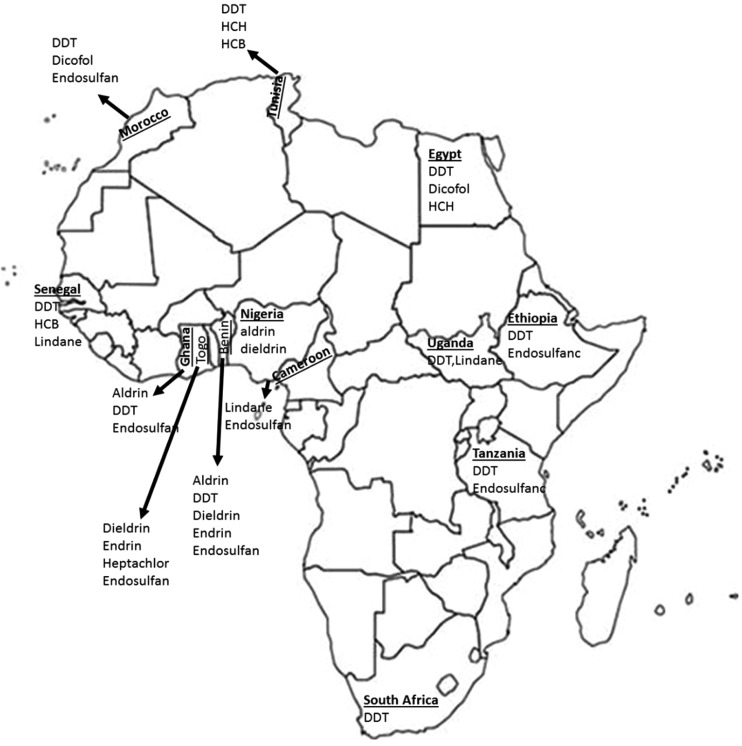
Organochlorine pesticides (OCPs) have been used worldwide, particularly in Africa, for several decades. Although many are banned, several African countries still use OCPs especially for the prevention and control of malaria. OCPs are characterized by their bio-accumulation in the environment, especially in the food chain, where they find their way into the human body. Despite no clear epidemiological studies confirming hazardous effects of these chemicals on human health, many studies have reported positive associations between the use of OCPs and neurological and reproductive disorders, and cancer risk. There is a clear gap in published reports on OCPs in Africa and their potential health hazards. Thus, the aim of this review is to summarize the incidence of OCP contamination in various foods in Africa, to demonstrate the potential transmission of these chemicals to people and to discuss their possible health hazards.
几十年来,有机氯农药(OCPs)一直在全球范围内使用,尤其是在非洲。尽管许多有机氯农药已被禁用,但一些非洲国家仍在使用,特别是用于疟疾的预防和控制。有机氯农药的特点是在环境中生物累积,尤其是在食物链中,它们通过食物链进入人体。尽管尚无明确的流行病学研究证实这些化学物质对人类健康的有害影响,但许多研究报告了使用有机氯农药与神经和生殖系统疾病以及癌症风险之间的正相关关系。关于非洲有机氯农药及其潜在健康危害的已发表报告存在明显空白。因此,本综述的目的是总结非洲各种食品中有机氯农药污染的发生率,展示这些化学物质向人群的潜在传播,并讨论其可能的健康危害。