
10个月频繁小运动量球类游戏训练或间歇跑对8至10岁学龄儿童的体能影响
Fitness Effects of 10-Month Frequent Low-Volume Ball Game Training or Interval Running for 8-10-Year-Old School Children.
作者信息
Larsen Malte Nejst, Nielsen Claus Malta, Ørntoft Christina, Randers Morten Bredsgaard, Helge Eva Wulff, Madsen Mads, Manniche Vibeke, Hansen Lone, Hansen Peter Riis, Bangsbo Jens, Krustrup Peter
机构信息
Department of Sports Science and Clinical Biomechanics, SDU Sport and Health Sciences Cluster (SHSC), University of Southern Denmark, Odense, Denmark; Department of Nutrition, Exercise and Sports, Copenhagen Centre for Team Sport and Health, University of Copenhagen, Copenhagen, Denmark.
Department of Nutrition, Exercise and Sports, Copenhagen Centre for Team Sport and Health, University of Copenhagen, Copenhagen, Denmark; Health Frederikssund Municipality, Frederikssund, Denmark.
出版信息
Biomed Res Int. 2017;2017:2719752. doi: 10.1155/2017/2719752. Epub 2017 Feb 19.
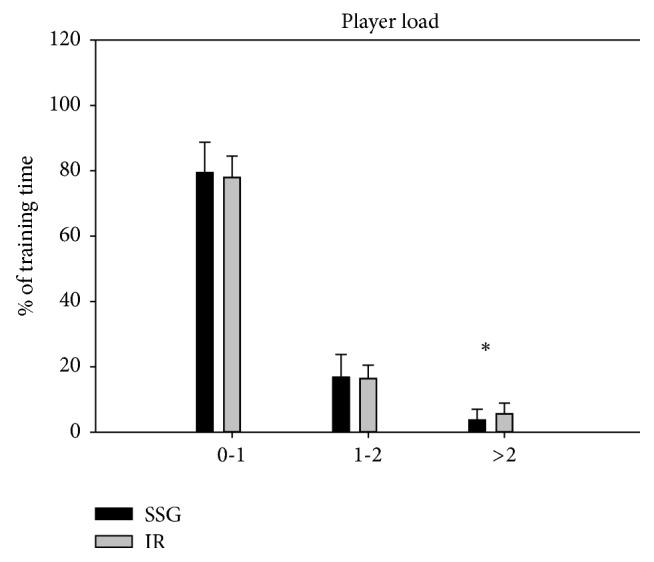
We investigated the exercise intensity and fitness effects of frequent school-based low-volume high-intensity training for 10 months in 8-10-year-old children. 239 Danish 3rd-grade school children from four schools were cluster-randomised into a control group (CON, = 116) or two training groups performing either 5 × 12 min/wk small-sided football plus other ball games (SSG, = 62) or interval running (IR, = 61). Whole-body DXA scans, flamingo balance, standing long-jump, 20 m sprint, and Yo-Yo IR1 children's tests (YYIR1C) were performed before and after the intervention. Mean running velocity was higher ( < 0.05) in SSG than in IR (0.88 ± 0.14 versus 0.63 ± 0.20 m/s), while more time ( < 0.05) was spent in the highest player load zone (>2; 5.6 ± 3.4 versus 3.7 ± 3.4%) and highest HR zone (>90% HR; 12.4 ± 8.9 versus 8.4 ± 8.0%) in IR compared to SSG. After 10 months, no significant between-group differences were observed for YYIR1C performance and HR after 2 min of YYIR1C (HR), but median-split analyses showed that HR was reduced ( < 0.05) in both training groups compared to CON for those with the lowest aerobic fitness (SSG versus CON: 3.2% HR [95% CI: 0.8-5.5]; IR versus CON: 2.6% HR [95% CI: 1.1-5.2]). After 10 months, IR had improved ( < 0.05) 20 m sprint performance (IR versus CON: 154 ms [95% CI: 61-241]). No between-group differences ( > 0.05) were observed for whole-body or leg aBMD, lean mass, postural balance, or jump length. In conclusion, frequent low-volume ball games and interval running can be conducted over a full school year with high intensity rate but has limited positive fitness effects in 8-10-year-old children.
我们对8至10岁儿童进行了为期10个月的频繁校内小运动量高强度训练的运动强度和健身效果调查。来自四所学校的239名丹麦三年级学童被整群随机分为对照组(CON,n = 116)或两个训练组,分别进行每周5×12分钟的小型足球比赛加其他球类游戏(SSG,n = 62)或间歇跑(IR,n = 61)。在干预前后进行了全身双能X线吸收法扫描、火烈鸟平衡测试、立定跳远、20米短跑和儿童Yo-Yo间歇耐力测试1(YYIR1C)。SSG组的平均跑步速度高于IR组(P<0.05)(0.88±0.14对0.63±0.20米/秒),而与SSG组相比,IR组在最高运动员负荷区(>2;5.6±3.4对3.7±3.4%)和最高心率区(>90%心率;12.4±8.9对8.4±8.0%)花费的时间更多(P<0.05)。10个月后,YYIR1C测试2分钟后的YYIR1C表现和心率在组间未观察到显著差异,但中位数分割分析显示,与CON组相比,两个训练组中有氧运动能力最低的儿童心率均降低(P<0.05)(SSG组与CON组:心率降低3.2%[95%置信区间:0.8 - 5.5];IR组与CON组:心率降低2.6%[95%置信区间:1. – 5.2])。10个月后,IR组的20米短跑成绩有所提高(P<0.05)(IR组与CON组:提高154毫秒[95%置信区间:61 - 241])。在全身或腿部骨密度、瘦体重、姿势平衡或跳跃长度方面未观察到组间差异(P>0.05)。总之,频繁的小运动量球类游戏和间歇跑可以在一整个学年内以高强度进行,但对8至10岁儿童的健身积极效果有限。


 Zotero 插件