Lee Ciaran M, Davis Timothy H, Bao Gang
Department of Bioengineering, Rice University, Houston, TX, USA.
Exp Physiol. 2018 Apr 1;103(4):456-460. doi: 10.1113/EP086043. Epub 2017 Apr 12.
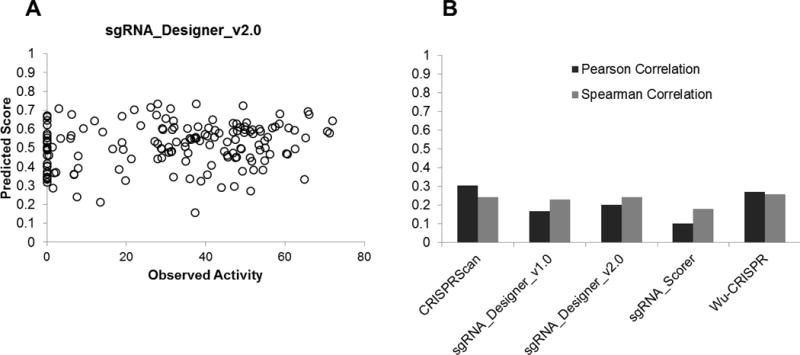
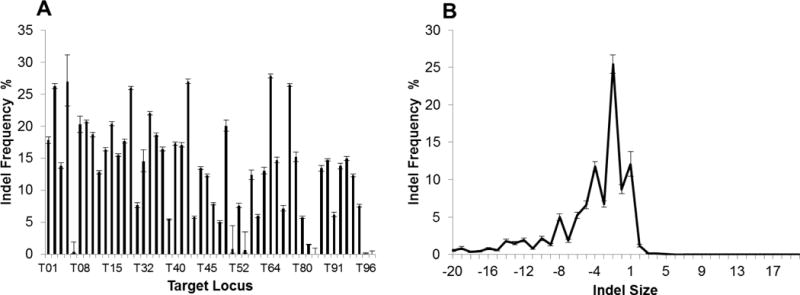
What is the topic of this review? In this review, we analyse the performance of recently described tools for CRISPR/Cas9 guide RNA design, in particular, design tools that predict CRISPR/Cas9 activity. What advances does it highlight? Recently, many tools designed to predict CRISPR/Cas9 activity have been reported. However, the majority of these tools lack experimental validation. Our analyses indicate that these tools have poor predictive power. Our preliminary results suggest that target site accessibility should be considered in order to develop better guide RNA design tools with improved predictive power. The recent adaptation of the clustered regulatory interspaced short palindromic repeats (CRISPR)/CRISPR-associated protein 9 (Cas9) system for targeted genome engineering has led to its widespread application in many fields worldwide. In order to gain a better understanding of the design rules of CRISPR/Cas9 systems, several groups have carried out large library-based screens leading to some insight into sequence preferences among highly active target sites. To facilitate CRISPR/Cas9 design, these studies have spawned a plethora of guide RNA (gRNA) design tools with algorithms based solely on direct or indirect sequence features. Here, we demonstrate that the predictive power of these tools is poor, suggesting that sequence features alone cannot accurately inform the cutting efficiency of a particular CRISPR/Cas9 gRNA design. Furthermore, we demonstrate that DNA target site accessibility influences the activity of CRISPR/Cas9. With further optimization, we hypothesize that it will be possible to increase the predictive power of gRNA design tools by including both sequence and target site accessibility metrics.
这篇综述的主题是什么?在本综述中,我们分析了最近描述的用于CRISPR/Cas9导向RNA设计的工具的性能,特别是预测CRISPR/Cas9活性的设计工具。它突出了哪些进展?最近,已经报道了许多旨在预测CRISPR/Cas9活性的工具。然而,这些工具中的大多数缺乏实验验证。我们的分析表明这些工具的预测能力较差。我们的初步结果表明,为了开发具有更高预测能力的更好的导向RNA设计工具,应考虑靶位点可及性。成簇规律间隔短回文重复序列(CRISPR)/CRISPR相关蛋白9(Cas9)系统最近被应用于靶向基因组工程,已在全球许多领域广泛应用。为了更好地理解CRISPR/Cas9系统的设计规则,几个研究小组进行了基于大型文库的筛选,从而对高活性靶位点之间的序列偏好有了一些了解。为了便于CRISPR/Cas9设计,这些研究催生了大量基于算法的导向RNA(gRNA)设计工具,这些算法仅基于直接或间接的序列特征。在这里,我们证明这些工具的预测能力较差,这表明仅序列特征不能准确反映特定CRISPR/Cas9 gRNA设计的切割效率。此外,我们证明DNA靶位点可及性会影响CRISPR/Cas9的活性。我们假设,通过进一步优化,纳入序列和靶位点可及性指标有可能提高gRNA设计工具的预测能力。