de Oliveira Jefferson Paulo, Olivete Fernanda, de Oliveira Naylin Danyele, Giovanini Allan Fernando, Zielak João César, Klüppel Leandro, Scariot Rafaela
Universidade Positivo, 5300 Prof. Pedro Viriato Parigot de Souza St., Campo Comprido, Curitiba, PR, 81280-330, Brazil.
J Med Case Rep. 2017 Mar 20;11(1):74. doi: 10.1186/s13256-016-1173-3.
Central giant cell lesion is a non-neoplastic proliferation, usually asymptomatic, of unknown etiology. The purpose of this case report is to report the diagnosis and the treatment of a recurrent central giant cell lesion in the maxilla.
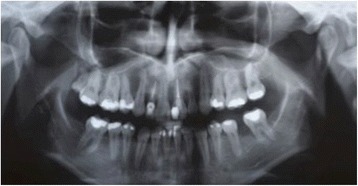
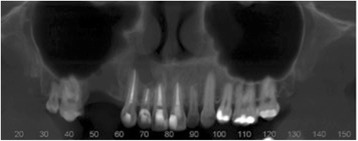
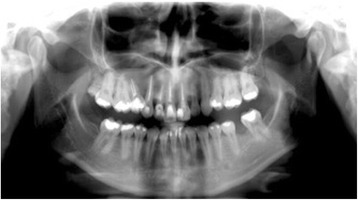
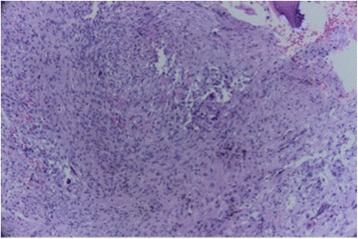
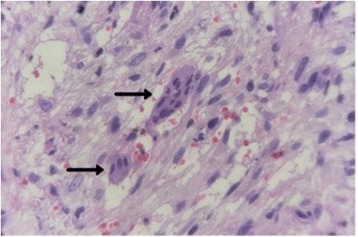
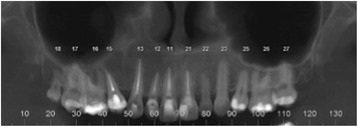
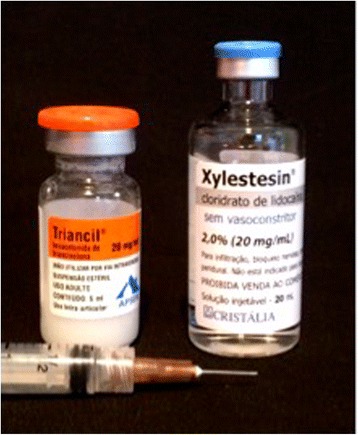
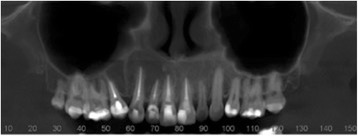
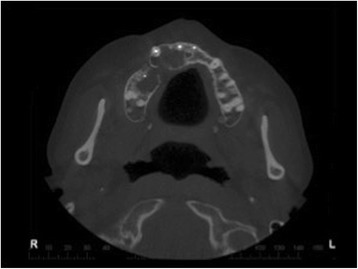
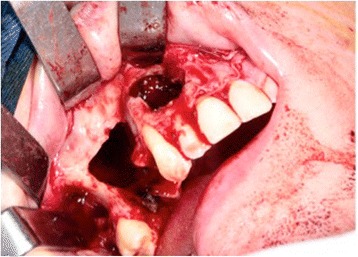
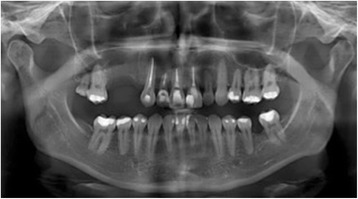
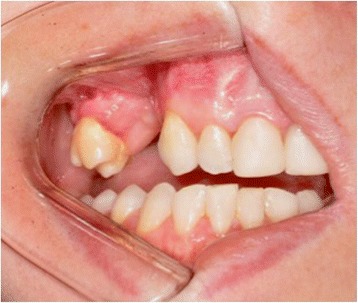
A 31-year-old Brazilian woman presented to our Surgery Service for evaluation of a cystic lesion in her teeth 13 and 15, although she had previously received endodontic treatment for her teeth 13 and 15 without regression of the lesion. On clinical examination, an increase and painless swelling was observed in her right jaw. An excisional biopsy of the lesion was performed under general anesthesia; the material was sent for pathological examination and a diagnosis compatible with central giant cell lesion was made. She presented again, 10 months after the removal of the lesion, with a recurrent lesion that surrounded her incisors, canine, and right premolar. We suggested that she underwent treatment with intralesional corticosteroids injection. The lesion was significantly reduced and the remainder of the lesion was enucleated. She is monitored at 3-month intervals; at 6 months postoperatively there has been no recurrence.
Central giant cell lesion can have a high degree of invasiveness, which increases the importance of early diagnosis. Combination therapies can provide a favorable prognosis. Periodic monitoring is recommended, thus avoiding the chance of a relapse.
中央巨细胞病变是一种病因不明的非肿瘤性增殖,通常无症状。本病例报告的目的是报告上颌骨复发性中央巨细胞病变的诊断和治疗。
一名31岁的巴西女性因13号和15号牙的囊性病变前来我院外科就诊,尽管她此前已对13号和15号牙进行了根管治疗,但病变并未消退。临床检查发现其右颌骨有增大且无痛性肿胀。在全身麻醉下对病变进行了切除活检;将标本送去做病理检查,诊断为符合中央巨细胞病变。在病变切除10个月后,她再次出现病变复发,病变围绕着她的切牙、尖牙和右前磨牙。我们建议她接受病灶内注射皮质类固醇治疗。病变明显缩小,其余病变组织被摘除。每3个月对她进行一次监测;术后6个月未出现复发。
中央巨细胞病变可能具有高度侵袭性,这增加了早期诊断的重要性。联合治疗可提供良好的预后。建议进行定期监测,从而避免复发的可能性。