Lei Baiying, Jiang Feng, Chen Siping, Ni Dong, Wang Tianfu
School of Biomedical Engineering, Shenzhen UniversityShenzhen, China; National-Regional Key Technology Engineering Laboratory for Medical Ultrasound, Shenzhen UniversityShenzhen, China; Guangdong Key Laboratory for Biomedical Measurements and Ultrasound Imaging, Shenzhen UniversityShenzhen, China; Fujian Provincial Key Laboratory of Information Processing and Intelligent Control, Minjiang UniversityFuzhou, China.
School of Biomedical Engineering, Shenzhen UniversityShenzhen, China; National-Regional Key Technology Engineering Laboratory for Medical Ultrasound, Shenzhen UniversityShenzhen, China; Guangdong Key Laboratory for Biomedical Measurements and Ultrasound Imaging, Shenzhen UniversityShenzhen, China.
Front Aging Neurosci. 2017 Mar 3;9:6. doi: 10.3389/fnagi.2017.00006. eCollection 2017.
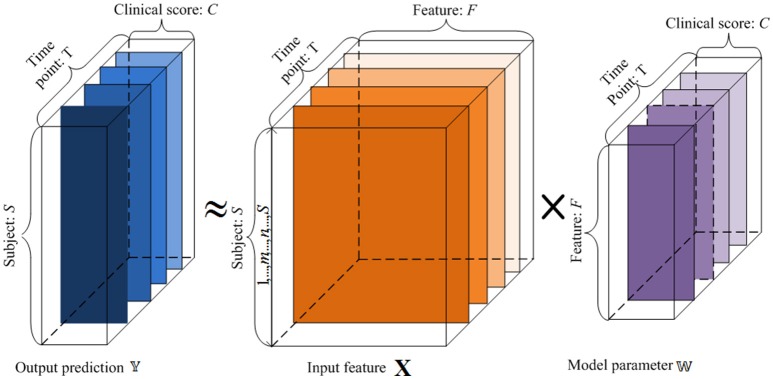
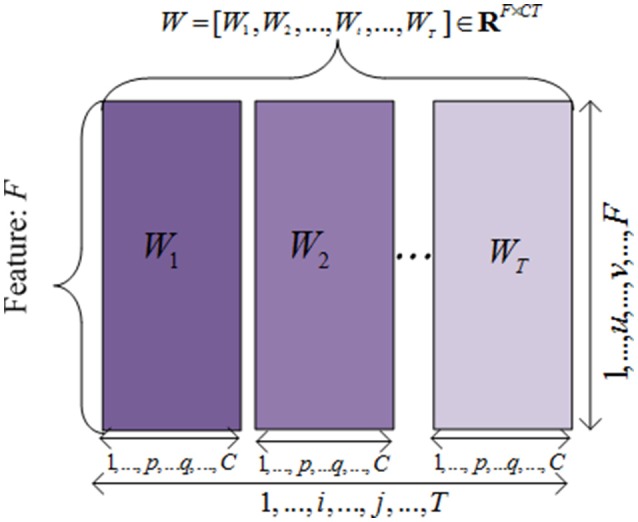
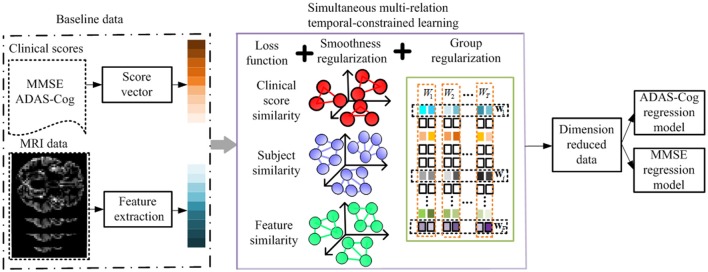
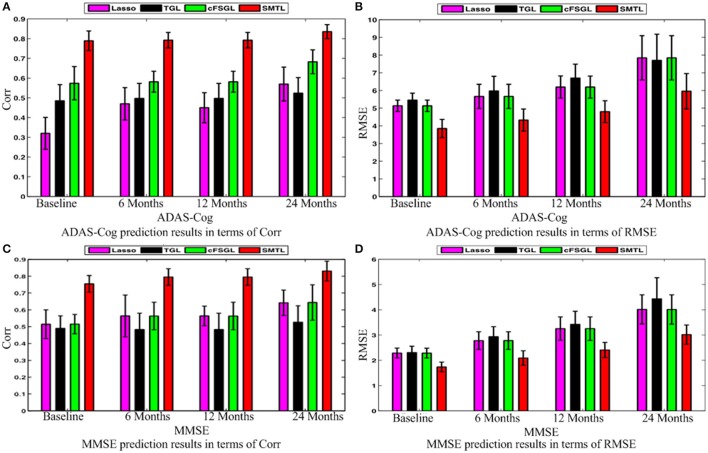
It is highly desirable to predict the progression of Alzheimer's disease (AD) of patients [e.g., to predict conversion of mild cognitive impairment (MCI) to AD], especially longitudinal prediction of AD is important for its early diagnosis. Currently, most existing methods predict different clinical scores using different models, or separately predict multiple scores at different future time points. Such approaches prevent coordinated learning of multiple predictions that can be used to jointly predict clinical scores at multiple future time points. In this paper, we propose a joint learning method for predicting clinical scores of patients using multiple longitudinal prediction models for various future time points. Three important relationships among training samples, features, and clinical scores are explored. The relationship among different longitudinal prediction models is captured using a common feature set among the multiple prediction models at different time points. Our experimental results based on the Alzheimer's disease neuroimaging initiative (ADNI) database shows that our method achieves considerable improvement over competing methods in predicting multiple clinical scores.
非常希望能够预测患者阿尔茨海默病(AD)的进展情况[例如,预测轻度认知障碍(MCI)向AD的转化],尤其是AD的纵向预测对于其早期诊断至关重要。目前,大多数现有方法使用不同的模型预测不同的临床评分,或者分别在不同的未来时间点预测多个评分。这些方法阻碍了对多个预测的协同学习,而这些预测可用于联合预测多个未来时间点的临床评分。在本文中,我们提出了一种联合学习方法,使用针对不同未来时间点的多个纵向预测模型来预测患者的临床评分。探索了训练样本、特征和临床评分之间的三个重要关系。通过在不同时间点的多个预测模型之间使用共同的特征集来捕捉不同纵向预测模型之间的关系。我们基于阿尔茨海默病神经影像倡议(ADNI)数据库的实验结果表明,我们的方法在预测多个临床评分方面比竞争方法有显著改进。