Department of Radiology and Biomedical Research Imaging Center-BRIC, University of North Carolina at Chapel Hill, Chapel Hill, North Carolina, United States of America.
PLoS One. 2012;7(3):e33182. doi: 10.1371/journal.pone.0033182. Epub 2012 Mar 22.
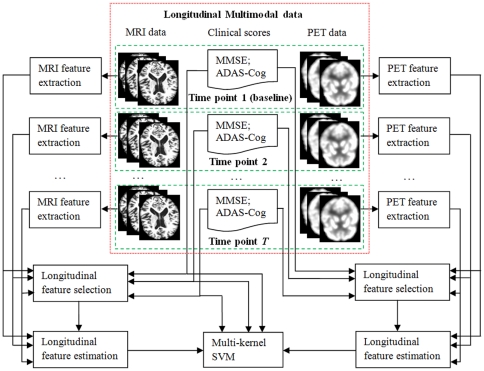
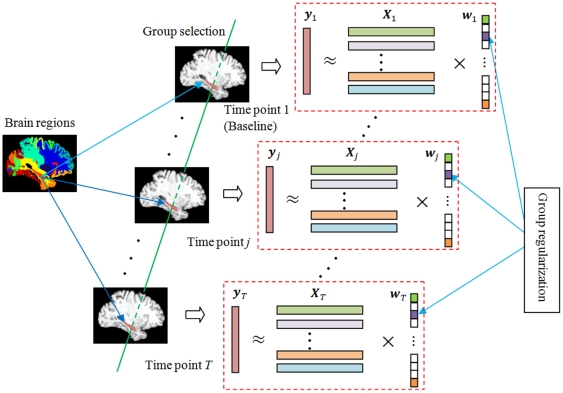
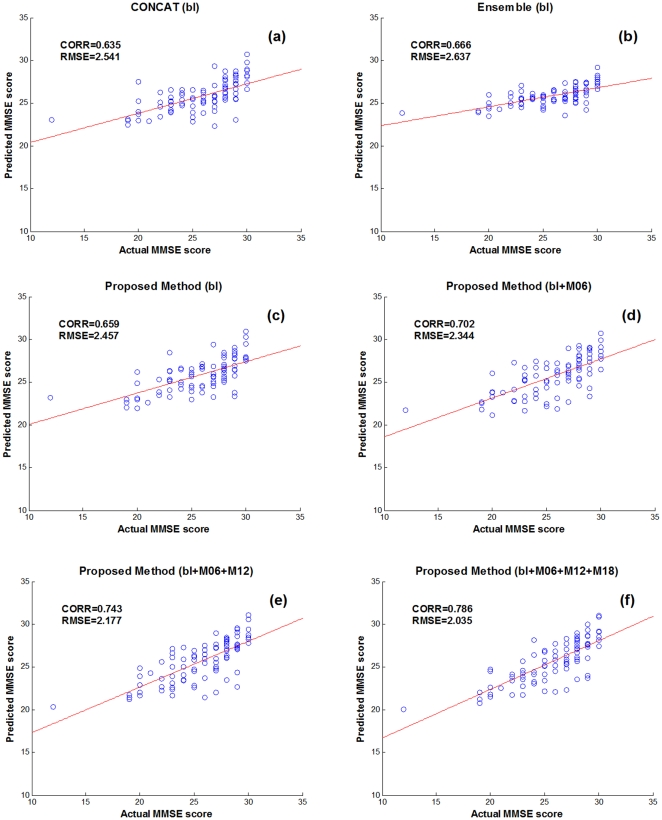
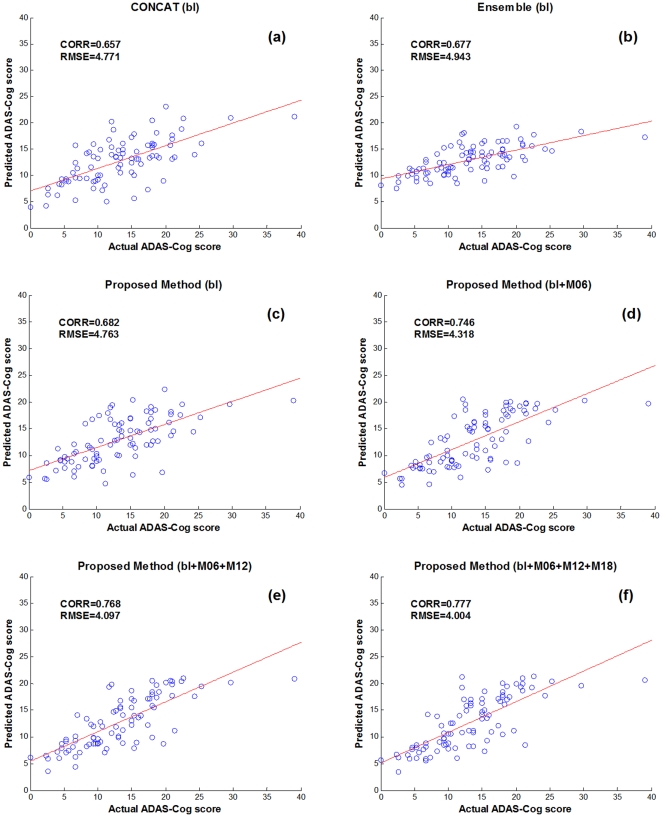
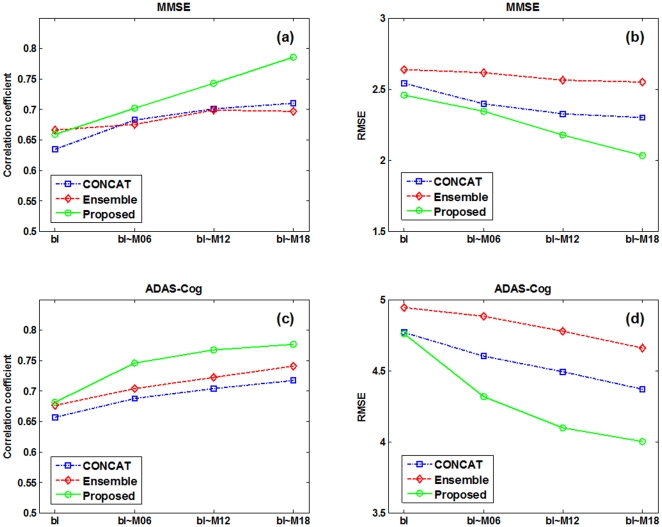
Accurate prediction of clinical changes of mild cognitive impairment (MCI) patients, including both qualitative change (i.e., conversion to Alzheimer's disease (AD)) and quantitative change (i.e., cognitive scores) at future time points, is important for early diagnosis of AD and for monitoring the disease progression. In this paper, we propose to predict future clinical changes of MCI patients by using both baseline and longitudinal multimodality data. To do this, we first develop a longitudinal feature selection method to jointly select brain regions across multiple time points for each modality. Specifically, for each time point, we train a sparse linear regression model by using the imaging data and the corresponding clinical scores, with an extra 'group regularization' to group the weights corresponding to the same brain region across multiple time points together and to allow for selection of brain regions based on the strength of multiple time points jointly. Then, to further reflect the longitudinal changes on the selected brain regions, we extract a set of longitudinal features from the original baseline and longitudinal data. Finally, we combine all features on the selected brain regions, from different modalities, for prediction by using our previously proposed multi-kernel SVM. We validate our method on 88 ADNI MCI subjects, with both MRI and FDG-PET data and the corresponding clinical scores (i.e., MMSE and ADAS-Cog) at 5 different time points. We first predict the clinical scores (MMSE and ADAS-Cog) at 24-month by using the multimodality data at previous time points, and then predict the conversion of MCI to AD by using the multimodality data at time points which are at least 6-month ahead of the conversion. The results on both sets of experiments show that our proposed method can achieve better performance in predicting future clinical changes of MCI patients than the conventional methods.
准确预测轻度认知障碍(MCI)患者的临床变化,包括未来时间点的定性变化(即向阿尔茨海默病(AD)转化)和定量变化(即认知评分),对于 AD 的早期诊断和监测疾病进展非常重要。在本文中,我们提出使用基线和纵向多模态数据来预测 MCI 患者的未来临床变化。为此,我们首先开发了一种纵向特征选择方法,以联合选择每个模态的多个时间点的脑区。具体来说,对于每个时间点,我们通过使用成像数据和相应的临床评分来训练稀疏线性回归模型,其中额外的“组正则化”将对应于多个时间点的相同脑区的权重分组在一起,并允许基于多个时间点的强度共同选择脑区。然后,为了进一步反映所选脑区的纵向变化,我们从原始基线和纵向数据中提取一组纵向特征。最后,我们使用我们之前提出的多核 SVM 结合来自不同模态的所选脑区上的所有特征进行预测。我们在 88 名 ADNI MCI 受试者上验证了我们的方法,这些受试者具有 MRI 和 FDG-PET 数据以及相应的临床评分(即 MMSE 和 ADAS-Cog)在 5 个不同的时间点。我们首先使用以前时间点的多模态数据预测 24 个月的临床评分(MMSE 和 ADAS-Cog),然后使用至少 6 个月前转换的时间点的多模态数据预测 MCI 向 AD 的转换。两组实验的结果均表明,与传统方法相比,我们提出的方法可以更好地预测 MCI 患者的未来临床变化。