Computational Engineering Division, Lawrence Livermore National Laboratory, Livermore, CA 94550 USA.
The MITRE Corporation, McLean, VA 22102 USA.
Sci Rep. 2017 Mar 20;7:44499. doi: 10.1038/srep44499.
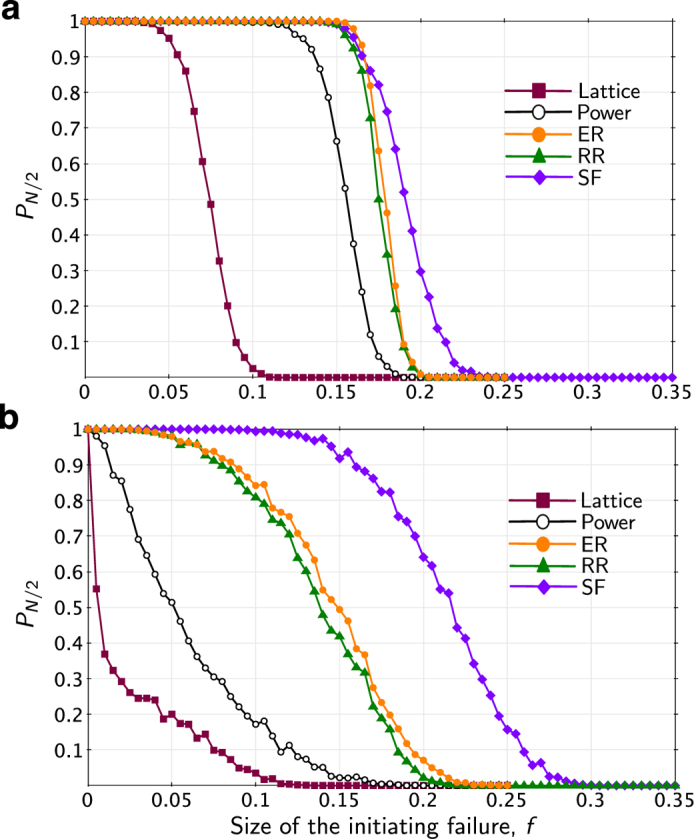
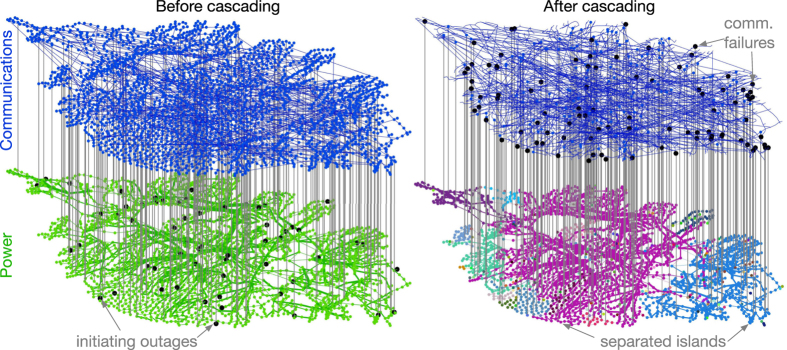
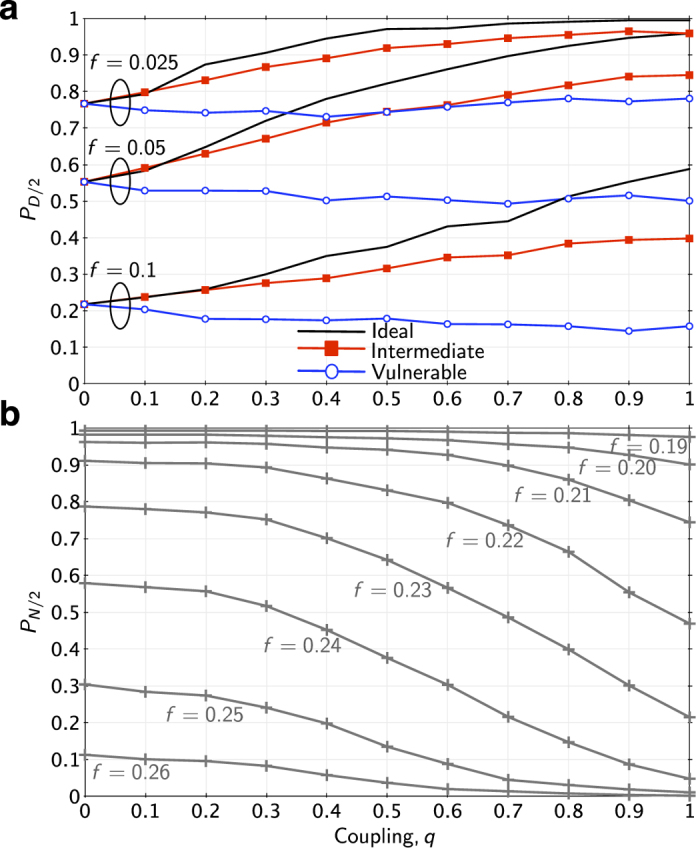
Increased interconnection between critical infrastructure networks, such as electric power and communications systems, has important implications for infrastructure reliability and security. Others have shown that increased coupling between networks that are vulnerable to internetwork cascading failures can increase vulnerability. However, the mechanisms of cascading in these models differ from those in real systems and such models disregard new functions enabled by coupling, such as intelligent control during a cascade. This paper compares the robustness of simple topological network models to models that more accurately reflect the dynamics of cascading in a particular case of coupled infrastructures. First, we compare a topological contagion model to a power grid model. Second, we compare a percolation model of internetwork cascading to three models of interdependent power-communication systems. In both comparisons, the more detailed models suggest substantially different conclusions, relative to the simpler topological models. In all but the most extreme case, our model of a "smart" power network coupled to a communication system suggests that increased power-communication coupling decreases vulnerability, in contrast to the percolation model. Together, these results suggest that robustness can be enhanced by interconnecting networks with complementary capabilities if modes of internetwork failure propagation are constrained.
关键基础设施网络(如电力和通信系统)之间的互联增加,对基础设施的可靠性和安全性有重要影响。其他人已经表明,容易受到网络级联故障影响的网络之间的耦合增加会增加脆弱性。然而,这些模型中的级联机制与实际系统中的机制不同,并且这些模型忽略了通过耦合实现的新功能,例如级联期间的智能控制。本文比较了简单拓扑网络模型与更准确地反映特定耦合基础设施中级联动力学的模型的稳健性。首先,我们将传染病模型与电网模型进行比较。其次,我们将互联网级联的渗流模型与三种相互依存的电力通信系统模型进行比较。在这两种比较中,相对于更简单的拓扑模型,更详细的模型得出了截然不同的结论。除了最极端的情况外,我们的智能电网与通信系统耦合模型表明,增加电力通信耦合会降低脆弱性,这与渗流模型相反。这些结果表明,如果能够限制网络间故障传播模式,通过互联具有互补能力的网络可以提高稳健性。