Shen John Paul, Zhao Dongxin, Sasik Roman, Luebeck Jens, Birmingham Amanda, Bojorquez-Gomez Ana, Licon Katherine, Klepper Kristin, Pekin Daniel, Beckett Alex N, Sanchez Kyle Salinas, Thomas Alex, Kuo Chih-Chung, Du Dan, Roguev Assen, Lewis Nathan E, Chang Aaron N, Kreisberg Jason F, Krogan Nevan, Qi Lei, Ideker Trey, Mali Prashant
Department of Medicine, Division of Genetics, University of California, San Diego, La Jolla, California, USA.
Moores UCSD Cancer Center, La Jolla, California, USA.
Nat Methods. 2017 Jun;14(6):573-576. doi: 10.1038/nmeth.4225. Epub 2017 Mar 20.
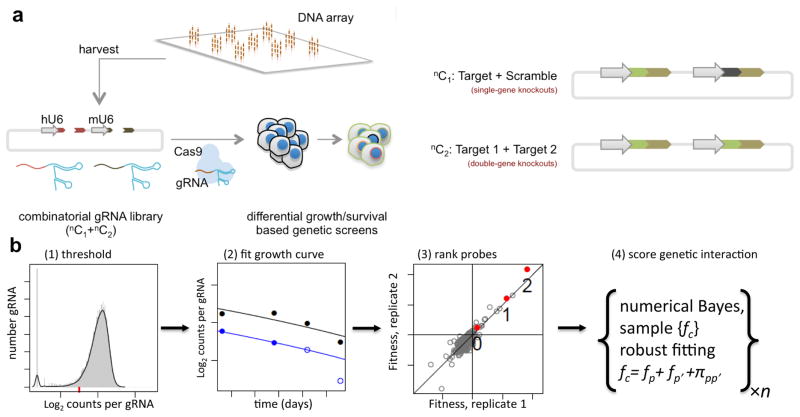
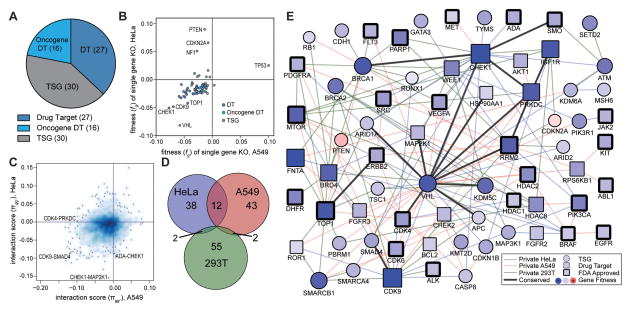
We developed a systematic approach to map human genetic networks by combinatorial CRISPR-Cas9 perturbations coupled to robust analysis of growth kinetics. We targeted all pairs of 73 cancer genes with dual guide RNAs in three cell lines, comprising 141,912 tests of interaction. Numerous therapeutically relevant interactions were identified, and these patterns replicated with combinatorial drugs at 75% precision. From these results, we anticipate that cellular context will be critical to synthetic-lethal therapies.
我们开发了一种系统方法,通过组合CRISPR-Cas9干扰并结合对生长动力学的稳健分析来绘制人类遗传网络。我们在三种细胞系中用双导向RNA靶向73个癌症基因的所有基因对,共进行了141,912次相互作用测试。鉴定出了许多与治疗相关的相互作用,并且这些模式在联合使用药物时以75%的精度得到了复制。从这些结果来看,我们预计细胞环境对于合成致死疗法至关重要。