Kutzner Ines, Richter Anja, Gordt Katharina, Dymke Jörn, Damm Philipp, Duda Georg N, Günzl Reiner, Bergmann Georg
Julius Wolff Institute, Charité - Universitätsmedizin Berlin, Berlin, Germany.
Olympiastützpunkt Berlin, Berlin, Germany.
PLoS One. 2017 Mar 20;12(3):e0171972. doi: 10.1371/journal.pone.0171972. eCollection 2017.
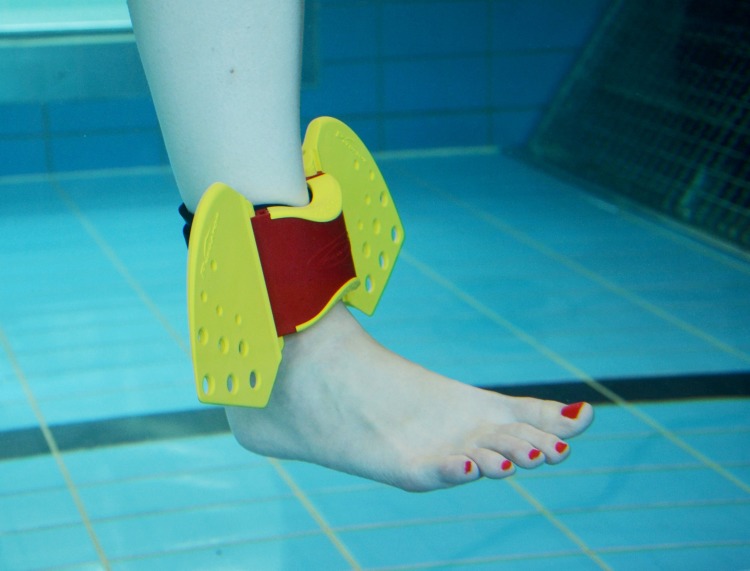
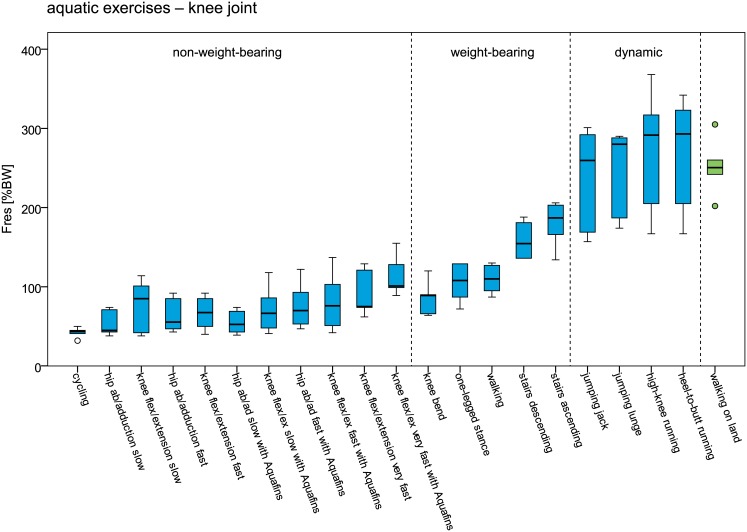
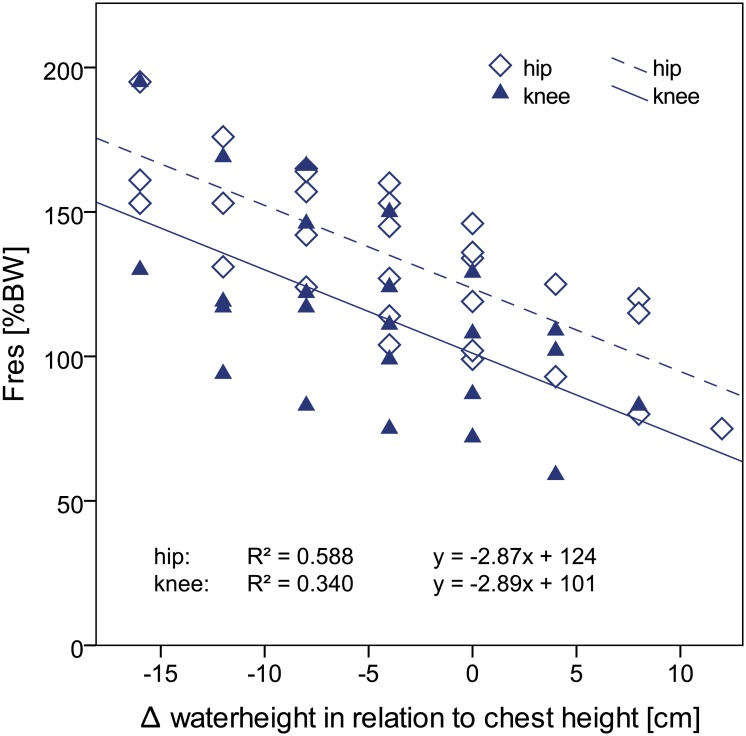
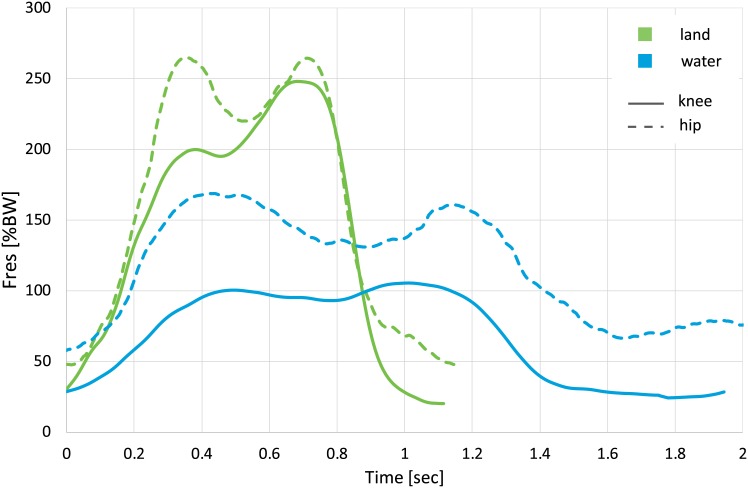
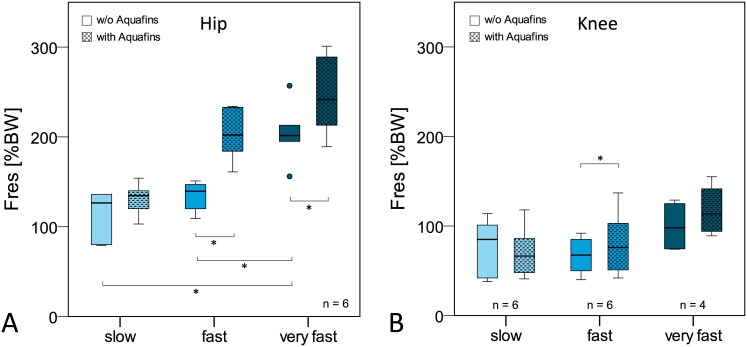
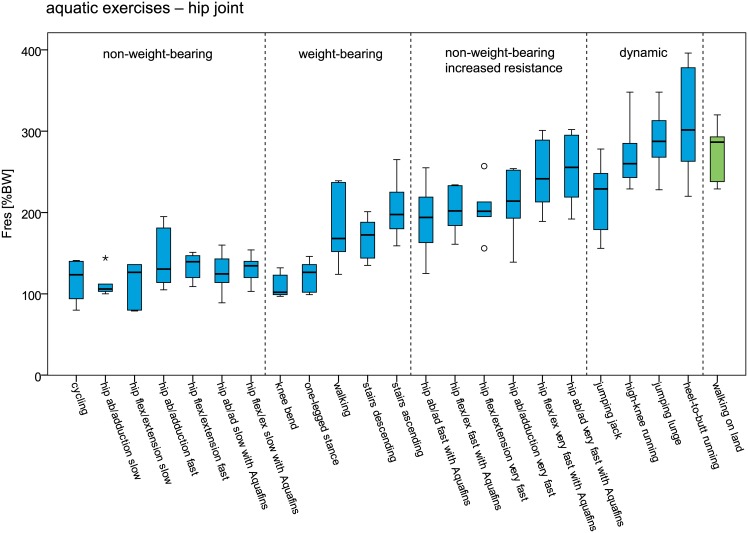
Aquatic exercises are widely used for rehabilitation or preventive therapies in order to enable mobilization and muscle strengthening while minimizing joint loading of the lower limb. The load reducing effect of water due to buoyancy is a main advantage compared to exercises on land. However, also drag forces have to be considered that act opposite to the relative motion of the body segments and require higher muscle activity. Due to these opposing effects on joint loading, the load-reducing effect during aquatic exercises remains unknown. The aim of this study was to quantify the joint loads during various aquatic exercises and to determine the load reducing effect of water. Instrumented knee and hip implants with telemetric data transfer were used to measure the resultant joint contact forces in 12 elderly subjects (6x hip, 6x knee) in vivo. Different dynamic, weight-bearing and non-weight-bearing activities were performed by the subjects on land and in chest-high water. Non-weight-bearing hip and knee flexion/extension was performed at different velocities and with additional Aquafins. Joint forces during aquatic exercises ranged between 32 and 396% body weight (BW). Highest forces occurred during dynamic activities, followed by weight-bearing and slow non-weight-bearing activities. Compared to the same activities on land, joint forces were reduced by 36-55% in water with absolute reductions being greater than 100%BW during weight-bearing and dynamic activities. During non-weight-bearing activities, high movement velocities and additional Aquafins increased the joint forces by up to 59% and resulted in joint forces of up to 301%BW. This study confirms the load reducing effect of water during weight-bearing and dynamic exercises. Nevertheless, high drag forces result in increased joint contact forces and indicate greater muscle activity. By the choice of activity, movement velocity and additional resistive devices joint forces can be modulated individually in the course of rehabilitation or preventive therapies.
水上运动广泛用于康复或预防性治疗,以便在尽量减少下肢关节负荷的同时实现活动能力和肌肉力量增强。与陆上运动相比,水的浮力产生的负荷减轻效果是一个主要优势。然而,还必须考虑与身体各部位相对运动方向相反的阻力,这需要更高的肌肉活动。由于这些对关节负荷的相反作用,水上运动期间的负荷减轻效果仍然未知。本研究的目的是量化各种水上运动期间的关节负荷,并确定水的负荷减轻效果。使用具有遥测数据传输功能的仪器化膝关节和髋关节植入物,在12名老年受试者(6名髋关节,6名膝关节)体内测量合成关节接触力。受试者在陆上和齐胸深的水中进行不同的动态、负重和非负重活动。非负重髋关节和膝关节屈伸以不同速度进行,并额外使用了水翼。水上运动期间的关节力在体重的32%至396%之间。最高力出现在动态活动期间,其次是负重和缓慢的非负重活动。与陆上相同活动相比,水中关节力降低了36%至55%,在负重和动态活动期间绝对降低超过体重的100%。在非负重活动期间,高运动速度和额外的水翼使关节力增加高达59%,并导致关节力高达体重的301%。本研究证实了在负重和动态运动期间水的负荷减轻效果。然而,高阻力会导致关节接触力增加,并表明肌肉活动增加。通过选择活动、运动速度和额外的阻力装置,可以在康复或预防性治疗过程中单独调节关节力。