Iwamoto Aikichi, Taira Rikizo, Yokomaku Yoshiyuki, Koibuchi Tomohiko, Rahman Mahbubur, Izumi Yoko, Tadokoro Kenji
Japan Agency for Medical Research and Development, Tokyo, Japan.
Blood Service Headquarters, Japanese Red Cross Society, Tokyo, Japan.
PLoS One. 2017 Mar 20;12(3):e0174360. doi: 10.1371/journal.pone.0174360. eCollection 2017.
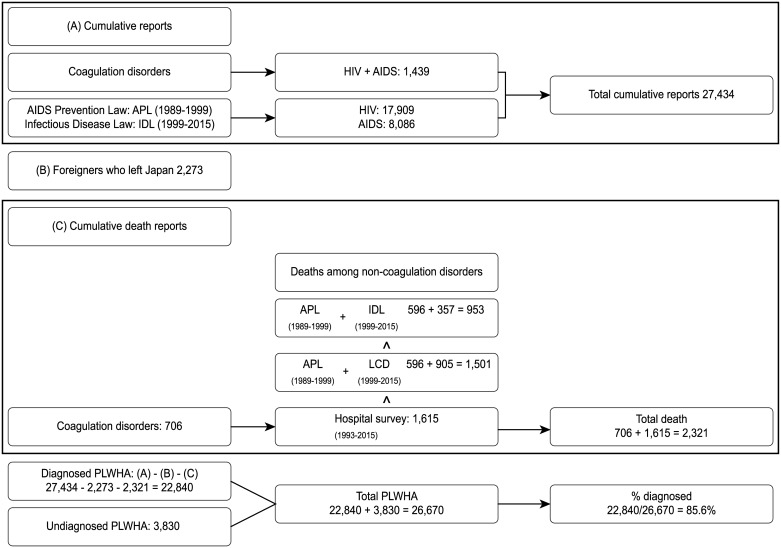
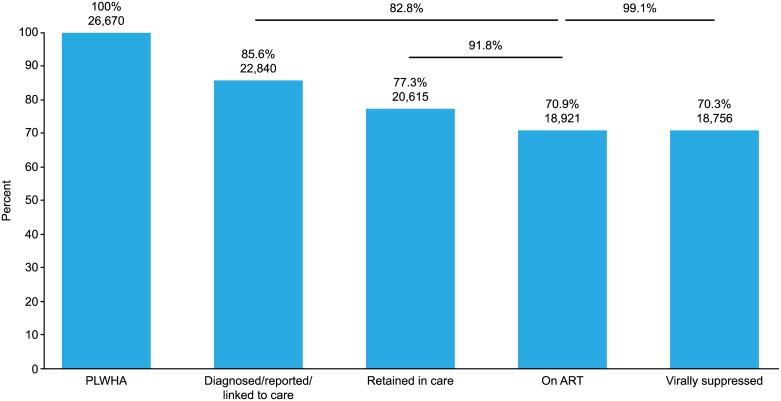
Japan has been known as a low HIV-prevalence country with a concentrated epidemic among high-risk groups. However, it has not been determined whether Japan meets the 90-90-90 goals set by the Joint United Nations Programme on HIV/AIDS (UNAIDS)/World Health Organization (WHO). Moreover, to date, the HIV care cascade has not been examined. We estimated the total number of diagnosed people living with HIV/AIDS (PLWHA) (n = 22,840) based on legal reports to the Ministry of Health, Labour and Welfare by subtracting the number of foreigners who left Japan (n = 2,273) and deaths (n = 2,321) from the cumulative diagnosis report (n = 27,434). The number of total undiagnosed PLWHA was estimated by age and sex specific HIV-positive rates observed among first-time blood donors between 2011-2015 in Japan. Our estimates show that 14.4% (n = 3,830) of all PLWHA (n = 26,670) were undiagnosed in Japan at the end of 2015. The number of patients retained in care (n = 20,615: 77.3% of PLWHA), the percentage of those on antiretroviral therapy (n = 18,921: 70.9% of PLWHA) and those with suppressed viral loads (<200 copies/mL; n = 18,756: 70.3% of PLWHA) were obtained through a questionnaire survey conducted in the AIDS Core Hospitals throughout the country. According to these estimates, Japan failed to achieve the first two of the three UNAIDS/WHO targets (22,840/26,670 = 85.6% of HIV-positive cases were diagnosed; 18,921/22,840 = 82.8% of those diagnosed were treated; 18,756/18,921 = 99.1% of those treated experienced viral suppression). Although the antiretroviral treatment uptake and success after retention in medical care appears to be excellent in Japan, there are unmet needs, mainly at the surveillance level before patients are retained in care. The promotion of HIV testing and treatment programs among the key affected populations (especially men who have sex with men) may contribute to further decreasing the HIV epidemic and achieving the UNAIDS/WHO targets in Japan.
日本一直被认为是一个艾滋病毒感染率较低的国家,艾滋病主要在高危人群中流行。然而,日本是否实现了联合国艾滋病规划署(UNAIDS)/世界卫生组织(WHO)设定的90-90-90目标尚未确定。此外,迄今为止,尚未对艾滋病护理连续过程进行过研究。我们根据向厚生劳动省提交的法定报告,通过从累计诊断报告(n = 27,434)中减去离开日本的外国人数量(n = 2,273)和死亡人数(n = 2,321),估算出已诊断的艾滋病毒/艾滋病感染者(PLWHA)总数(n = 22,840)。未诊断的PLWHA总数是根据2011 - 2015年日本首次献血者中按年龄和性别划分的艾滋病毒阳性率估算得出的。我们的估算结果显示,截至2015年底,日本所有PLWHA(n = 26,670)中有14.4%(n = 3,830)未被诊断出来。通过在全国艾滋病核心医院进行的问卷调查,得出接受护理的患者人数(n = 20,615:占PLWHA的77.3%)、接受抗逆转录病毒治疗的患者比例(n = 18,921:占PLWHA的70.9%)以及病毒载量得到抑制(<200拷贝/毫升;n = 固定布局
宋体
五号
否
否
否
2字符
18,756:占PLWHA的70.3%)。根据这些估算结果,日本未能实现UNAIDS/WHO的三个目标中的前两个(22,840/26,670 = 85.6%的艾滋病毒阳性病例被诊断出来;18,921/22,840 = 82.8%的已诊断患者接受了治疗;18,756/18,921 = 99.1%的接受治疗患者实现了病毒抑制)。尽管在日本,接受抗逆转录病毒治疗的比例以及接受治疗后的成功率似乎很高,但仍存在未满足的需求,主要集中在患者接受护理之前的监测层面。在主要受影响人群(尤其是男男性行为者)中推广艾滋病毒检测和治疗项目,可能有助于进一步降低日本的艾滋病流行率,并实现UNAIDS/WHO的目标。