Centre for Environment Science and Climate Resilient Agriculture, ICAR-Indian Agricultural Research Institute, New Delhi 110012, India.
Sci Rep. 2017 Mar 21;7:44928. doi: 10.1038/srep44928.
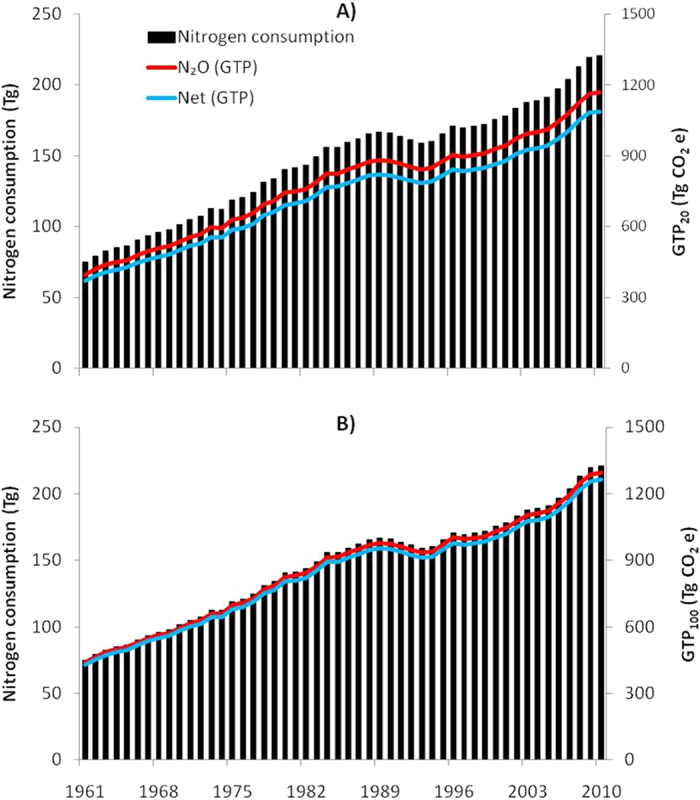
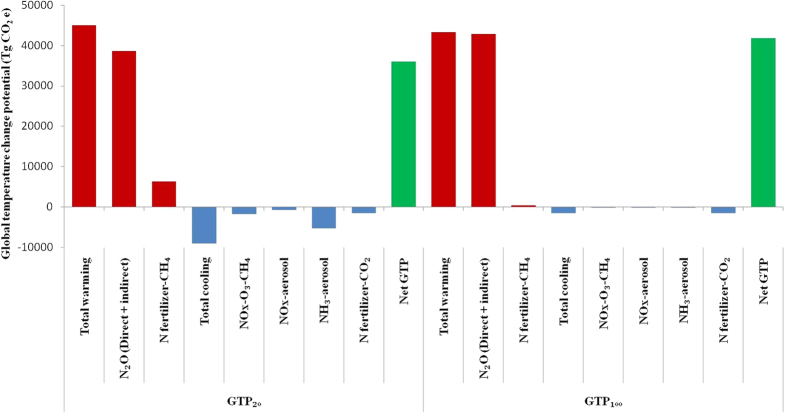
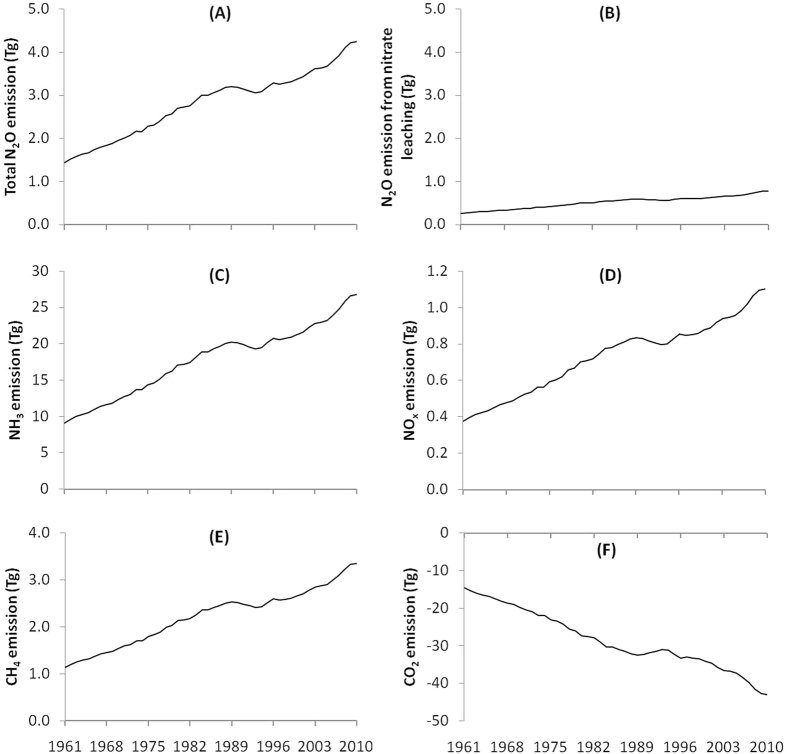
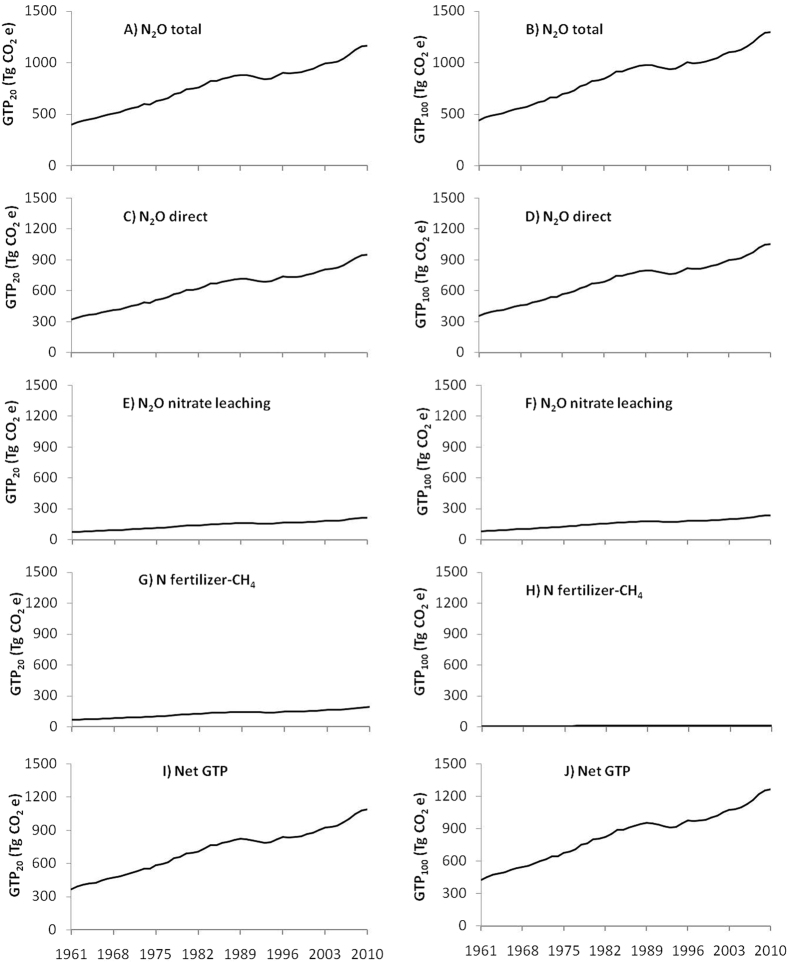
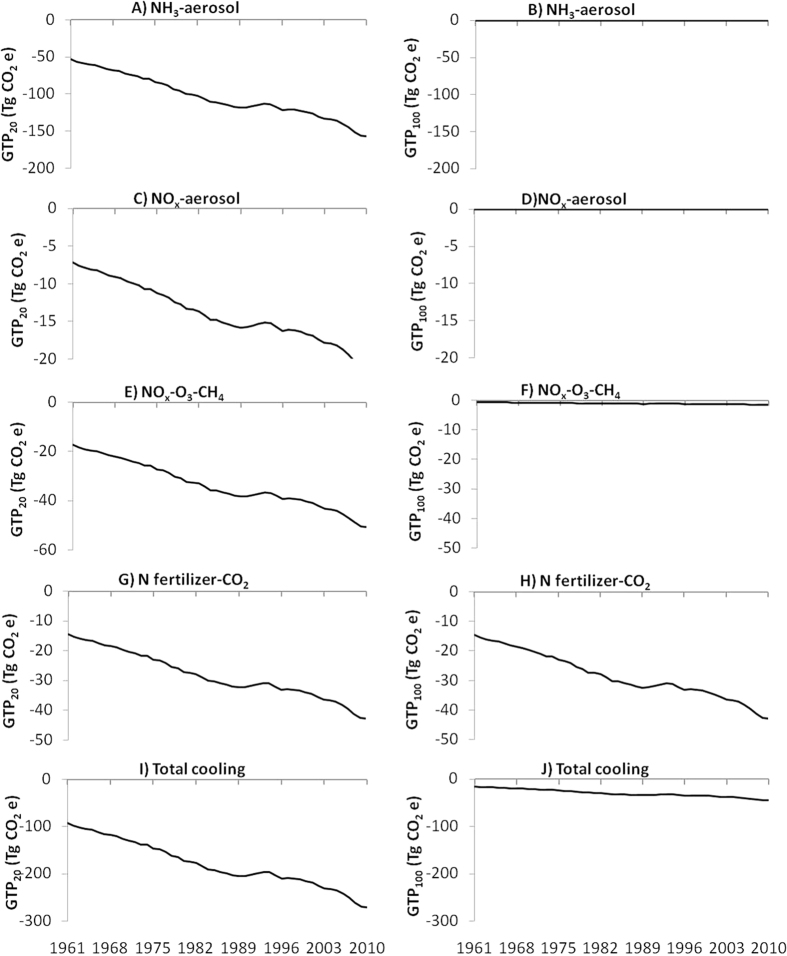
Nitrogen (N) use in agriculture substantially alters global N cycle with the short- and long-term effects on global warming and climate change. It increases emission of nitrous oxide, which contributes 6.2%, while carbon dioxide and methane contribute 76% and 16%, respectively of the global warming. However, N causes cooling due to emission of NO, which alters concentrations of tropospheric ozone and methane. NO and NH also form aerosols with considerable cooling effects. We studied global temperature change potential (GTP) of N use in agriculture. The GTP due to NO was 396.67 and 1168.32 Tg COe on a 20-year (GTP) and 439.94 and 1295.78 Tg COe on 100-year scale (GTP) during years 1961 and 2010, respectively. Cooling effects due to N use were 92.14 and 271.39 Tg COe (GTP) and 15.21 and 44.80 Tg COe (GTP) during 1961 and 2010, respectively. Net GTP was 369.44 and 1088.15 Tg COe and net GTP was 429.17 and 1264.06 Tg COe during 1961 and 2010, respectively. Thus net GTP is lower by 6.9% and GTP by 2.4% compared to the GTP considering NO emission alone. The study shows that both warming and cooling effects should be considered to estimate the GTP of N use.
农业生产中的氮素利用会极大地改变全球氮循环,对全球变暖及气候变化产生短期和长期影响。氮素利用会增加氧化亚氮的排放,氧化亚氮对全球变暖的贡献率为 6.2%,而二氧化碳和甲烷的贡献率分别为 76%和 16%。然而,氮素排放的一氧化氮会导致冷却,从而改变平流层臭氧和甲烷的浓度。一氧化氮和氨气也会形成具有相当冷却效应的气溶胶。我们研究了农业生产中氮素利用的全球升温潜势(GTP)。1961 年至 2010 年期间,NO 引起的 20 年(GTP)和 439.94 年(GTP)尺度上的 GTP 分别为 396.67 和 1168.32Tg COe,100 年尺度上的 GTP 分别为 439.94 和 1295.78Tg COe。氮素利用引起的冷却效应分别为 92.14 和 271.39Tg COe(GTP)和 15.21 和 44.80Tg COe(GTP)。1961 年至 2010 年期间,净 GTP 分别为 369.44 和 1088.15Tg COe,净 GTP 分别为 429.17 和 1264.06Tg COe。因此,与仅考虑一氧化氮排放的 GTP 相比,GTP 降低了 6.9%,而 GTP 降低了 2.4%。研究表明,在估算氮素利用的 GTP 时,应同时考虑升温效应和冷却效应。