Hatthakaroon Chanin, Pharkjaksu Sujiraphong, Chongtrakool Piriyaporn, Suwannakarn Kamol, Kiratisin Pattarachai, Ngamskulrungroj Popchai
Department of Microbiology, Faculty of Medicine Siriraj Hospital, Mahidol University, Bangkok Noi, Bangkok, Thailand.
PLoS One. 2017 Mar 21;12(3):e0173744. doi: 10.1371/journal.pone.0173744. eCollection 2017.
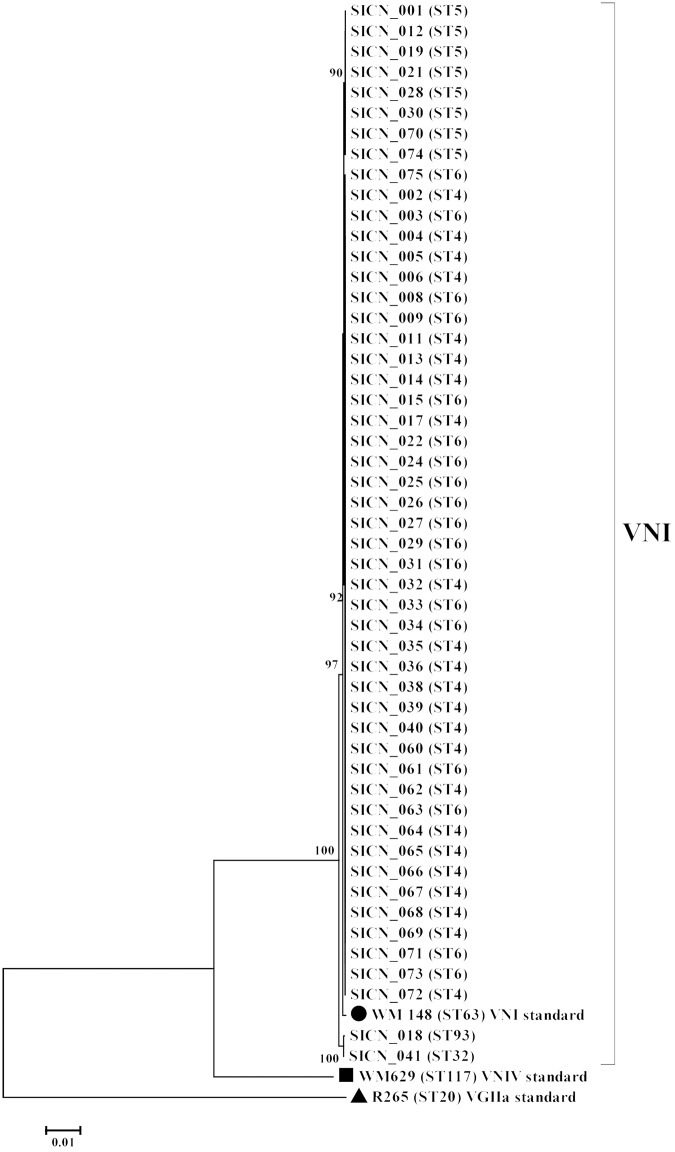
Despite the strong association between Cryptococcus neoformans infection and the Human immunodeficiency virus (HIV) status of patients globally, most cryptococcosis cases in Far East Asia occur in non-HIV individuals. Molecular epidemiological studies, using multilocus sequence typing (MLST), have shown that more than 95% of cryptococcal strains belong to a specific subtype of VNI. However, this association has never been specifically examined in other parts of Asia. Therefore, in this study, we investigated the VNIc/ST5 genotype distribution among cryptococcosis patients in Thailand. Fifty-one C. neoformans isolates were collected from clinical samples in Siriraj Hospital, Bangkok, Thailand. The strains were predominantly isolated from HIV-positive patients (88.57%) and all were molecular type VNI MATα. An MLST analysis identified five sequence types (ST) in Siriraj Hospital, of which ST4 (45.10%) and ST6 (35.29%) were most common, and ST5 (15.69%), ST32 (1.96%), and ST93 (1.96) were less common. Contrary to reports from Far East Asia, ST5 was predominantly (83.33%) found in HIV patients (P = 0.657), and there was no significant change in the prevalence of ST5 over the past 10 years (P = 0.548). A further analysis of comorbidities showed higher morbidity and delays in the cryptococcal diagnosis in patients with tuberculosis coinfection or without HIV. Our study suggests that although the Thai population is genetically closely related to the Far East Asian population, ST5 is not associated with non-HIV status in Thailand. Therefore, this association may not be related to the host's genetic background. However, its mechanism remains unclear.
尽管全球范围内新型隐球菌感染与患者的人类免疫缺陷病毒(HIV)状态密切相关,但在东亚地区,大多数隐球菌病病例发生在非HIV感染者中。利用多位点序列分型(MLST)进行的分子流行病学研究表明,超过95%的隐球菌菌株属于VNI的一种特定亚型。然而,在亚洲其他地区从未对这种关联进行过专门研究。因此,在本研究中,我们调查了泰国隐球菌病患者中VNIc/ST5基因型的分布情况。从泰国曼谷诗里拉吉医院的临床样本中收集了51株新型隐球菌分离株。这些菌株主要从HIV阳性患者中分离得到(88.57%),且均为分子型VNI MATα。MLST分析在诗里拉吉医院鉴定出五种序列类型(ST),其中ST4(45.10%)和ST6(35.29%)最为常见,ST5(15.69%)、ST32(1.96%)和ST93(1.96%)较不常见。与东亚地区的报道相反,ST5主要(83.33%)在HIV患者中发现(P = 0.657),并且在过去10年中ST5的患病率没有显著变化(P = 0.548)。对合并症的进一步分析表明,合并肺结核或无HIV的患者中隐球菌病的发病率更高,诊断延迟。我们的研究表明,尽管泰国人群在基因上与东亚人群密切相关,但在泰国ST5与非HIV状态无关。因此,这种关联可能与宿主的基因背景无关。然而,其机制仍不清楚。