Faculty of Medicine, Department of Basic Sciences, Molecular Biology Service, University of Kinshasa, Kinshasa, The Democratic Republic of Congo.
Centre for Interdisciplinary Research on Medicines, University of Liege, Liege, Belgium.
PLoS One. 2022 May 19;17(5):e0267842. doi: 10.1371/journal.pone.0267842. eCollection 2022.
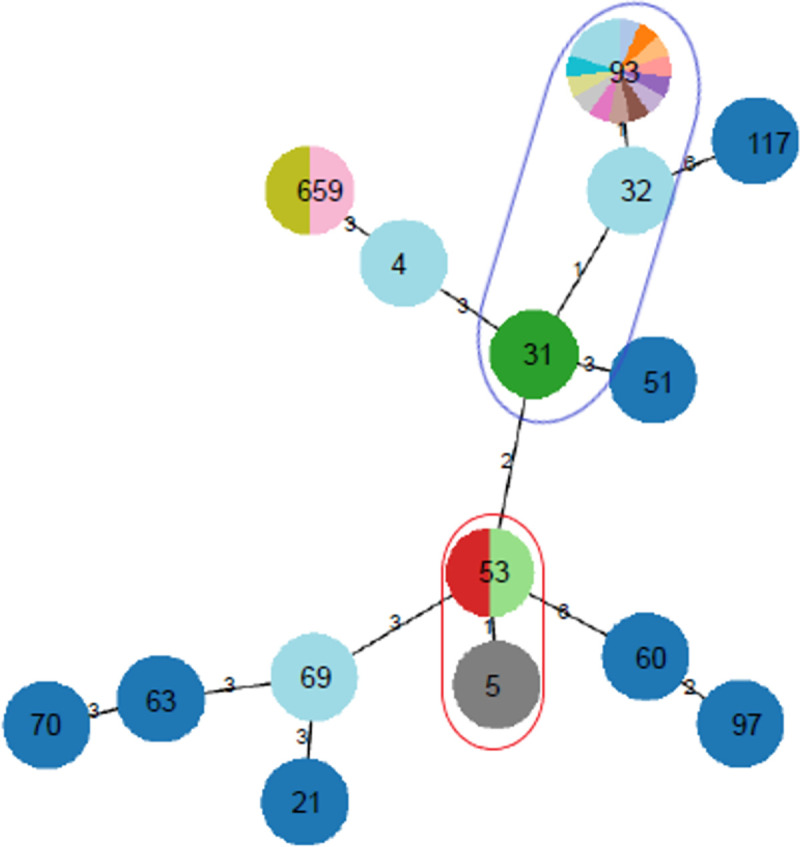
Neuromeningeal cryptococcosis (NMC) is a life-threatening opportunistic infection in advanced HIV disease patients (AHDP). It is caused by Cryptococcus spp. complexes and mainly occurs in sub-Saharan Africa. In this study, we performed molecular characterization and antifungal susceptibility profiling of Cryptococcus isolates from AHDP in Kinshasa (DRC). Additionally, we investigated a possible association between NMC severity factors and the Cryptococcus neoformans (Cn) multilocus sequence typing (MLST) profiles. We characterized the isolates using PCR serotyping, MALDI-TOF MS, internal transcribed spacer (ITS) sequencing, and MLST. Susceptibility testing for the major antifungal drugs was performed according to the EUCAST guidelines. Parameters associated with NMC severity, such as hypoglycorrhachia (< 50 mg/dL), increased cerebral spinal fluid opening pressure (> 30 cm H2O), and poor therapeutic outcome were compared with the Cn MLST sequences type (ST). Twenty-three out of 29 Cryptococcus isolates were identified as serotype A using PCR serotyping (79.3%; 95% IC: 65.5-93.1), while six (20.7%; 95% IC: 6.9-34.5) were not serotypable. The 29 isolates were identified by ITS sequencing as follows: Cryptococcus neoformans (23/29, 79.3%), Cutaneotrichosporon curvatus (previously called Cryptococcus curvatus) (5/29, 17.2%), and Papiliotrema laurentii (Cryptococcus laurentii) (1/29, 3.5%). Using the ISHAM MLST scheme, all Cn isolates were identified as molecular type VNI. These comprised seven different STs: ST93 (n = 15), ST5 (n = 2), ST53 (n = 1), ST31 (n = 1), ST4 (n = 1), ST69 (n = 1), and one novel ST that has not yet been reported from other parts of the world and was subsequently assigned as ST659 (n = 2). Of the included strains, only Papiliotrema laurentii was resistant to amphoterin B (1/29, 3.5%), 6.8% (2/29) were resistant to 5-flucytosine (the single Papiliotrema laurentii strain and one Cryptococcus neoformans isolate), and 13.8% (4/29) to fluconazole, including two of five (40%) Cutaneotrichosporon curvatus and two of 23 (8.7%) C. neoformans strains. We found a significative association between poor therapeutic outcome and a non-ST93 sequence type of causative strains (these concerned the less common sequence types: ST53, ST31, ST5, ST4, ST659, and ST69) (87.5% versus 40%, p = 0.02). Molecular analysis of Cryptococcus spp. isolates showed a wide species diversity and genetic heterogenicity of Cn within the VNI molecular type. Furthermore, it is worrying that among included strains we found resistances to several of the commonly used antifungals.
神经脑膜隐球菌病 (NMC) 是晚期 HIV 疾病患者 (AHDP) 中危及生命的机会性感染。它由隐球菌属复合物引起,主要发生在撒哈拉以南非洲。在这项研究中,我们对金沙萨 (DRC) 的 AHDP 中的隐球菌分离株进行了分子特征分析和抗真菌药敏分析。此外,我们还研究了 NMC 严重程度因素与新型隐球菌 (Cn) 多位点序列分型 (MLST) 谱之间可能存在的关联。我们使用 PCR 血清分型、基质辅助激光解吸电离飞行时间质谱 (MALDI-TOF MS)、内部转录间隔区 (ITS) 测序和 MLST 对分离株进行了特征分析。根据 EUCAST 指南进行了主要抗真菌药物的药敏试验。将与 NMC 严重程度相关的参数,如低血糖 (<50mg/dL)、脑脊髓液开放压升高 (>30cmH2O) 和治疗效果不佳等参数与 Cn MLST 序列类型 (ST) 进行了比较。使用 PCR 血清分型鉴定了 29 个隐球菌分离株中的 23 个 (79.3%;95%CI:65.5-93.1),6 个 (20.7%;95%CI:6.9-34.5) 不可分型。29 个分离株通过 ITS 测序鉴定为:新型隐球菌 (23/29,79.3%)、表皮毛孢子菌 (以前称为隐球菌弯曲菌) (5/29,17.2%) 和Laurentii Papiliotrema (隐球菌 Laurentii) (1/29,3.5%)。使用 ISHAM MLST 方案,所有 Cn 分离株均被鉴定为分子型 VNI。这些包括七个不同的 ST:ST93(n=15)、ST5(n=2)、ST53(n=1)、ST31(n=1)、ST4(n=1)、ST69(n=1)和一个尚未从世界其他地区报道的新 ST,随后被分配为 ST659(n=2)。在所包括的菌株中,只有Laurentii Papiliotrema 对两性霉素 B 有耐药性 (1/29,3.5%),6.8%(2/29)对 5-氟胞嘧啶有耐药性 (即单一的Laurentii Papiliotrema 菌株和一个新型隐球菌分离株),13.8% (4/29)对氟康唑有耐药性,其中包括两个 5-氟胞嘧啶耐药的表皮毛孢子菌 (40%)和两个新型隐球菌菌株 (8.7%)。我们发现治疗效果不佳与致病菌株非 ST93 序列类型之间存在显著关联 (这些涉及较少见的序列类型:ST53、ST31、ST5、ST4、ST659 和 ST69) (87.5%比 40%,p=0.02)。隐球菌属分离株的分子分析显示,新型隐球菌在 VNI 分子类型内具有广泛的种多样性和遗传异质性。此外,令人担忧的是,在所包括的菌株中,我们发现了对几种常用抗真菌药物的耐药性。