Huan Yang W, Bengtsson Rebecca J, MacIntyre Neil, Guthrie Jack, Finlayson Heather, Smith Sionagh H, Archibald Alan L, Ait-Ali Tahar
The Roslin Institute, University of Edinburgh, Easter Bush Campus, Roslin, Midlothian, United Kingdom.
Royal (Dick) School of Veterinary Studies, University of Edinburgh, Easter Bush Campus, Roslin, Midlothian, United Kingdom.
PLoS One. 2017 Mar 21;12(3):e0173782. doi: 10.1371/journal.pone.0173782. eCollection 2017.
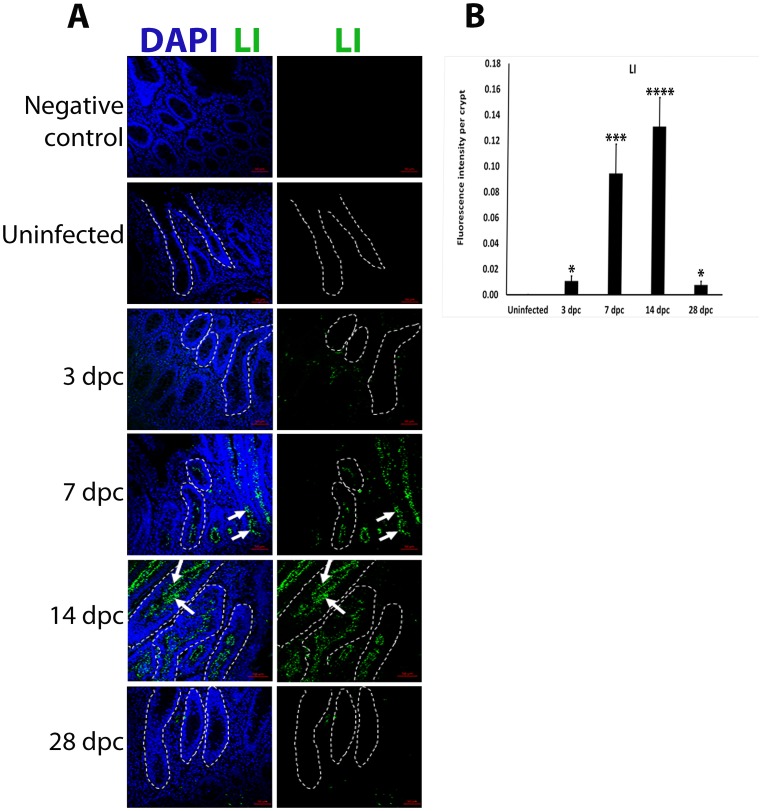
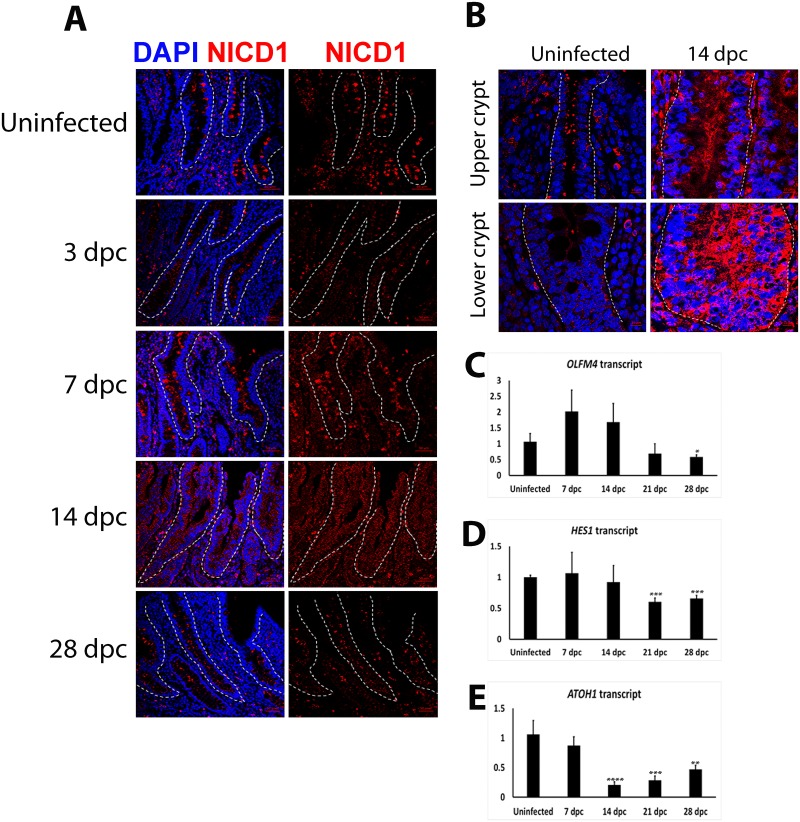
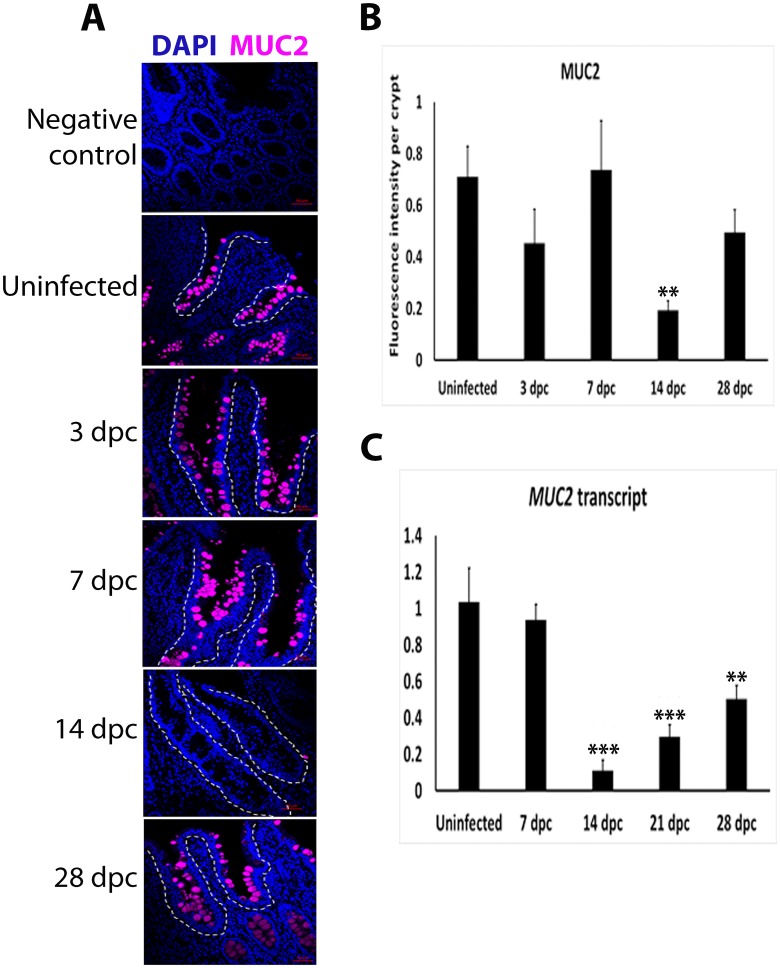
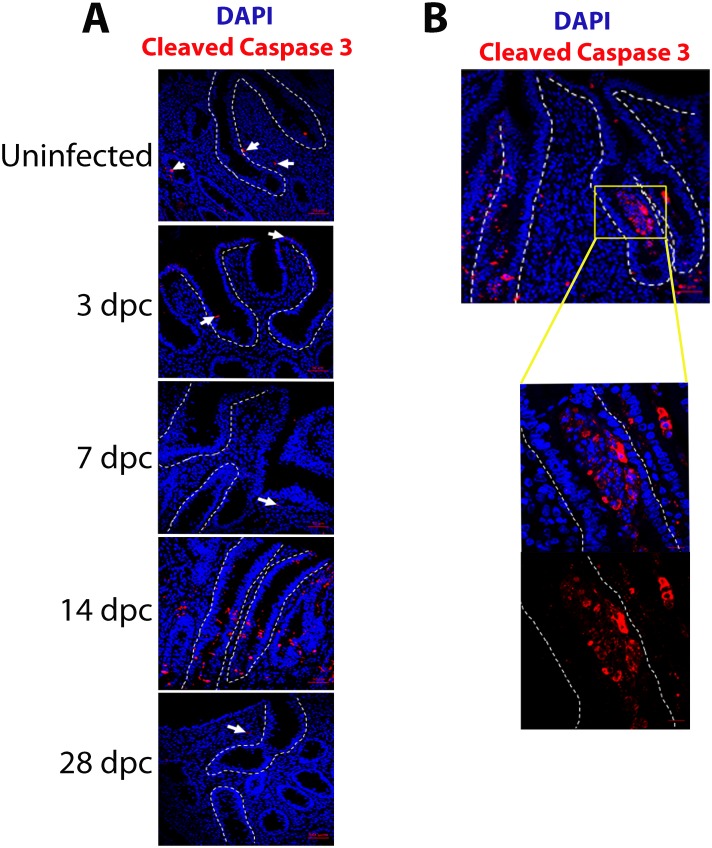
Lawsonia intracellularis is an obligate intracellular bacterial pathogen that causes proliferative enteropathy (PE) in pigs. L. intracellularis infection causes extensive intestinal crypt cell proliferation and inhibits secretory and absorptive cell differentiation. However, the affected host upstream cellular pathways leading to PE are still unknown. β-catenin/Wnt signalling is essential in maintaining intestinal stem cell (ISC) proliferation and self-renewal capacity, while Notch signalling governs differentiation of secretory and absorptive lineage specification. Therefore, in this report we used immunofluorescence (IF) and quantitative reverse transcriptase PCR (RTqPCR) to examine β-catenin/Wnt and Notch-1 signalling levels in uninfected and L. intracellularis infected pig ileums at 3, 7, 14, 21 and 28 days post challenge (dpc). We found that while the significant increase in Ki67+ nuclei in crypts at the peak of L. intracellularis infection suggested enhanced cell proliferation, the expression of c-MYC and ASCL2, promoters of cell growth and ISC proliferation respectively, was down-regulated. Peak infection also coincided with enhanced cytosolic and membrane-associated β-catenin staining and induction of AXIN2 and SOX9 transcripts, both encoding negative regulators of β-catenin/Wnt signalling and suggesting a potential alteration to β-catenin/Wnt signalling levels, with differential regulation of the expression of its target genes. We found that induction of HES1 and OLFM4 and the down-regulation of ATOH1 transcript levels was consistent with the increased Notch-1 signalling in crypts at the peak of infection. Interestingly, the significant down-regulation of ATOH1 transcript levels coincided with the depletion of MUC2 expression at 14 dpc, consistent with the role of ATOH1 in promoting goblet cell maturation. The lack of significant change to LGR5 transcript levels at the peak of infection suggested that the crypt hyperplasia was not due to the expansion of ISC population. Overall, simultaneous induction of Notch-1 signalling and the attenuation of β-catenin/Wnt pathway appear to be associated with the inhibition of goblet cell maturation and enhanced crypt cell proliferation at the peak of L. intracellularis infection. Moreover, the apparent differential regulation of apoptosis between crypt and lumen cells together with the strong induction of Notch-1 signalling and the enhanced SOX9 expression along crypts 14 dpc suggest an expansion of actively dividing transit amplifying and/or absorptive progenitor cells and provide a potential basis for understanding the development and maintenance of PE.
胞内劳森菌是一种专性胞内细菌病原体,可导致猪的增生性肠炎(PE)。胞内劳森菌感染会引起广泛的肠道隐窝细胞增殖,并抑制分泌细胞和吸收细胞的分化。然而,导致PE的受影响宿主上游细胞途径仍不清楚。β-连环蛋白/Wnt信号对于维持肠道干细胞(ISC)的增殖和自我更新能力至关重要,而Notch信号则控制分泌和吸收谱系特化的分化。因此,在本报告中,我们使用免疫荧光(IF)和定量逆转录酶PCR(RTqPCR)来检测攻毒后3、7、14、21和28天未感染和感染胞内劳森菌的猪回肠中β-连环蛋白/Wnt和Notch-1信号水平。我们发现,虽然在胞内劳森菌感染高峰期隐窝中Ki67+细胞核的显著增加表明细胞增殖增强,但分别促进细胞生长和ISC增殖的c-MYC和ASCL2的表达却下调了。感染高峰期还与胞质和膜相关β-连环蛋白染色增强以及AXIN2和SOX9转录本的诱导同时出现,这两种转录本均编码β-连环蛋白/Wnt信号的负调节因子,表明β-连环蛋白/Wnt信号水平可能发生改变,其靶基因的表达受到差异调节。我们发现,HES1和OLFM4的诱导以及ATOH1转录水平的下调与感染高峰期隐窝中Notch-1信号的增加一致。有趣的是,ATOH1转录水平的显著下调与攻毒后14天MUC2表达的减少同时出现,这与ATOH1在促进杯状细胞成熟中的作用一致。感染高峰期LGR5转录水平没有显著变化,这表明隐窝增生不是由于ISC群体的扩增。总体而言,Notch-1信号的同时诱导和β-连环蛋白/Wnt途径的减弱似乎与胞内劳森菌感染高峰期杯状细胞成熟的抑制和隐窝细胞增殖的增强有关。此外,隐窝细胞和肠腔细胞之间凋亡的明显差异调节,以及攻毒后14天沿隐窝Notch-1信号的强烈诱导和SOX9表达的增强,表明活跃分裂的过渡扩增和/或吸收祖细胞的扩增,并为理解PE的发展和维持提供了潜在基础。