Department of Animal Science, Iowa State University, Ames, IA, 50011, USA.
Department of Veterinary Diagnostic and Production Animal Medicine, Iowa State University, Ames, IA, 50011, USA.
Vet Res. 2021 Jun 19;52(1):90. doi: 10.1186/s13567-021-00958-2.
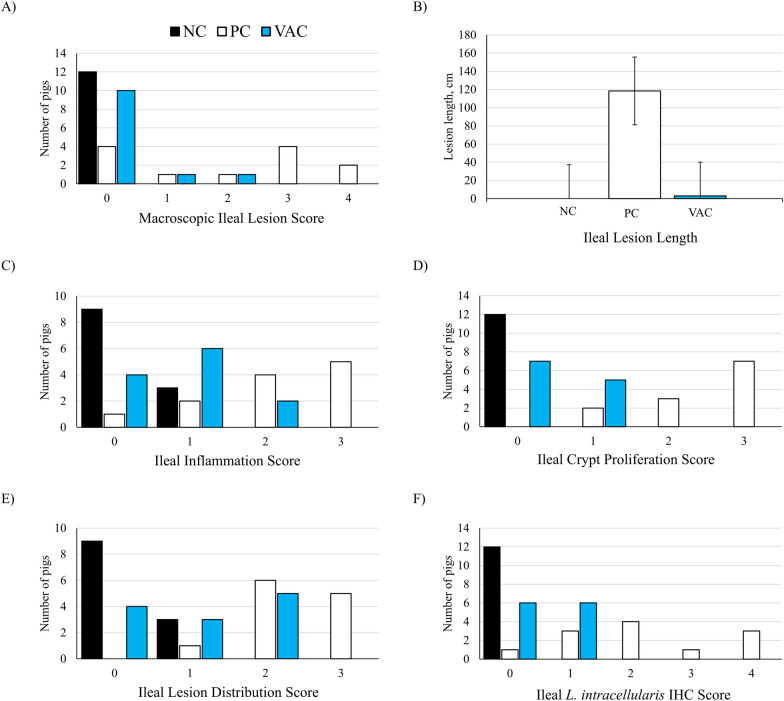
Lawsonia intracellularis is endemic to swine herds worldwide, however much is still unknown regarding its impact on intestinal function. Thus, this study aimed to characterize the impact of L. intracellularis on digestive function, and how vaccination mitigates these impacts. Thirty-six L. intracellularis negative barrows were assigned to treatment groups (n = 12/trt): (1) nonvaccinated, L. intracellularis negative (NC); (2) nonvaccinated, L intracellularis challenged (PC); and (3) L. intracellularis challenged, vaccinated (Enterisol Ileitis, Boehringer Ingelheim) 7 weeks pre-challenge (VAC). On days post-inoculation (dpi) 0 PC and VAC pigs were inoculated with L. intracellularis. From dpi 19-21 fecal samples were collected for apparent total tract digestibility (ATTD) and at dpi 21, pigs were euthanized for sample collection. Post-inoculation, ADG was reduced in PC pigs compared with NC (41%, P < 0.001) and VAC (25%, P < 0.001) pigs. Ileal gross lesion severity was greater in PC pigs compared with NC (P = 0.003) and VAC (P = 0.018) pigs. Dry matter, organic matter, nitrogen, and energy ATTD were reduced in PC pigs compared with NC pigs (P ≤ 0.001 for all). RNAscope in situ hybridization revealed abolition of sucrase-isomaltase transcript in the ileum of PC pigs compared with NC and VAC pigs (P < 0.01). Conversely, abundance of stem cell signaling markers Wnt3, Hes1, and p27 were increased in PC pigs compared with NC pigs (P ≤ 0.085). Taken together, these data demonstrate that reduced digestibility during L. intracellularis challenge is partially driven by abolition of digestive machinery in lesioned tissue. Further, vaccination mitigated several of these effects, likely from lower bacterial burden and reduced disease severity.
肠细胞内罗松菌在全世界的猪群中流行,但人们对其对肠道功能的影响仍知之甚少。因此,本研究旨在描述肠细胞内罗松菌对消化功能的影响,以及疫苗接种如何减轻这些影响。将 36 头肠细胞内罗松菌阴性的去势公猪分配到治疗组(每组 12 头猪):(1)未接种疫苗、肠细胞内罗松菌阴性(NC);(2)未接种疫苗、肠细胞内罗松菌感染(PC);和(3)肠细胞内罗松菌感染、接种疫苗(Boehringer Ingelheim 的 Enterisol Ileitis)7 周前感染(VAC)。在接种后第 0 天(dpi),PC 和 VAC 猪被接种肠细胞内罗松菌。从 dpi 19-21 收集粪便样本进行表观全肠道消化率(ATTD),在 dpi 21 处死猪只收集样本。接种后,PC 猪的 ADG 与 NC(41%,P < 0.001)和 VAC(25%,P < 0.001)猪相比降低。与 NC(P = 0.003)和 VAC(P = 0.018)猪相比,PC 猪的回肠总病变严重程度更大。与 NC 猪相比,PC 猪的干物质、有机物、氮和能量 ATTD 降低(P ≤ 0.001)。RNAscope 原位杂交显示,与 NC 和 VAC 猪相比,PC 猪的蔗糖酶-异麦芽糖酶转录在回肠中被消除(P < 0.01)。相反,与 NC 猪相比,PC 猪的干细胞信号标记物 Wnt3、Hes1 和 p27 的丰度增加(P ≤ 0.085)。综上所述,这些数据表明,在肠细胞内罗松菌感染期间消化率降低部分是由受损组织中消化机制的消除引起的。此外,疫苗接种减轻了其中的一些影响,可能是由于细菌负荷降低和疾病严重程度降低。