Sato Masaaki
Graduate School of Science and Engineering and Brain and Body System Science Institute, Saitama UniversitySaitama, Japan; RIKEN Brain Science InstituteWako, Japan.
Front Cell Neurosci. 2017 Mar 7;11:62. doi: 10.3389/fncel.2017.00062. eCollection 2017.
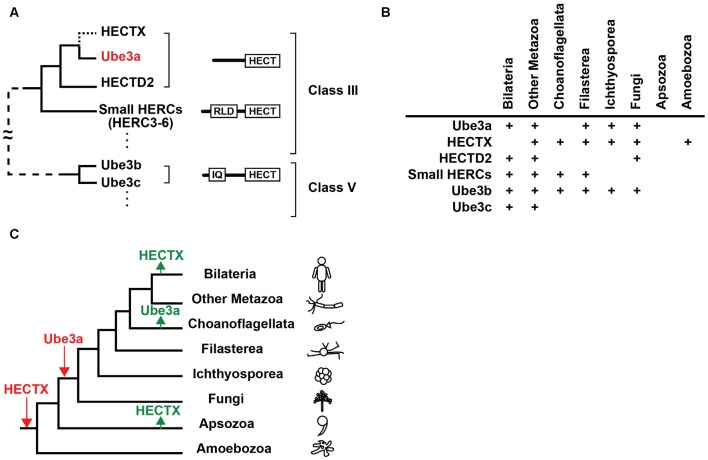
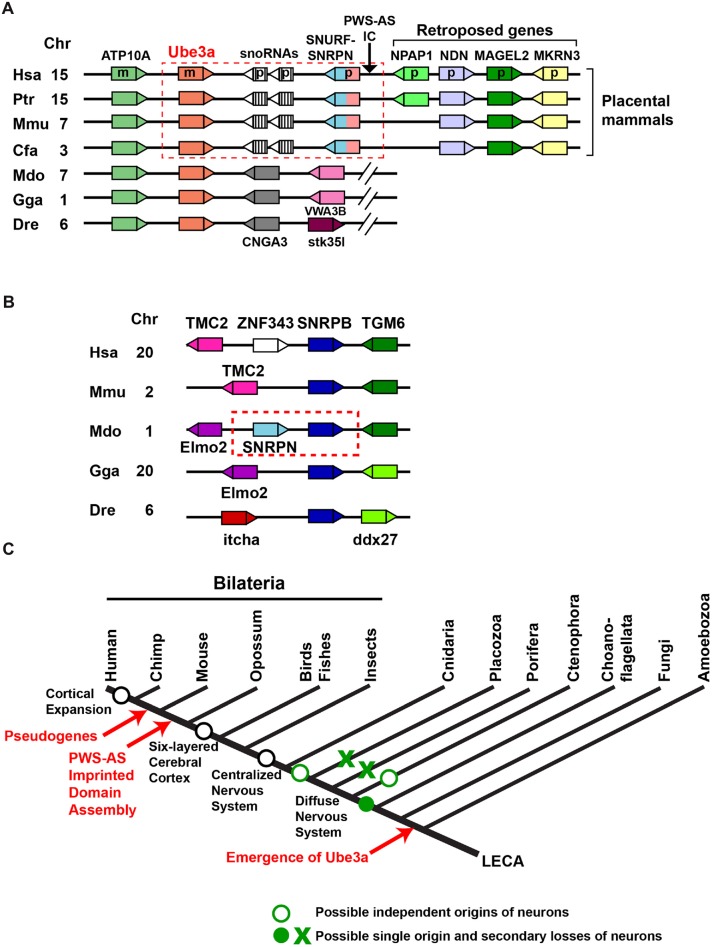
The human gene encodes an E3 ubiquitin ligase and exhibits brain-specific genomic imprinting. Genetic abnormalities that affect the maternal copy of this gene cause the neurodevelopmental disorder Angelman syndrome (AS), which is characterized by severe mental retardation, speech impairment, seizure, ataxia and some unique behavioral phenotypes. In this review article, I highlight the evolution of the gene and its imprinting to provide evolutionary insights into AS. Recent comparative genomic studies have revealed that is most phylogenetically similar to among the human HECT (homologous to the E6AP carboxyl terminus) family of E3 ubiquitin ligases, and its distant evolutionary origin can be traced to common ancestors of fungi and animals. Moreover, a gene more similar to than is found in a range of eukaryotes from amoebozoans to basal metazoans, but is lost in later lineages. Unlike in mice and humans, expression is biallelic in birds, monotremes, marsupials and insects. The imprinting domain that governs maternal expression of was formed from non-imprinted elements following multiple chromosomal rearrangements after diversification of marsupials and placental mammals. Hence, the evolutionary origins of date from long before the emergence of the nervous system, although its imprinted expression was acquired relatively recently. These observations suggest that exogenous expression and functional analyses of ancient orthologs in mammalian neurons will facilitate the evolutionary understanding of AS.
人类基因编码一种E3泛素连接酶,并表现出脑特异性基因组印记。影响该基因母本拷贝的遗传异常会导致神经发育障碍——安吉尔曼综合征(AS),其特征为严重智力迟钝、语言障碍、癫痫、共济失调以及一些独特的行为表型。在这篇综述文章中,我着重介绍该基因及其印记的进化,以提供对AS的进化见解。最近的比较基因组研究表明,在人类E3泛素连接酶的HECT(与E6AP羧基末端同源)家族中,该基因在系统发育上与[具体基因名称未给出]最为相似,其遥远的进化起源可追溯到真菌和动物的共同祖先。此外,在从变形虫到基础后生动物的一系列真核生物中发现了一个比[具体基因名称未给出]更类似于该基因的基因,但在后来的谱系中丢失了。与小鼠和人类不同,该基因在鸟类、单孔目动物、有袋动物和昆虫中呈双等位基因表达。控制该基因母本表达的印记结构域是在有袋动物和胎盘哺乳动物分化后经过多次染色体重排,由非印记元件形成的。因此,该基因的进化起源可追溯到神经系统出现之前很久,尽管其印记表达是相对较近才获得的。这些观察结果表明,对哺乳动物神经元中古老同源基因进行外源表达和功能分析将有助于从进化角度理解AS。