Gentry-Maharaj A, Karpinskyj C, Glazer C, Burnell M, Bailey K, Apostolidou S, Ryan A, Lanceley A, Fraser L, Jacobs I, Hunter M S, Menon U
a Gynaecological Cancer Research Centre, Department of Women's Cancer , Institute for Women's Health, University College London , London , UK.
b Department of Occupational and Environmental Medicine , Bispebjerg - Frederiksberg Hospital, Institute of Public Health, University of Copenhagen , Copenhagen , Denmark.
Climacteric. 2017 Jun;20(3):240-247. doi: 10.1080/13697137.2017.1301919. Epub 2017 Mar 22.
The negative publicity about menopausal hormone therapy (MHT) has led to increased use of complementary and alternative medicines (CAM) and non-pharmacological interventions (NPI) for menopausal symptom relief. We report on the prevalence and predictors of CAM/NPI among UK postmenopausal women.
Postmenopausal women aged 50-74 years were invited to participate in the UK Collaborative Trial of Ovarian Cancer Screening (UKCTOCS). A total of 202 638 women were recruited and completed a baseline questionnaire. Of these, 136 020 were sent a postal follow-up-questionnaire between September 2006 and May 2009 which included ever-use of CAM/NPI for menopausal symptom relief. Both questionnaires included MHT use.
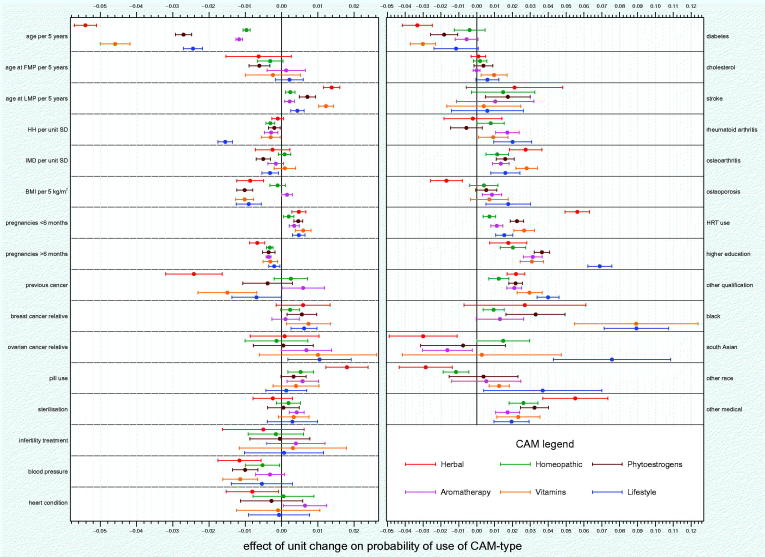
A total of 88 430 (65.0%) women returned a completed follow-up-questionnaire; 22 206 (25.1%) reported ever-use of one or more CAM/NPI. Highest use was reported for herbal therapies (43.8%; 9725/22 206), vitamins (42.6%; 9458/22 206), lifestyle approaches (32.1%; 7137/22 206) and phytoestrogens (21.6%; 4802/22 206). Older women reported less ever-use of herbal therapies, vitamins and phytoestrogens. Lifestyle approaches, aromatherapy/reflexology/acupuncture and homeopathy were similar across age groups. Higher education, Black ethnicity, MHT or previous oral contraceptive pill use were associated with higher CAM/NPI use. Women assessed as being less hopeful about their future were less likely to use CAM/NPI.
One in four postmenopausal women reported ever-use of CAM therapies/NPI for menopausal symptom relief, with lower use reported by older women. Higher levels of education and previous MHT use were positive predictors of CAM/NPI use. UKCTOCS Trial registration: ISRCTN22488978.
关于绝经激素治疗(MHT)的负面宣传导致用于缓解绝经症状的补充和替代药物(CAM)及非药物干预(NPI)的使用增加。我们报告了英国绝经后女性中CAM/NPI的使用 prevalence 及预测因素。
邀请年龄在50 - 74岁的绝经后女性参与英国卵巢癌筛查协作试验(UKCTOCS)。共招募了202638名女性并完成了一份基线问卷。其中,136020名女性在2006年9月至2009年5月期间收到一份邮寄的随访问卷,问卷包括是否曾使用CAM/NPI来缓解绝经症状。两份问卷均包括MHT的使用情况。
共有88430名(65.0%)女性返回了完整的随访问卷;22206名(25.1%)报告曾使用一种或多种CAM/NPI。草药疗法的使用比例最高(43.8%;9725/22206),维生素(42.6%;9458/22206)、生活方式干预(32.1%;7137/22206)和植物雌激素(21.6%;4802/22206)。老年女性报告的草药疗法、维生素和植物雌激素的使用比例较低。生活方式干预、芳香疗法/反射疗法/针灸和顺势疗法在各年龄组中相似。高等教育、黑人种族、MHT或以前使用口服避孕药与更高的CAM/NPI使用相关。被评估为对未来希望较低的女性使用CAM/NPI的可能性较小。
四分之一的绝经后女性报告曾使用CAM疗法/NPI来缓解绝经症状,老年女性的使用比例较低。较高的教育水平和以前使用MHT是CAM/NPI使用的积极预测因素。UKCTOCS试验注册号:ISRCTN22488978。