Ouedraogo Nafissatou, Ngangas Stephanie Moustapha Tomba, Bonkoungou Isidore Juste Ouindguèta, Tiendrebeogo Aissatou Bénéwendé, Traore Kuan Abdoulaye, Sanou Idrissa, Traore Alfred Sababénédjo, Barro Nicolas
Laboratoire de Biologie Moléculaire, d'Epidémiologie et de Surveillance des Bactéries et Virus Transmis par les Aliments, Centre de Recherche en Sciences Biologiques Alimentaires et Nutritionnelles (CRSBAN), Université Ouaga I Joseph KI-ZERBO, Ouagadougou, Burkina Faso.
Laboratoire National de Santé Publique, Direction de la Biologie médicale (DBM), Ouagadougou, Burkina Faso.
BMC Public Health. 2017 Mar 21;17(1):274. doi: 10.1186/s12889-017-4161-7.
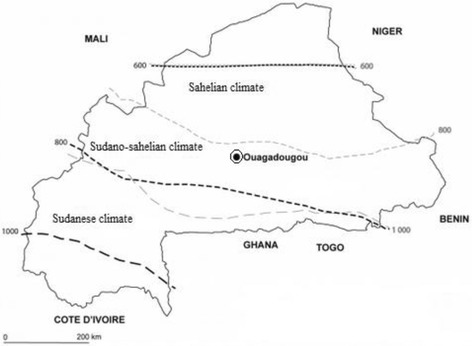
Acute gastroenteritis is one of the most common diseases among children and adults, and continues to cause a major problem of public health in Burkina Faso. The temporal pattern of rotavirus, norovirus, sapovirus, astrovirus, adenovirus and Aichivirus A was studied by examining prevalence of gastroenteritis viruses in association with meteorological variables in Ouagadougou, Burkina Faso.
Stool samples from 263 children under 5 years of age and 170 older children patients, adolescent and adults with gastroenteritis were collected in Ouagadougou, Burkina Faso from November 2011 to September 2012. Enteric viruses were detected using real-time or end-point (RT-) PCR. Temperature, humidity and monthly rainfall were recorded from the National Meteorological Direction. Categorical data were compared by Chi-square tests and the effect of weather variables and monthly prevalence were analyzed using Pearson Correlation Coefficient test.
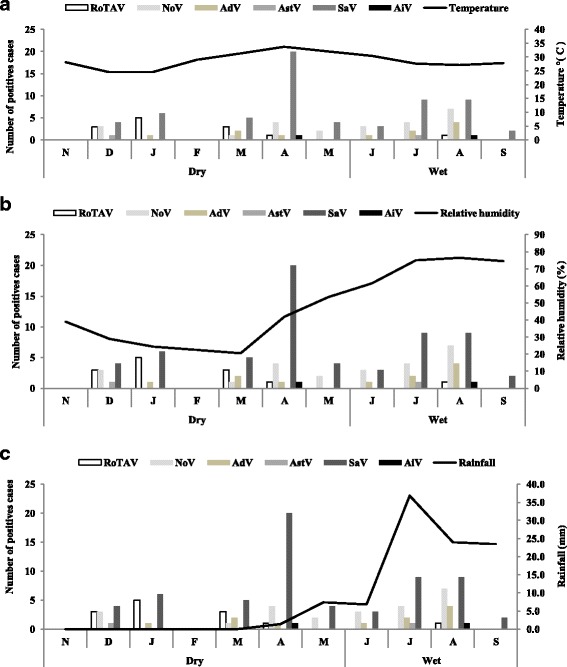
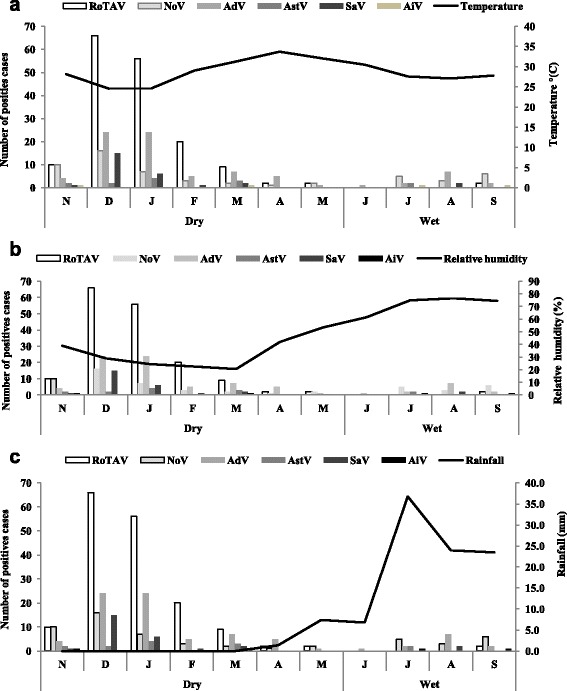
The prevalence of rotavirus infections was significantly higher in the dry season (Season S1) compared to the wet season (season S2) (p = 0.03) among the population of children under 5 years of age. No statistically significant difference was observed regarding other gastroenteritis viruses comparing the dry season and the wet season. Positive cases of rotavirus, norovirus, adenovirus and sapovirus in children under 5 years of age were correlated with temperature (r = -0.68, p = 0.01; r = -0.74, p < 0.001; r = -0.68, p = 0.01; r = -0.65, p = 0.02, respectively) and only rotavirus, adenovirus and astrovirus were correlated with relative humidity (r = -0.61, p = 0.04; r = -0.54, p = 0.08; r = -0.51, p = 0.1 respectively). No correlation was observed with rainfall. In older children, adolescent and adults patients, rotavirus and norovirus correlated with relative humidity (r = -0.58, p = 0.05; r = 0.54, p = 0.08 respectively), but, no correlation was observed between the temperature and the rainfall.
This study extends knowledge on the monthly fluctuations on the prevalence of viral gastroenteritis. These results can provide valuable information necessary to alert health care providers when a period of infection in the community is likely to occur. The transmission of these viruses in Burkina Faso could depends on multiple factors including climatic variables.
急性肠胃炎是儿童和成人中最常见的疾病之一,在布基纳法索仍是一个重大的公共卫生问题。通过研究布基纳法索瓦加杜古肠胃炎病毒的流行情况与气象变量的关系,对轮状病毒、诺如病毒、札如病毒、星状病毒、腺病毒和艾奇病毒A的时间模式进行了研究。
2011年11月至2012年9月期间,在布基纳法索瓦加杜古收集了263名5岁以下儿童以及170名年龄较大的儿童、青少年和成人肠胃炎患者的粪便样本。使用实时或终点(RT-)PCR检测肠道病毒。从国家气象部门记录温度、湿度和月降雨量。分类数据通过卡方检验进行比较,并使用Pearson相关系数检验分析天气变量和月流行率的影响。
在5岁以下儿童群体中,轮状病毒感染的流行率在旱季(季节S1)显著高于雨季(季节S2)(p = 0.03)。比较旱季和雨季,其他肠胃炎病毒未观察到统计学上的显著差异。5岁以下儿童中轮状病毒、诺如病毒、腺病毒和札如病毒的阳性病例与温度相关(r分别为-0.68,p = 0.01;r = -0.74,p < 0.001;r = -0.68,p = 0.01;r = -0.65,p = 0.02),只有轮状病毒、腺病毒和星状病毒与相对湿度相关(r分别为-0.61,p = 0.04;r = -0.54,p = 0.08;r = -0.51,p = 0.1)。未观察到与降雨量的相关性。在年龄较大的儿童、青少年和成人患者中,轮状病毒和诺如病毒与相对湿度相关(r分别为-0.58,p = 0.05;r = 0.54,p = 0.08),但温度和降雨量之间未观察到相关性。
本研究扩展了关于病毒性肠胃炎流行率每月波动的知识。这些结果可以提供有价值的信息,以便在社区可能发生感染期时提醒医疗保健人员。这些病毒在布基纳法索的传播可能取决于多种因素,包括气候变量。