Feizabadi Mitra Shojania
Physics Department, Seton Hall University, 400 South Orange Ave, South Orange, NJ, 07079, USA.
Theor Biol Med Model. 2017 Mar 21;14(1):6. doi: 10.1186/s12976-017-0052-y.
Drug-induced resistance is one the major obstacles that may lead to therapeutic failure during cancer treatment. Different genetic alterations occur when tumor cells divide. Among new generations of tumor cells, some may express intrinsic resistance to a specific chemotherapeutic agent. Also, some tumor cells may carry a gene that can develop resistance induced by the therapeutic drug. The methods by which the therapeutic approaches need to be revised in the occurrence of drug induced resistance is still being explored. Previously, we introduced a model that expresses only intrinsic drug resistance in a conjoint normal-tumor cell setting. The focus of this work is to expand our previously reported model to include terms that can express both intrinsic drug resistance and drug-induced resistance. Additionally, we assess the response of the cell population as a function of time under different treatment strategies and discuss the outcomes.
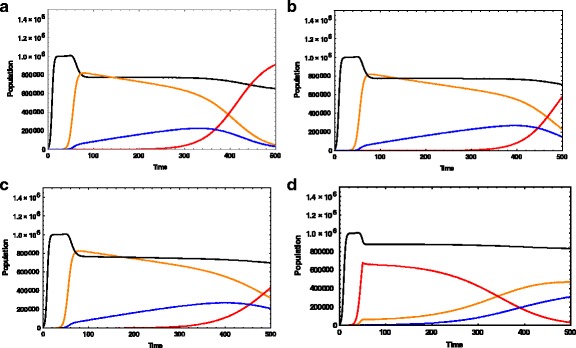
The model introduced is expressed in the format of coupled differential equations which describe the growth pattern of the cells. The dynamic of the cell populations is simulated under different treatment cases. All computational simulations were executed using Mathematica v7.0.
The outcome of the simulations clearly demonstrates that while some therapeutic strategies can overcome or control the intrinsic drug resistance, they may not be effective, and are even to some extent damaging, if the administered drug creates resistance by itself.
In the present study, the evolution of the cells in a conjoint setting, when the system expresses both intrinsic and induced resistance, is mathematically modeled. Followed by a set of computer simulations, the different growing patterns that can be created based on choices of therapy were examined. The model can still be improved by considering other factors including, but not limited to, the nature of the cancer growth, the level of toxicity that the body can tolerate, or the strength of the patient's immune system.
药物诱导的耐药性是癌症治疗过程中可能导致治疗失败的主要障碍之一。肿瘤细胞分裂时会发生不同的基因改变。在新一代肿瘤细胞中,有些可能对特定化疗药物表现出内在耐药性。此外,一些肿瘤细胞可能携带一种能产生对治疗药物诱导的耐药性的基因。在出现药物诱导的耐药性时,治疗方法需要如何修改仍在探索中。此前,我们引入了一个在联合正常 - 肿瘤细胞环境中仅表达内在耐药性的模型。这项工作的重点是扩展我们之前报道的模型,以纳入能够表达内在耐药性和药物诱导耐药性的术语。此外,我们评估在不同治疗策略下细胞群体随时间的反应并讨论结果。
引入的模型以耦合微分方程的形式表示,描述细胞的生长模式。在不同治疗情况下模拟细胞群体的动态。所有计算模拟均使用Mathematica v7.0执行。
模拟结果清楚地表明,虽然一些治疗策略可以克服或控制内在耐药性,但如果所施用的药物自身产生耐药性,这些策略可能无效,甚至在某种程度上具有损害性。
在本研究中,对系统同时表达内在和诱导耐药性时联合环境中细胞的进化进行了数学建模。随后通过一组计算机模拟,研究了基于治疗选择可以产生的不同生长模式。该模型仍可通过考虑其他因素来改进,这些因素包括但不限于癌症生长的性质、身体可耐受的毒性水平或患者免疫系统的强度。