Ong Ju Lynn, Lo June C, Gooley Joshua J, Chee Michael W L
Centre for Cognitive Neuroscience, Neuroscience and Behavioral Disorders Program, Duke-NUS Medical School, Singapore.
Sleep. 2017 Apr 1;40(4). doi: 10.1093/sleep/zsx030.
To investigate the temporal evolution of sleep EEG changes in adolescents across two cycles of sleep restriction and recovery simulating an intense school week and to examine the effect of an afternoon nap on nocturnal sleep.
A parallel-group design, quasi-laboratory study was conducted in a student hostel. Fifty-seven adolescents (31 males, age = 15-19 years) were randomly assigned to nap or no nap groups. Participants underwent a 15-day protocol comprising two sleep restriction (5-hour time-in-bed [TIB]) and recovery (9-hour TIB) cycles. The nap group was also provided with a 1-hour nap opportunity at 14:00 following each sleep restriction night. Polysomnography recordings were obtained on nine nights and five nap episodes.
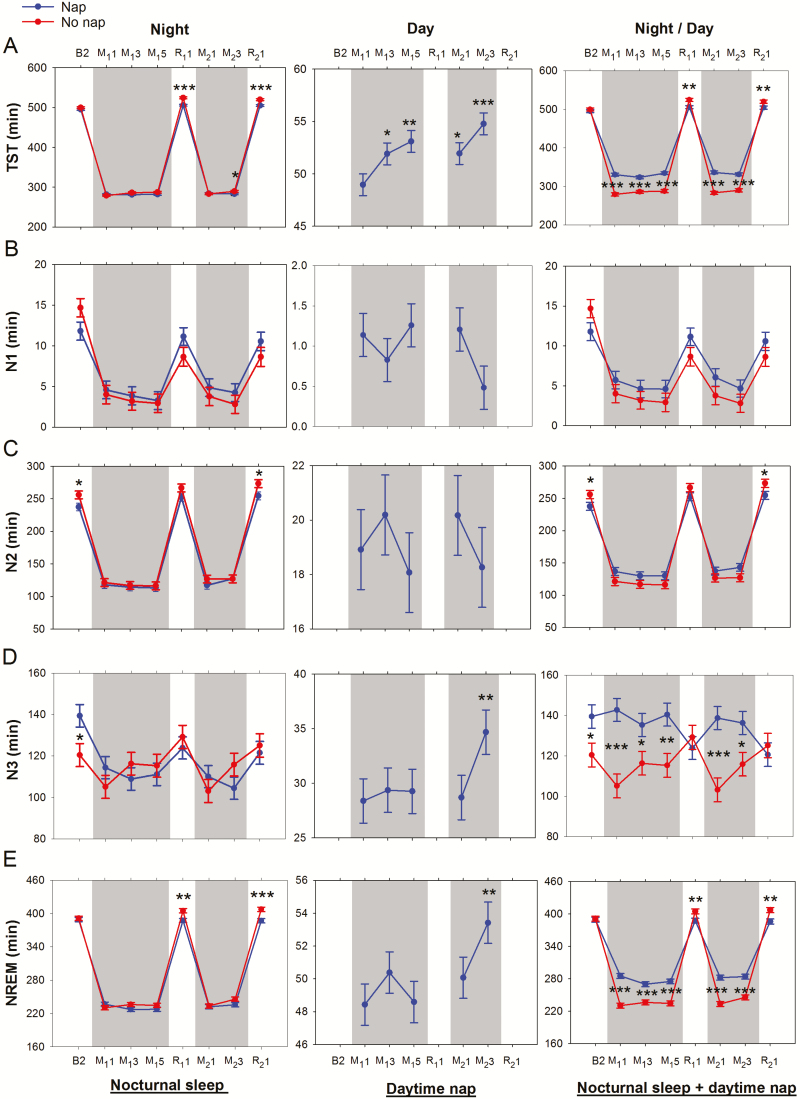
Naps reduced homeostatic sleep pressure on sleep restriction nights as evidenced by longer N2 latency and reduced total sleep time (TST), sleep efficiency (SE), and slow wave energy. Sleep debt accumulated in both groups, evidenced by increased TST, greater SE, and reduced wake after sleep onset on recovery compared to baseline nights. Changes were greater in the no nap group. Recovery sleep after the first cycle of sleep restriction did not restore sleep architecture to baseline in either group. SE, rapid eye movement (REM), and non-REM sleep increased, and N2 latency was reduced in the second sleep restriction period.
Changes in sleep EEG induced by sleep restriction to 5-hour TIB for five nights were not eliminated after two nights of 9-hour recovery sleep. An afternoon nap helped but residual effects on the sleep EEG suggest that there is no substitute for adequate nocturnal sleep.
研究青少年在模拟紧张学习周的两个睡眠限制和恢复周期中睡眠脑电图变化的时间演变,并考察午睡对夜间睡眠的影响。
在学生宿舍进行了一项平行组设计的准实验室研究。57名青少年(31名男性,年龄15 - 19岁)被随机分为午睡组和无午睡组。参与者接受了一个为期15天的方案,包括两个睡眠限制(卧床时间5小时)和恢复(卧床时间9小时)周期。午睡组在每个睡眠限制夜后的14:00还有1小时的午睡机会。在九个晚上和五次午睡期间进行了多导睡眠图记录。
午睡降低了睡眠限制夜间的内稳态睡眠压力,表现为N2潜伏期延长,总睡眠时间(TST)、睡眠效率(SE)和慢波能量降低。两组均积累了睡眠债,与基线夜相比,恢复期间TST增加、SE提高、睡眠开始后觉醒减少。无午睡组的变化更大。在任何一组中,第一个睡眠限制周期后的恢复睡眠都没有将睡眠结构恢复到基线水平。在第二个睡眠限制期,SE、快速眼动(REM)和非快速眼动睡眠增加,N2潜伏期缩短。
连续五个晚上将睡眠时间限制为5小时所引起的睡眠脑电图变化,在9小时的恢复睡眠两晚后并未消除。午睡有帮助,但对睡眠脑电图的残留影响表明,充足的夜间睡眠无可替代。