Assefa Awraris Derbie, Ko Eun Young, Moon So Hyun, Keum Young-Soo
Department of Bioresources and Food Science, Konkuk University, Seoul, 143-701, South Korea.
3 Biotech. 2016 Jun;6(1):109. doi: 10.1007/s13205-016-0424-8. Epub 2016 Apr 19.
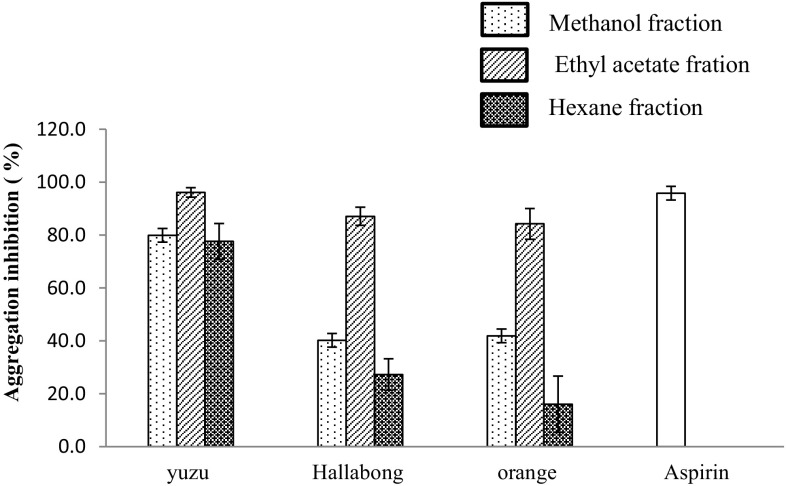
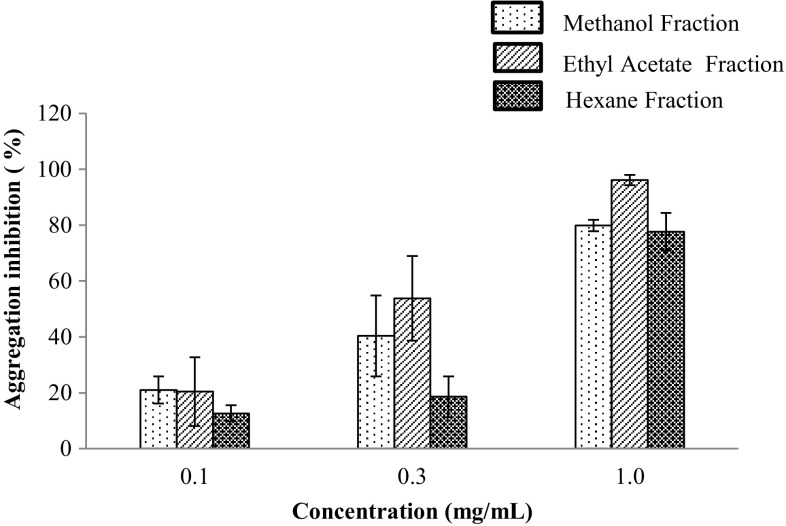
Three different fractional (methanol, ethyl acetate and hexane) extracts from yuzu (Citrus junos Sieb ex Tanaka), hallabong [(C. unshiu Marcov × C. sinensis Osbeck) × C. reticulata Blanco] and orange (C. sinensis) were evaluated for their antioxidant activity and antiplatelet effects. 2,2-Diphenyl-1-Picrylhydrazyl (DPPH), cupric reducing antioxidant capacity (CUPRAC) and ferric-reducing antioxidant power (FRAP) methods were used for the antioxidant activity tests. Total flavonoids and total phenolics were also evaluated spectrophotometrically. The ethyl acetate fraction contained the highest total flavonoid and total phenolic content and exhibited the highest antioxidant activities (185.2 ± 14.5 and 208.7 ± 17.5 mg/g dry extract for FRAP and CUPRAC values, respectively). The total phenolic and total flavonoid content ranged from 58.2 ± 1.4 to 102.4 ± 8.6 and 19.6 ± 0.5 to 64.3 ± 0.8 mg/g dry extract, respectively. The results of DPPH assay showed that ethyl acetate fractions had the least IC50 values (0.12 ± 0.002, 0.04 ± 0.0006, in mg/mL for orange and hallabong samples, respectively) followed by the hexane fraction (0.19 ± 0.007 mg/mL) of the orange sample. For all fractions, the antioxidant activity and contents of total phenolics and total flavonoids correlated well with each other. In vitro investigation of the antiplatelet effect showed that ethyl acetate fraction has the highest inhibition (84.3 ± 5.8 to 96.1 ± 1.8 %). Hexane and MeOH fractions of hallabong and orange samples inhibited platelet aggregations by less than or equal to 41 %.
对柚子(Citrus junos Sieb ex Tanaka)、汉拿峰([(C. unshiu Marcov × C. sinensis Osbeck) × C. reticulata Blanco])和橙子(C. sinensis)的三种不同的馏分提取物(甲醇、乙酸乙酯和己烷提取物)进行了抗氧化活性和抗血小板作用评估。采用2,2-二苯基-1-苦基肼自由基(DPPH)、铜离子还原抗氧化能力(CUPRAC)和铁离子还原抗氧化能力(FRAP)方法进行抗氧化活性测试。还通过分光光度法对总黄酮和总酚进行了评估。乙酸乙酯馏分的总黄酮和总酚含量最高,抗氧化活性也最高(FRAP和CUPRAC值分别为185.2±14.5和208.7±17.5mg/g干提取物)。总酚和总黄酮含量分别为58.2±1.4至102.4±8.6mg/g干提取物和19.6±0.5至64.3±0.8mg/g干提取物。DPPH测定结果表明,乙酸乙酯馏分的半数抑制浓度(IC50)值最低(橙子和汉拿峰样品分别为0.12±0.002、0.04±0.0006mg/mL),其次是橙子样品的己烷馏分(0.19±0.007mg/mL)。对于所有馏分,抗氧化活性与总酚和总黄酮含量之间具有良好的相关性。抗血小板作用的体外研究表明,乙酸乙酯馏分的抑制作用最强(84.3±5.8%至96.1±1.8%)。汉拿峰和橙子样品的己烷和甲醇馏分对血小板聚集的抑制率小于或等于41%。