Hussain Ali, Hasan Ali, Javid Arshad, Qazi Javed Iqbal
Department of Wildlife & Ecology, University of Veterinary & Animal Sciences, Lahore, Pakistan.
Department of Zoology, University of the Punjab, Lahore, Pakistan.
3 Biotech. 2016 Dec;6(2):119. doi: 10.1007/s13205-016-0437-3. Epub 2016 Jun 3.
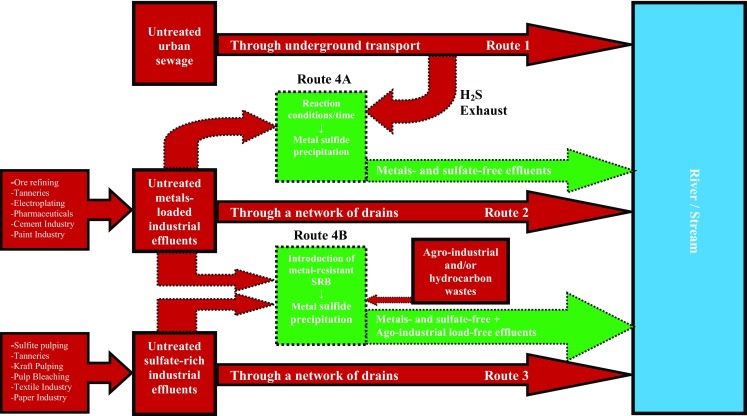
A variety of multidimensional anthropogenic activities, especially of industrial level, are contaminating our aquatic and terrestrial environments with a variety of metallic and non-metallic pollutants. The metallic and non-metallic pollutants addressed specifically in this review are heavy metals and various compound forms of sulfates, respectively. Direct and indirect deleterious effects of the both types of pollutants to all forms of life are well-known. The treatment of such pollutants is therefore much necessary before their final discharge into the environment. This review summarizes the productive utility of sulfate-reducing bacteria (SRB) for economical and concomitant treatment of the above mentioned wastes. Utilization of agro-industrial wastes and some environmental contaminants including hydrocarbons, as economical growth substrates for SRB, is also suggested and proved efficient in this review. Mechanistically, SRB will utilize sulfates as their terminal electron acceptors during respiration while utilizing agro-industrial and/or hydrocarbon wastes as electron donors/carbon sources and generate HS. The biogenic HS will then react vigorously with dissolved metals present in the wastewaters thus forming metal sulfide. The metal sulfide being water insoluble and heavier than water will settle down in the water as precipitates. In this way, three types of pollutants i.e., metals, sulfates and agro-industrial and/or hydrocarbon wastes will be treated simultaneously.
各种多维的人为活动,尤其是工业层面的活动,正用各种金属和非金属污染物污染我们的水生和陆地环境。本综述特别提及的金属和非金属污染物分别是重金属和各种硫酸盐化合物形式。这两类污染物对所有生命形式的直接和间接有害影响是众所周知的。因此,在这些污染物最终排放到环境之前进行处理非常必要。本综述总结了硫酸盐还原菌(SRB)在经济且同时处理上述废物方面的生产效用。本综述还建议并证明了利用农业工业废物和一些环境污染物(包括碳氢化合物)作为SRB的经济生长底物是有效的。从机制上讲,SRB在呼吸过程中将利用硫酸盐作为其末端电子受体,同时利用农业工业和/或碳氢化合物废物作为电子供体/碳源并产生HS。然后,生物源HS将与废水中存在的溶解金属剧烈反应,从而形成金属硫化物。金属硫化物不溶于水且比水重,将以沉淀物的形式沉淀在水中。通过这种方式,金属、硫酸盐以及农业工业和/或碳氢化合物废物这三种类型的污染物将同时得到处理。