Heckman Bryan W, MacQueen David A, Marquinez Nicole S, MacKillop James, Bickel Warren K, Brandon Thomas H
Department of Psychiatry and Behavioral Sciences, Medical University of South Carolina.
Department of Psychiatry, University of California, San Diego.
J Consult Clin Psychol. 2017 Apr;85(4):381-396. doi: 10.1037/ccp0000197.
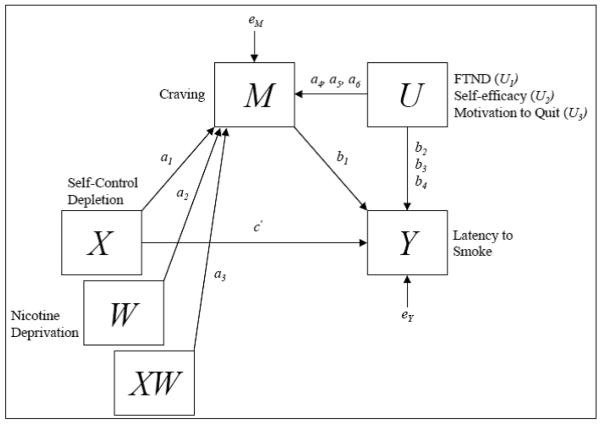
The need to understand potential precipitants of smoking relapse is exemplified by relapse rates as high as 95%. The Self-Control Strength model, which proposes that self-control is dependent upon limited resources and susceptible to fatigue, may offer insight into relapse processes. The current study tested the hypothesis that self-control depletion (SCD), produced from engagement in emotional suppression, would serve as a novel antecedent for cessation failure, as indexed by a validated laboratory analogue of smoking lapse and relapse. We also examined whether SCD effects interacted with those of a well-established relapse precipitant (i.e., nicotine deprivation). Craving and behavioral economic indices (delay discounting and demand) were tested as hypothesized mechanisms for increased cessation failure. Ultimately, a moderated mediation model was used to test nicotine deprivation as a hypothesized moderator of SCD effects.
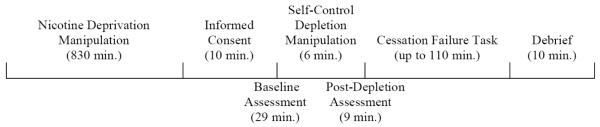
We used a 2 × 2 (12-hr deprivation vs. no deprivation; SCD vs. no SCD) factorial between-subjects design (N = 128 smokers).
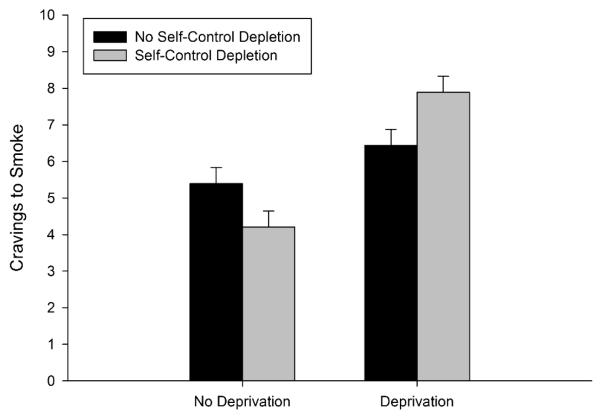
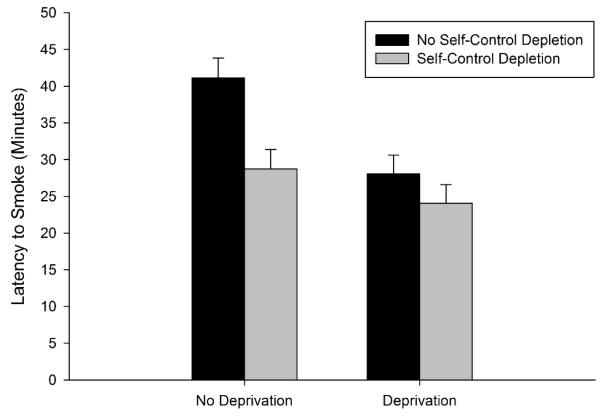
The primary hypothesis of the study was supported, as SCD increased lapse behavior (p = .04). Nicotine deprivation significantly increased craving, cigarette demand, delay discounting, and lapse behavior. No main effects were found for SCD on putative mediators (i.e., craving, demand, and discounting), but the SCD and deprivation manipulations interacted upon craving (p = .04). The moderated mediation model was significant. SCD was found to increase craving among nicotine deprived smokers, which mediated effects on lapse behavior.
SCD appears to play an important role in smoking relapse and may be a viable target for intervention. (PsycINFO Database Record
高达95%的复吸率表明有必要了解吸烟复吸的潜在诱发因素。自我控制强度模型提出自我控制依赖于有限的资源且易疲劳,这可能为复吸过程提供见解。本研究检验了以下假设:因进行情绪抑制而产生的自我控制损耗(SCD)将成为戒烟失败的一个新的先行因素,这通过一个经过验证的吸烟失误和复吸的实验室模拟指标来衡量。我们还研究了SCD效应是否与一个已确立的复吸诱发因素(即尼古丁剥夺)的效应相互作用。对渴望以及行为经济学指标(延迟折扣和需求)作为戒烟失败增加的假设机制进行了检验。最终,使用一个有调节的中介模型来检验尼古丁剥夺作为SCD效应的假设调节因素。
我们采用了2×2(12小时剥夺与无剥夺;SCD与无SCD)被试间析因设计(N = 128名吸烟者)。
研究的主要假设得到支持,因为SCD增加了失误行为(p = .04)。尼古丁剥夺显著增加了渴望、香烟需求、延迟折扣和失误行为。未发现SCD对假定中介因素(即渴望、需求和折扣)有主效应,但SCD和剥夺操作在渴望上存在交互作用(p = .04)。有调节的中介模型显著。发现SCD增加了尼古丁剥夺吸烟者的渴望,这介导了对失误行为的影响。
SCD似乎在吸烟复吸中起重要作用,可能是一个可行的干预靶点。(PsycINFO数据库记录