Hayney Mary S, Henriquez Kelsey M, Barnet Jodi H, Ewers Tola, Champion Heather M, Flannery Sean, Barrett Bruce
School of Pharmacy, University of Wisconsin-Madison, School of Medicine and Public Health, Madison, WI, United States.
School of Pharmacy, University of Wisconsin-Madison, School of Medicine and Public Health, Madison, WI, United States.
J Clin Virol. 2017 May;90:32-37. doi: 10.1016/j.jcv.2017.03.003. Epub 2017 Mar 16.
The inflammatory chemokine, interferon-gamma inducible protein of 10kDa (IP-10), is a biomarker associated with several conditions.
This study investigated serum concentrations of IP-10 in healthy individuals who developed acute respiratory infection (ARI). The hypothesis is that serum IP-10 concentrations correlate with ARI severity and detection of viral pathogens.
Data come from a randomized controlled trial measuring the effects of mindfulness meditation or exercise on ARI (Clinical Trials ID: NCT01654289). Healthy adults ages 30-69 were followed for a single season for ARI incidence and severity. This trial is ongoing, and the investigators are still blinded. When a participant reported ARI symptoms, nasal swab and lavage for PCR-based viral identification and blood samples were collected within the first 72h of ARI symptoms. Serum IP-10 concentrations were measured by ELISA (R&D Systems, Inc., Quantikine ELISA, Minneapolis, MN). ARI severity was measured using the validated Wisconsin Upper Respiratory Symptom Survey (WURSS-24) until the ARI episode resolved.
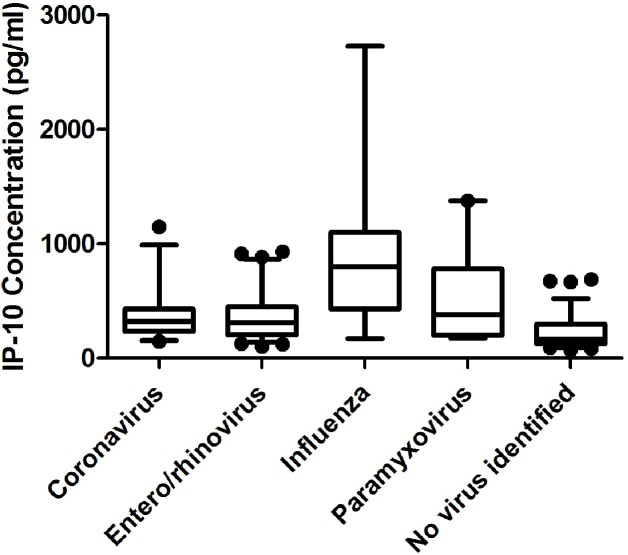
Serum IP-10 concentrations from 225 ARI episodes correlated with ARI global severity (rho 0.28 [95% CI: 0.15-0.39]; p<0.001). IP-10 concentrations were higher with an ARI in which a viral pathogen was detected compared to no viral pathogen detected (median 366pg/ml [IQR: 227-486] vs 163pg/ml [IQR: 127-295], p<0.0001). Influenza infections had higher IP-10 concentrations than coronavirus, enterovirus or rhinovirus, and paramyxovirus.
Serum IP-10 concentration correlates with ARI global severity. Also, IP-10 concentration measured early in the course of the ARI correlates with the daily severity, duration, and illness symptoms.
炎症趋化因子,10 kDa干扰素γ诱导蛋白(IP-10),是一种与多种病症相关的生物标志物。
本研究调查了发生急性呼吸道感染(ARI)的健康个体的血清IP-10浓度。假设是血清IP-10浓度与ARI严重程度及病毒病原体检测相关。
数据来自一项测量正念冥想或运动对ARI影响的随机对照试验(临床试验编号:NCT01654289)。对30 - 69岁的健康成年人随访一个季节,观察ARI的发病率和严重程度。该试验正在进行中,研究人员仍处于盲态。当参与者报告ARI症状时,在ARI症状出现的前72小时内采集鼻拭子和灌洗液用于基于PCR的病毒鉴定,并采集血样。通过酶联免疫吸附测定法(R&D Systems公司,Quantikine ELISA,明尼阿波利斯,明尼苏达州)测量血清IP-10浓度。使用经过验证的威斯康星上呼吸道症状调查(WURSS-24)评估ARI严重程度,直至ARI发作缓解。
225次ARI发作的血清IP-10浓度与ARI总体严重程度相关(rho 0.28 [95% CI:0.15 - 0.39];p<0.001)。与未检测到病毒病原体的ARI相比,检测到病毒病原体的ARI的IP-10浓度更高(中位数366 pg/ml [IQR:227 - 486] 对163 pg/ml [IQR:127 - 295],p<0.0001)。流感感染的IP-10浓度高于冠状病毒、肠道病毒、鼻病毒和副粘病毒感染。
血清IP-10浓度与ARI总体严重程度相关。此外,在ARI病程早期测量的IP-10浓度与每日严重程度、病程及疾病症状相关。