Stanley Sarah L, Scholle Frank, Zhu Jiadeng, Lu Yao, Zhang Xiangwu, Situ Xingci, Ghiladi Reza A
Department of Chemistry, North Carolina State University, Raleigh, NC 27695-8204, USA.
Department of Biological Sciences, North Carolina State University, Raleigh, NC 27695-7614, USA.
Nanomaterials (Basel). 2016 Apr 20;6(4):77. doi: 10.3390/nano6040077.
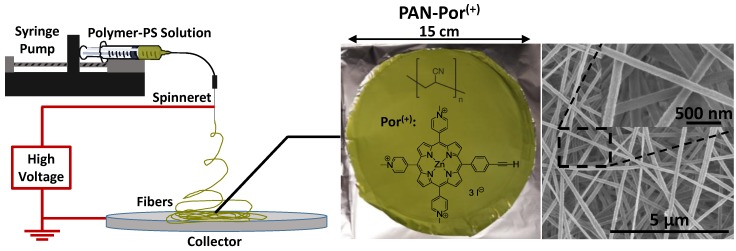
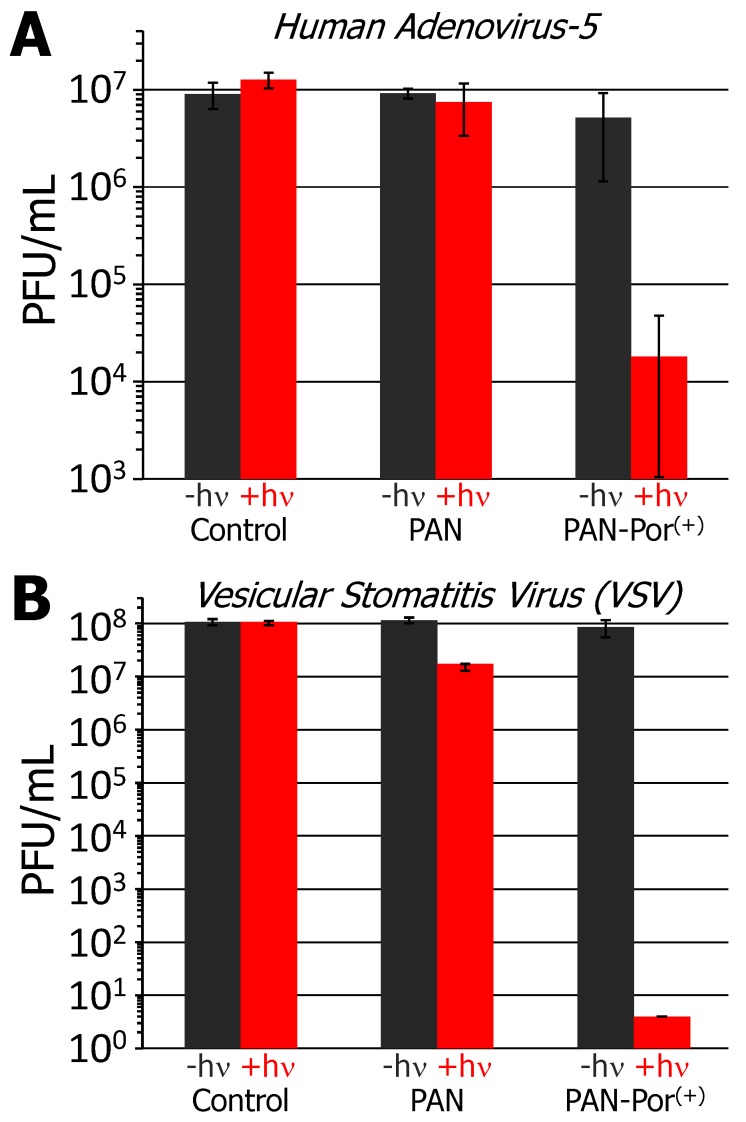
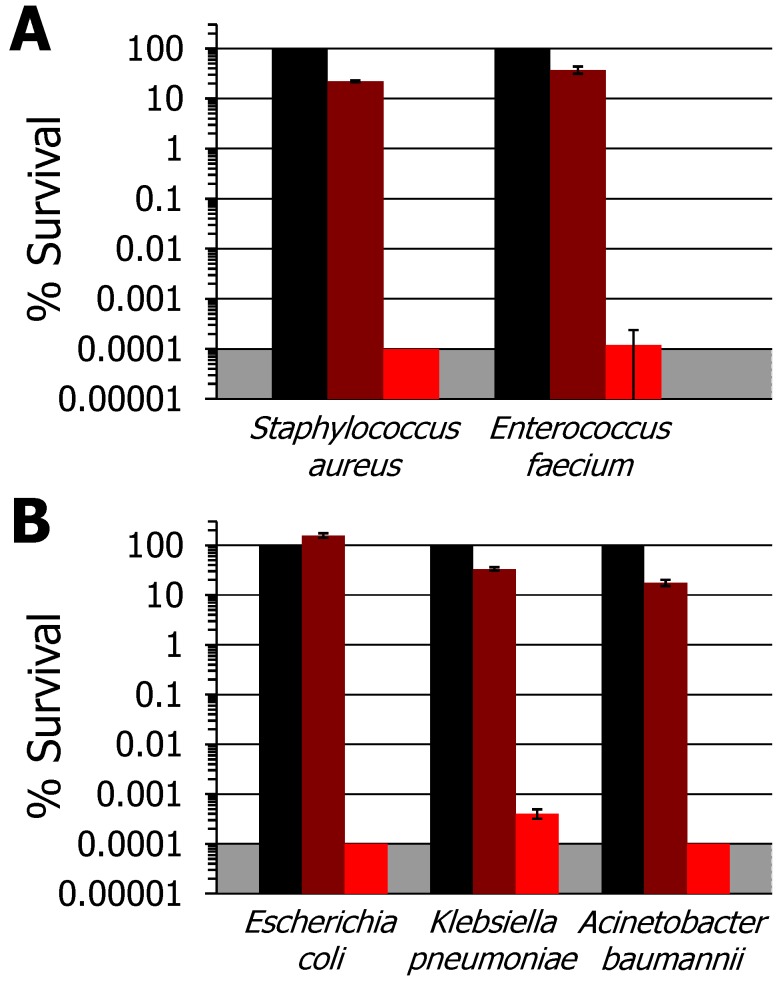
Toward the objective of developing platform technologies for anti-infective materials based upon photodynamic inactivation, we employed electrospinning to prepare a non-woven textile comprised of polyacrylonitrile nanofibers embedded with a porphyrin-based cationic photosensitizer; termed PAN-Por. Photosensitizer loading was determined to be 34.8 nmol/mg material; with thermostability to 300 °C. Antibacterial efficacy was evaluated against four bacteria belonging to the ESKAPE family of pathogens (; vancomycin-resistant ; ; and ), as well as . Our results demonstrated broad photodynamic inactivation of all bacterial strains studied upon illumination (30 min; 65 ± 5 mW/cm²; 400-700 nm) by a minimum of 99.9996+% (5.8 log units) regardless of taxonomic classification. PAN-Por also inactivated human adenovirus-5 (~99.8% reduction in PFU/mL) and vesicular stomatitis virus (>7 log units reduction in PFU/mL). When compared to cellulose-based materials employing this same photosensitizer; the higher levels of photodynamic inactivation achieved here with PAN-Por are likely due to the combined effects of higher photosensitizer loading and a greater surface area imparted by the use of nanofibers. These results demonstrate the potential of photosensitizer-embedded polyacrylonitrile nanofibers to serve as scalable scaffolds for anti-infective or self-sterilizing materials against both bacteria and viruses when employing a photodynamic inactivation mode of action.
为了实现基于光动力灭活的抗感染材料平台技术的开发目标,我们采用静电纺丝法制备了一种非织造织物,该织物由嵌入卟啉基阳离子光敏剂的聚丙烯腈纳米纤维组成;称为PAN-Por。光敏剂负载量为34.8 nmol/mg材料;热稳定性可达300℃。评估了其对属于ESKAPE病原体家族的四种细菌(耐万古霉素的 、 、 和 )以及 的抗菌效果。我们的结果表明,在光照(30分钟;65±5 mW/cm²;400 - 700 nm)下,所有研究的细菌菌株均表现出广泛的光动力灭活,灭活率至少为99.9996 +%(5.8个对数单位),与分类学类别无关。PAN-Por还能灭活人腺病毒5(PFU/mL降低约99.8%)和水疱性口炎病毒(PFU/mL降低>7个对数单位)。与使用相同光敏剂的纤维素基材料相比,此处PAN-Por实现的更高水平的光动力灭活可能是由于更高的光敏剂负载量和使用纳米纤维赋予的更大表面积的综合作用。这些结果表明,当采用光动力灭活作用模式时,嵌入光敏剂的聚丙烯腈纳米纤维有潜力作为针对细菌和病毒的抗感染或自消毒材料的可扩展支架。