Department of Chemistry, Nagoya University, Nagoya, 464-8602, Japan.
Institute of Advanced Energy, Kyoto University, Uji, Kyoto, 611-0011, Japan.
Sci Rep. 2017 Mar 23;7(1):322. doi: 10.1038/s41598-017-00068-0.
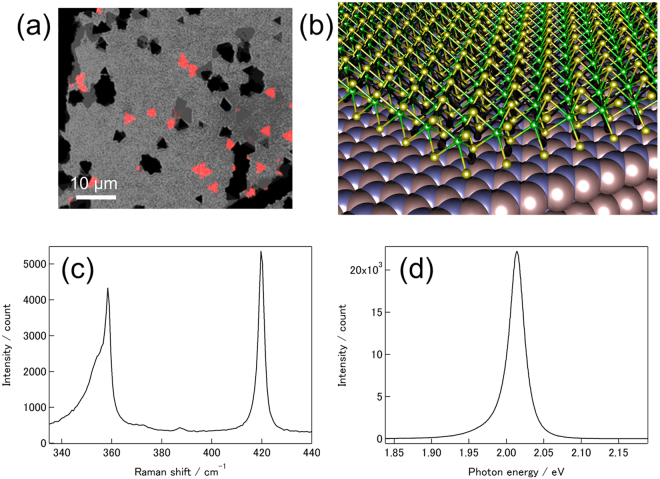
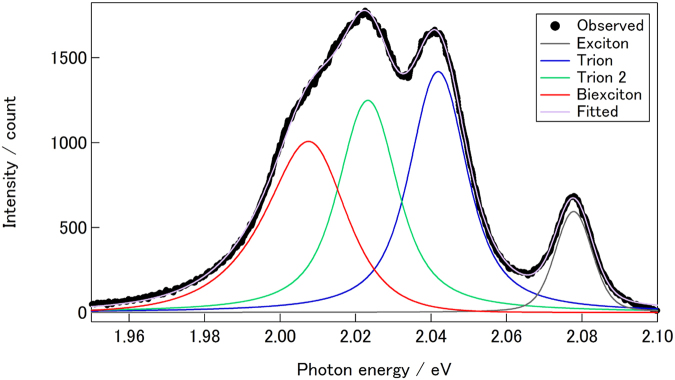
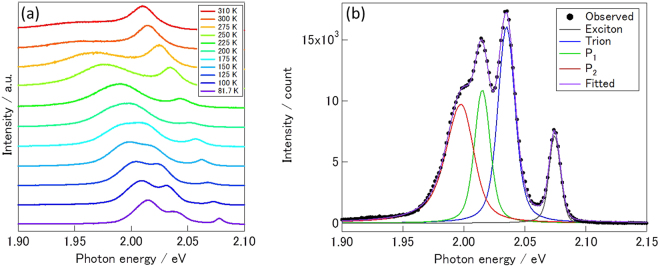
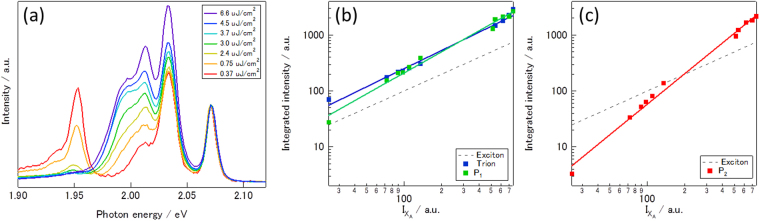
Monolayer transition metal dichalcogenides (TMDCs) including WS, MoS, WSe and WS, are two-dimensional semiconductors with direct bandgap, providing an excellent field for exploration of many-body effects in 2-dimensions (2D) through optical measurements. To fully explore the physics of TMDCs, the prerequisite is preparation of high-quality samples to observe their intrinsic properties. For this purpose, we have focused on high-quality samples, WS grown by chemical vapor deposition method with hexagonal boron nitride as substrates. We observed sharp exciton emissions, whose linewidth is typically 22~23 meV, in photoluminescence spectra at room temperature, which result clearly demonstrates the high-quality of the current samples. We found that biexcitons formed with extremely low-excitation power (240 W/cm) at 80 K, and this should originate from the minimal amount of localization centers in the present high-quality samples. The results clearly demonstrate that the present samples can provide an excellent field, where one can observe various excitonic states, offering possibility of exploring optical physics in 2D and finding new condensates.
单层过渡金属二卤族化合物(TMDCs)包括 WS、MoS、WSe 和 WS2,是具有直接带隙的二维半导体,通过光学测量为探索二维(2D)中的多体效应提供了极好的领域。为了充分探索 TMDCs 的物理性质,前提是制备高质量的样品以观察其固有特性。为此,我们专注于高质量的样品,即通过化学气相沉积法在六方氮化硼衬底上生长的 WS2。我们在室温下的光致发光光谱中观察到了尖锐的激子发射,其线宽通常为 22~23 meV,这清楚地表明了当前样品的高质量。我们发现双激子在 80 K 时以极低的激发功率(240 W/cm)形成,这应该源于当前高质量样品中最小数量的局域化中心。结果清楚地表明,当前的样品可以提供一个极好的领域,在这个领域中可以观察到各种激子态,为探索二维光学物理和发现新凝聚态提供了可能性。