Zhang Longyun, Zhang Lijuan, Wang Xiaoyong, Si Hongwei
Department of Family and Consumer Sciences, Tennessee State University, Nashville, TN, USA.
Front Pharmacol. 2017 Mar 8;8:113. doi: 10.3389/fphar.2017.00113. eCollection 2017.
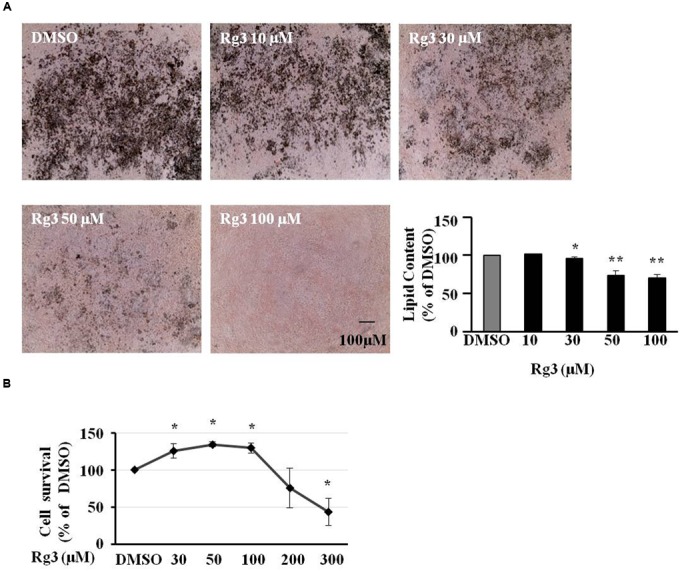
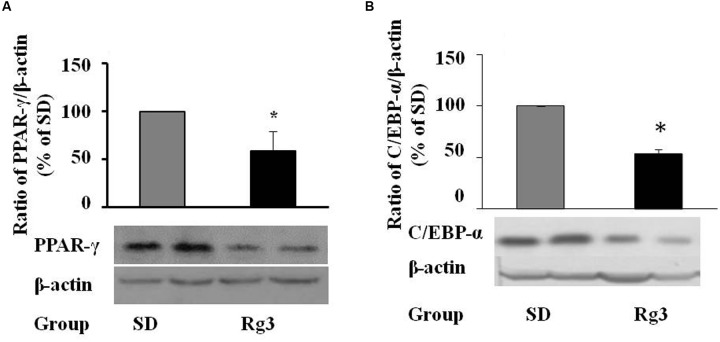
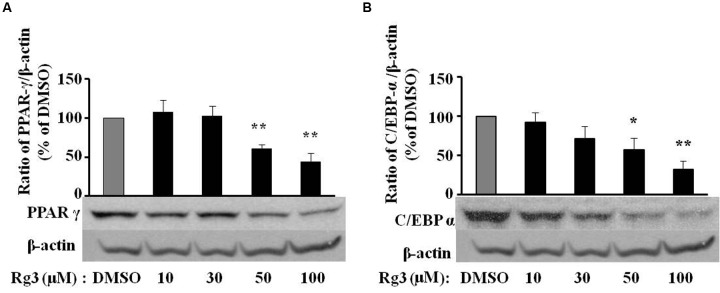
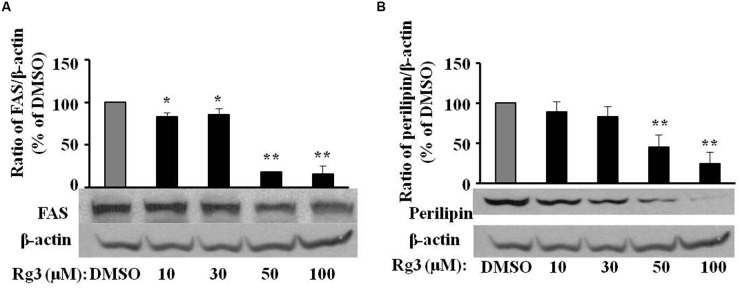
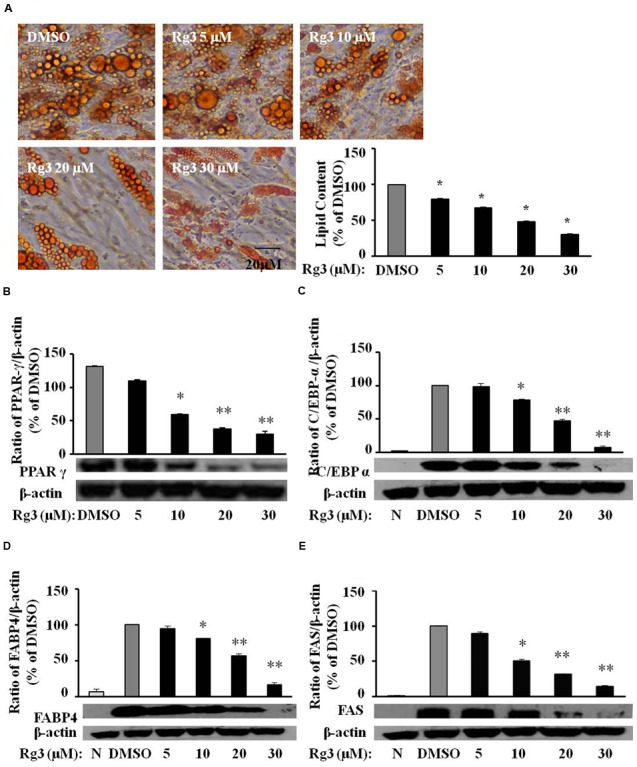
Red or black ginseng has been reported more powerful than white/fresh ginseng in dealing with various diseases/conditions including obesity. The major reason is that heating/steaming, the process of making red or black ginseng, produces large amount of bioactive compounds including ginsenoside Rg3 (Rg3), which are trace in fresh or white ginseng. In the present study, Rg3 was applied both in pre-adipocytes and obese mice to investigate the anti-adipogenic effects and relevant mechanisms. Our results show that Rg3 dose-dependently inhibited cell differentiation both in 3T3-L1 cells (30, 50, and 100 μM) and human primary pre-adipocytes (10, 20, and 30 μM). This inhibitory effect is accompanied by the attenuation of the expressions of adipogenic markers including peroxisome proliferator-activated receptor gamma (PPAR-γ), CCAAT/enhancer binding protein alpha (C/EBP-α), fatty acid synthase (FAS), fatty acid binding protein 4 (FABP4) and perilipin. Although dietary intake of Rg3 (0.1 mg Rg3/kg diet, 8 weeks) did not significantly affect body weight gain, fat pads and food intake as well as of PPAR-γ expression in fat tissues, we found that hepatic PPAR-γ and C/EBP-α protein expressions and hepatic glutathione reductase and glutathione -transferase, two major antioxidants molecules were significantly reduced by Rg3. These results suggest that ginsenoside Rg3 may be a potential agent in reducing/preventing obesity.
据报道,红参或黑参在应对包括肥胖症在内的各种疾病方面比白参/鲜参更有效。主要原因是制作红参或黑参的加热/蒸煮过程会产生大量生物活性化合物,包括人参皂苷Rg3(Rg3),而这些在鲜参或白参中含量极少。在本研究中,Rg3被应用于前脂肪细胞和肥胖小鼠,以研究其抗脂肪生成作用及相关机制。我们的结果表明,Rg3在3T3-L1细胞(30、50和100μM)和人原代前脂肪细胞(10、20和30μM)中均呈剂量依赖性地抑制细胞分化。这种抑制作用伴随着脂肪生成标志物表达的减弱,这些标志物包括过氧化物酶体增殖物激活受体γ(PPAR-γ)、CCAAT/增强子结合蛋白α(C/EBP-α)、脂肪酸合酶(FAS)、脂肪酸结合蛋白4(FABP4)和脂滴包被蛋白。尽管饮食中摄入Rg3(0.1mg Rg3/kg饮食,8周)对体重增加、脂肪垫、食物摄入量以及脂肪组织中PPAR-γ的表达没有显著影响,但我们发现Rg3显著降低了肝脏中PPAR-γ和C/EBP-α蛋白的表达以及肝脏中两种主要抗氧化分子谷胱甘肽还原酶和谷胱甘肽转移酶的表达。这些结果表明,人参皂苷Rg3可能是一种减少/预防肥胖症的潜在药物。