Nondo Ramadhani Selemani Omari, Moshi Mainen Julius, Erasto Paul, Masimba Pax Jessey, Machumi Francis, Kidukuli Abdul Waziri, Heydenreich Matthias, Zofou Denis
Department of Biological and Pre-Clinical Studies, Institute of Traditional Medicine, Muhimbili University of Health and Allied Sciences, P.O.Box 65001, Dar es Salaam, Tanzania.
National Institute for Medical Research, P.O.Box 9653, Dar es Salaam, Tanzania.
BMC Complement Altern Med. 2017 Mar 24;17(1):167. doi: 10.1186/s12906-017-1673-8.
Malaria is an old life-threatening parasitic disease that is still affecting many people, mainly children living in sub-Saharan Africa. Availability of effective antimalarial drugs played a significant role in the treatment and control of malaria. However, recent information on the emergence of P. falciparum parasites resistant to one of the artemisinin-based combination therapies suggests the need for discovery of new drug molecules. Therefore, this study aimed to evaluate the antiplasmodial activity of extracts, fractions and isolated compound from medicinal plants traditionally used in the treatment of malaria in Tanzania.
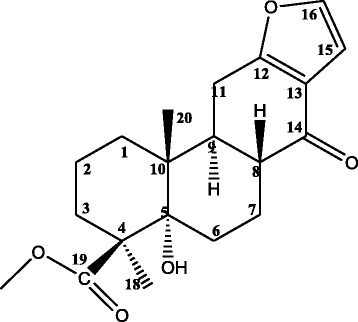
Dry powdered plant materials were extracted by cold macerations using different solvents. Norcaesalpin D was isolated by column chromatography from dichloromethane root extract of Caesalpinia bonducella and its structure was assigned based on the spectral data. Crude extracts, fractions and isolated compound were evaluated for antiplasmodial activity against chloroquine-sensitive P. falciparum (3D7), chloroquine-resistant P. falciparum (Dd2, K1) and artemisinin-resistant P. falciparum (IPC 5202 Battambang, IPC 4912 Mondolkiri) strains using the parasite lactate dehydrogenase assay.
The results indicated that extracts of Erythrina schliebenii, Holarrhena pubescens, Dissotis melleri and C. bonducella exhibited antiplasmodial activity against Dd2 parasites. Ethanolic root extract of E. schliebenii had an IC of 1.87 μg/mL while methanolic and ethanolic root extracts of H. pubescens exhibited an IC = 2.05 μg/mL and IC = 2.43 μg/mL, respectively. Fractions from H. pubescens and C. bonducella roots were found to be highly active against K1, Dd2 and artemisinin-resistant parasites. Norcaesalpin D from C. bonducella root extract was active with IC of 0.98, 1.85 and 2.13 μg/mL against 3D7, Dd2 and IPC 4912-Mondolkiri parasites, respectively.
Antiplasmodial activity of norcaesalpin D and extracts of E. schliebenii, H. pubescens, D. melleri and C. bonducella reported in this study requires further attention for the discovery of antimalarial lead compounds for future drug development.
疟疾是一种古老的威胁生命的寄生虫病,至今仍影响着许多人,主要是生活在撒哈拉以南非洲的儿童。有效的抗疟药物在疟疾的治疗和控制中发挥了重要作用。然而,最近有关恶性疟原虫对一种青蒿素联合疗法产生耐药性的信息表明,需要发现新的药物分子。因此,本研究旨在评估坦桑尼亚传统用于治疗疟疾的药用植物提取物、馏分和分离化合物的抗疟活性。
使用不同溶剂通过冷浸法提取干燥的植物粉末材料。从波叶云实的二氯甲烷根提取物中通过柱色谱法分离出降苏木精D,并根据光谱数据确定其结构。使用寄生虫乳酸脱氢酶测定法评估粗提取物、馏分和分离化合物对氯喹敏感的恶性疟原虫(3D7)、氯喹耐药的恶性疟原虫(Dd2、K1)和青蒿素耐药的恶性疟原虫(柬埔寨巴塔姆邦IPC 5202、柬埔寨蒙多基里IPC 4912)菌株的抗疟活性。
结果表明,刺桐、止泻木、美立 Dissotis 和波叶云实的提取物对 Dd2 寄生虫表现出抗疟活性。刺桐乙醇根提取物的IC50为1.87μg/mL,而止泻木的甲醇和乙醇根提取物的IC50分别为2.05μg/mL和2.43μg/mL。发现止泻木和波叶云实根的馏分对K1、Dd2和青蒿素耐药寄生虫具有高活性。波叶云实根提取物中的降苏木精D对3D7、Dd2和柬埔寨蒙多基里IPC 4912寄生虫的活性分别为IC50为0.98、1.85和2.13μg/mL。
本研究报道的降苏木精D以及刺桐、止泻木、美立 Dissotis 和波叶云实提取物的抗疟活性,需要进一步关注,以便发现用于未来药物开发的抗疟先导化合物。