Bortoluzzi Alessio, Amato Anastasia, Lucas Xavier, Blank Manuel, Ciulli Alessio
Division of Biological Chemistry and Drug Discovery, School of Life Sciences, University of Dundee, James Black Centre, Dow Street, Dundee DD1 5EH, U.K.
Biochem J. 2017 May 4;474(10):1633-1651. doi: 10.1042/BCJ20161053.
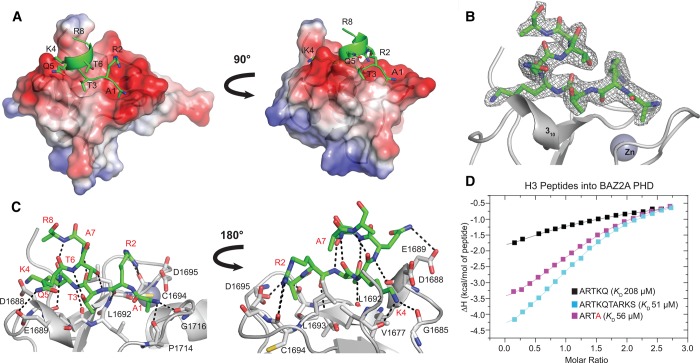
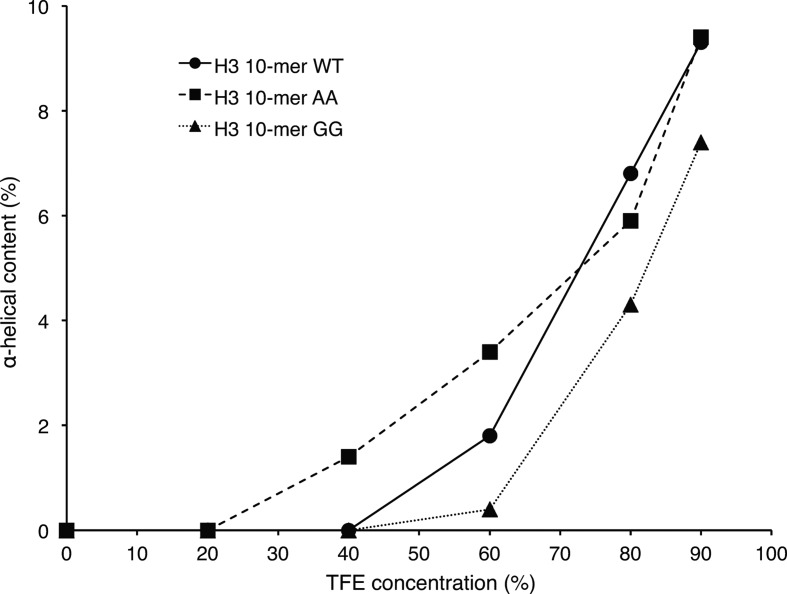
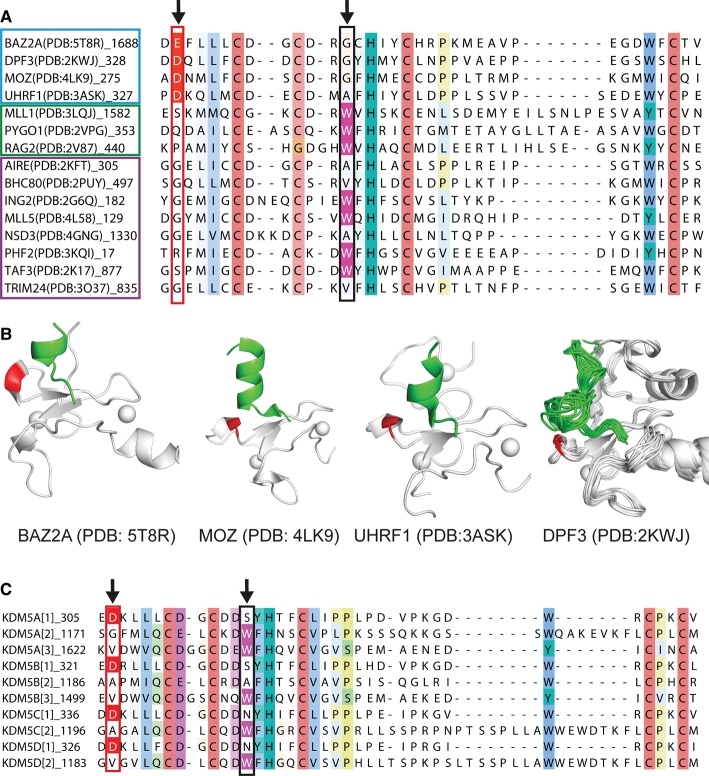
The plant homeodomain (PHD) fingers are among the largest family of epigenetic domains, first characterized as readers of methylated H3K4. Readout of histone post-translational modifications by PHDs has been the subject of intense investigation; however, less is known about the recognition of secondary structure features within the histone tail itself. We solved the crystal structure of the PHD finger of the bromodomain adjacent to zinc finger 2A [BAZ2A, also known as TIP5 (TTF-I/interacting protein 5)] in complex with unmodified N-terminal histone H3 tail. The peptide is bound in a helical folded-back conformation after K4, induced by an acidic patch on the protein surface that prevents peptide binding in an extended conformation. Structural bioinformatics analyses identify a conserved Asp/Glu residue that we name 'acidic wall', found to be mutually exclusive with the conserved Trp for K4Me recognition. Neutralization or inversion of the charges at the acidic wall patch in BAZ2A, and homologous BAZ2B, weakened H3 binding. We identify simple mutations on H3 that strikingly enhance or reduce binding, as a result of their stabilization or destabilization of H3 helicity. Our work unravels the structural basis for binding of the helical H3 tail by PHD fingers and suggests that molecular recognition of secondary structure motifs within histone tails could represent an additional layer of regulation in epigenetic processes.
植物同源异型结构域(PHD)指是最大的表观遗传结构域家族之一,最初被鉴定为甲基化H3K4的识别结构域。PHD对组蛋白翻译后修饰的识别一直是深入研究的主题;然而,对于组蛋白尾部自身二级结构特征的识别了解较少。我们解析了与未修饰的N端组蛋白H3尾部结合的锌指2A相邻的溴结构域(BAZ2A,也称为TIP5(TTF-I相互作用蛋白5))的PHD指的晶体结构。该肽在K4之后以螺旋回折构象结合,这是由蛋白质表面的一个酸性区域诱导的,该区域可防止肽以伸展构象结合。结构生物信息学分析确定了一个保守的Asp/Glu残基,我们将其命名为“酸性壁”,发现它与识别K4Me的保守色氨酸相互排斥。中和或反转BAZ2A以及同源的BAZ2B中酸性壁区域的电荷会削弱H3的结合。我们在H3上鉴定出简单的突变,这些突变由于稳定或破坏H3螺旋性而显著增强或降低结合。我们的工作揭示了PHD指结合螺旋H3尾部的结构基础,并表明对组蛋白尾部二级结构基序的分子识别可能代表表观遗传过程中的另一层调控。