Hägg David, Sundström Anders, Eriksson Marie, Schmitt-Egenolf Marcus
Dermatology, Department of Public Health and Clinical Medicine, Umea University, 901 85, Umeå, Sweden.
Centre for Pharmacoepidemiology (CPE), Karolinska Institutet, Karolinska University Hospital, T2, 171 76, Stockholm, Sweden.
Am J Clin Dermatol. 2017 Aug;18(4):583-590. doi: 10.1007/s40257-017-0274-0.
Psoriasis is a common skin disease and moderate to severe psoriasis is associated with a dose-dependent risk for metabolic and cardiovascular morbidity. It has previously been speculated that women have less severe psoriasis, as men are overrepresented in psoriasis registers and consume more care.
The objective of this study was to investigate, for the first time, the sex differences in the severity of psoriasis using the gold standard of severity measurement, the Psoriasis Area and Severity Index (PASI), and the distinct elements of the PASI score.
DESIGN, SETTING AND PARTICIPANTS: This was a cross-sectional study based on the national registry for systemic treatment of psoriasis in Sweden (PsoReg), with 5438 patients experiencing moderate to severe psoriasis. Differences in the PASI score and its elements at enrolment were tested by multivariable ordinal logistic regressions.
The different components of the PASI score were used to analyze the assessment of disease severity. For each body area (head, arms, trunk, and legs), the score of the plaque characteristics and degree of skin involvement were used as outcomes.
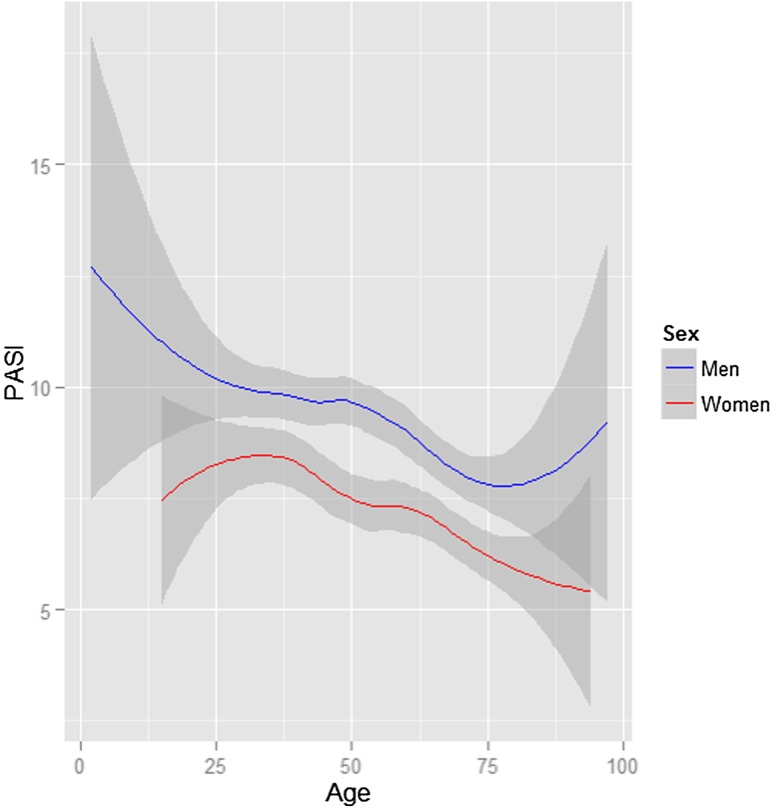
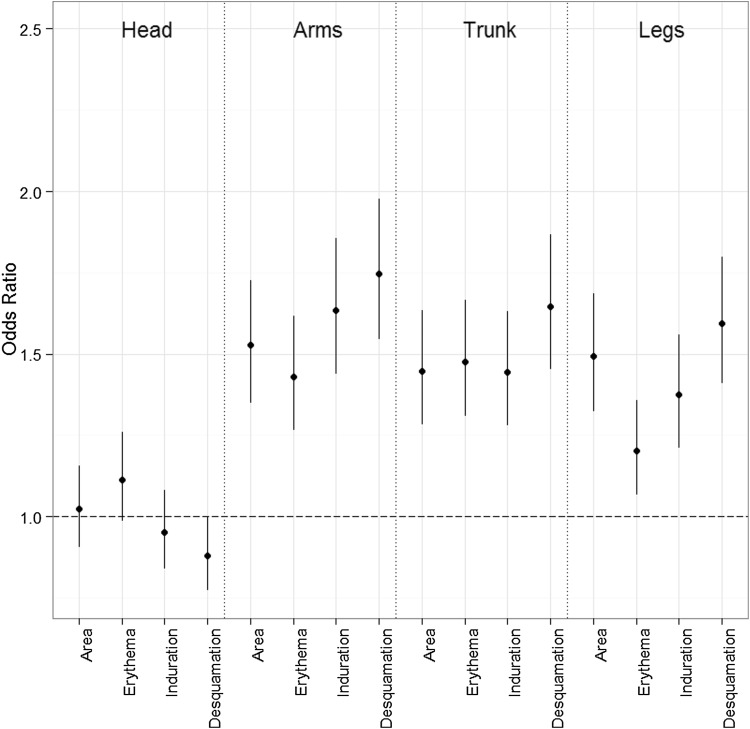
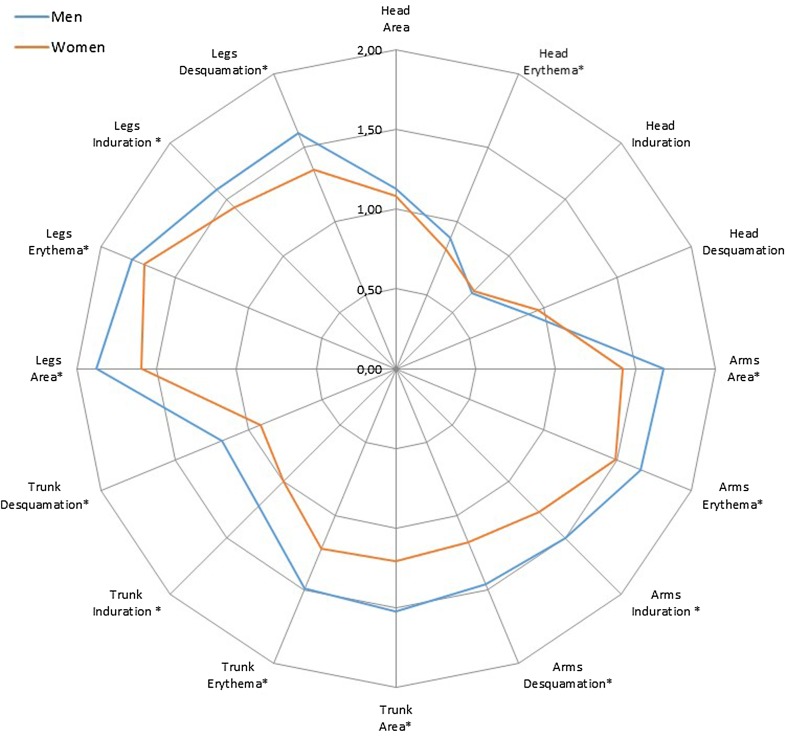
Women had statistically significantly lower median PASI scores (5.4) than men (7.3) [p < 0.001], which was consistent across all ages. The difference remained statistically significant in a multivariable linear regression. The itemized PASI analyses from the Mann-Whitney-Wilcoxon tests and the adjusted ordinal logistic regressions confirmed that women had significantly lower scores than men in all areas of the body, except for the head. No differences in the use of medications prior to enrolment could be found that may cause this difference between the sexes.
As the PsoReg contains the detailed disease measurement PASI, which was traditionally used for selected participants in clinical studies only, a nationwide unselected population could be investigated. The fact that women have less severe psoriasis can explain the dominance of males in the systemic treatment of psoriasis. These findings motivate a gender perspective in the management of psoriasis and in the prevention and management of its comorbidities.
银屑病是一种常见的皮肤病,中重度银屑病与代谢和心血管疾病的剂量依赖性风险相关。此前有人推测女性的银屑病病情较轻,因为在银屑病登记中男性占比过高且接受的治疗更多。
本研究的目的是首次使用严重程度测量的金标准——银屑病面积和严重程度指数(PASI)以及PASI评分的不同要素,来调查银屑病严重程度的性别差异。
设计、地点和参与者:这是一项基于瑞典全国银屑病系统治疗登记处(PsoReg)的横断面研究,有5438名中重度银屑病患者。通过多变量有序逻辑回归检验入组时PASI评分及其要素的差异。
使用PASI评分的不同组成部分来分析疾病严重程度的评估。对于每个身体部位(头部、手臂、躯干和腿部),将斑块特征评分和皮肤受累程度作为观察指标。
女性的PASI中位数得分(5.4)在统计学上显著低于男性(7.3)[p < 0.001],这在所有年龄段都是一致的。在多变量线性回归中,这种差异仍然具有统计学意义。曼-惠特尼-威尔科克森检验的分项PASI分析和调整后的有序逻辑回归证实,除头部外,女性在身体所有部位的得分均显著低于男性。在入组前的用药情况方面未发现可能导致这种性别差异的因素。
由于PsoReg包含详细的疾病测量指标PASI,而该指标传统上仅用于临床研究中的特定参与者,因此可以对全国范围内未经过筛选的人群进行调查。女性银屑病病情较轻这一事实可以解释在银屑病系统治疗中男性占主导地位的现象。这些发现促使在银屑病的管理及其合并症的预防和管理中考虑性别因素。