Geale Kirk, Henriksson Martin, Schmitt-Egenolf Marcus
Department of Public Health and Clinical Medicine, Dermatology, Umeå University, Umeå, Sweden.
PAREXEL International, Stockholm, Sweden.
Health Qual Life Outcomes. 2017 Jul 28;15(1):151. doi: 10.1186/s12955-017-0721-x.
Assessing the impact of disease severity on generic quality of life (QOL) is a critical step in outcomes research and in the development of decision-analytic models structured around health states defined by clinical measures. While data from routine clinical practice found in healthcare registers are increasingly used for research, more attention should be paid to understanding the relationship between clinical measures of disease severity and QOL. The purpose of this work was therefore to investigate this relationship in psoriasis using a population-based dataset.
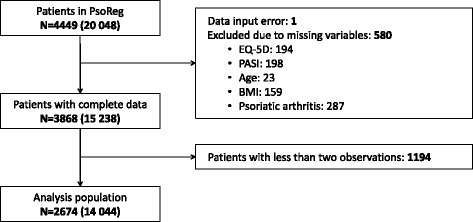
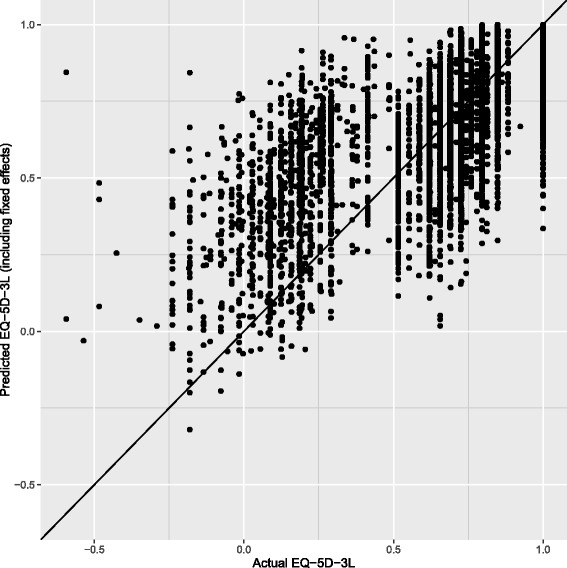
Severity was measured by the Psoriasis Area and Severity Index (PASI), which combines severity of erythema, induration, and desquamation into a single value ranging from 0 to 72. The generic EQ-5D-3L utility instrument, under the UK tariff, was used to measure QOL. The association between PASI and EQ-5D-3L was estimated using a population-based dataset of 2674 patients with moderate to severe psoriasis enrolled over ten years in the Swedish psoriasis register (PsoReg). Given the repeated measurement of patients in the register data, a longitudinal fixed-effects model was employed to control for unobserved patient-level heterogeneity.
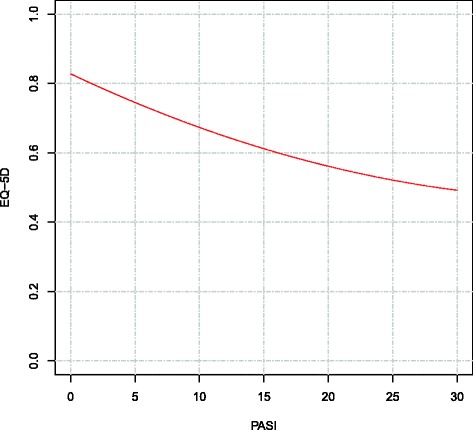
Marginal changes in PASI are associated with a non-linear response in EQ-5D-3L: Moving from PASI 10 to 9 (1 to 0) is associated with an increase of 0.0135 (0.0174) in EQ-5D-3L. Furthermore, unobserved patient-level heterogeneity appears to be an important source of confounding when estimating the relationship between QOL and PASI.
Using register data to estimate the impact of disease severity on QOL while controlling for unobserved patient-level heterogeneity shows that PASI appears to have a larger impact on QOL than previously estimated. Routine collection of generic QOL data in registers should be encouraged to enable similar applications in other disease areas.
Not applicable.
评估疾病严重程度对一般生活质量(QOL)的影响是结果研究以及围绕由临床指标定义的健康状态构建的决策分析模型开发中的关键步骤。虽然越来越多地使用医疗保健登记册中常规临床实践的数据进行研究,但应更加关注理解疾病严重程度的临床指标与生活质量之间的关系。因此,这项工作的目的是使用基于人群的数据集来研究银屑病中的这种关系。
严重程度通过银屑病面积和严重程度指数(PASI)进行测量,该指数将红斑、硬结和脱屑的严重程度合并为一个从0到72的单一值。使用英国关税下的通用EQ-5D-3L效用工具来测量生活质量。使用瑞典银屑病登记册(PsoReg)中在十年内登记的2674例中度至重度银屑病患者的基于人群的数据集,估计PASI与EQ-5D-3L之间的关联。鉴于登记数据中患者的重复测量,采用纵向固定效应模型来控制未观察到的患者水平异质性。
PASI的边际变化与EQ-5D-3L中的非线性反应相关:从PASI 10降至9(从1降至0)与EQ-5D-3L增加0.0135(0.0174)相关。此外,在估计生活质量与PASI之间的关系时,未观察到的患者水平异质性似乎是一个重要的混杂来源。
使用登记数据估计疾病严重程度对生活质量的影响,同时控制未观察到的患者水平异质性,结果表明PASI对生活质量的影响似乎比先前估计的更大。应鼓励在登记册中常规收集一般生活质量数据,以便在其他疾病领域进行类似应用。
不适用。