
NiCr和NiCrSi单层及双层纳米级薄膜电阻器的物理和电学性能研究进展
Developments of the Physical and Electrical Properties of NiCr and NiCrSi Single-Layer and Bi-Layer Nano-Scale Thin-Film Resistors.
作者信息
Cheng Huan-Yi, Chen Ying-Chung, Li Chi-Lun, Li Pei-Jou, Houng Mau-Phon, Yang Cheng-Fu
机构信息
Department of Electrical Engineering, National Sun Yat-sen University, Kaohsiung 804, Taiwan.
Institute of Microelectronics, National Cheng-Kung University, No.1, University Road, Tainan City 701, Taiwan.
出版信息
Nanomaterials (Basel). 2016 Feb 25;6(3):39. doi: 10.3390/nano6030039.
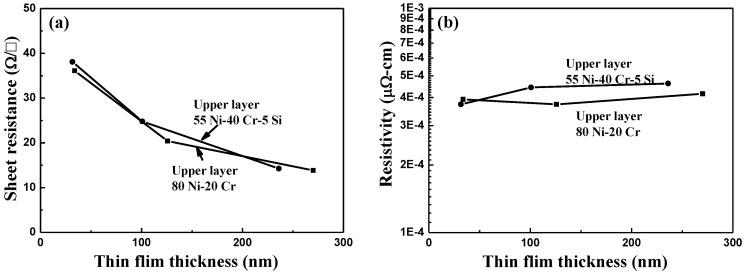
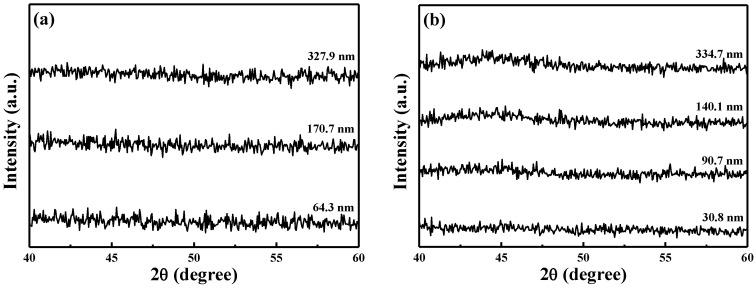
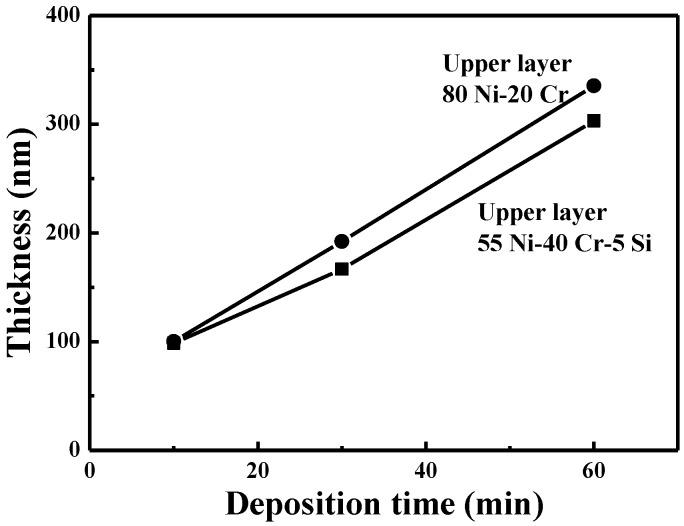
In this study, commercial-grade NiCr (80 wt % Ni, 20 wt % Cr) and NiCrSi (55 wt % Ni, 40 wt % Cr, 5 wt % Si) were used as targets and the sputtering method was used to deposit NiCr and NiCrSi thin films on Al₂O₃ and Si substrates at room temperature under different deposition time. X-ray diffraction patterns showed that the NiCr and NiCrSi thin films were amorphous phase, and the field-effect scanning electronic microscope observations showed that only nano-crystalline grains were revealed on the surfaces of the NiCr and NiCrSi thin films. The log (resistivity) values of the NiCr and NiCrSi thin-film resistors decreased approximately linearly as their thicknesses increased. We found that the value of temperature coefficient of resistance (TCR value) of the NiCr thin-film resistors was positive and that of the NiCrSi thin-film resistors was negative. To investigate these thin-film resistors with a low TCR value, we designed a novel bi-layer structure to fabricate the thin-film resistors via two different stacking methods. The bi-layer structures were created by depositing NiCr for 10 min as the upper (or lower) layer and depositing NiCrSi for 10, 30, or 60 min as the lower (or upper) layer. We aim to show that the stacking method had no apparent effect on the resistivity of the NiCr-NiCrSi bi-layer thin-film resistors but had large effect on the TCR value.
在本研究中,使用商业级的NiCr(80 wt% Ni,20 wt% Cr)和NiCrSi(55 wt% Ni,40 wt% Cr,5 wt% Si)作为靶材,采用溅射法在室温下于不同沉积时间在Al₂O₃和Si衬底上沉积NiCr和NiCrSi薄膜。X射线衍射图谱表明,NiCr和NiCrSi薄膜为非晶相,场效应扫描电子显微镜观察显示,在NiCr和NiCrSi薄膜表面仅发现纳米晶粒。NiCr和NiCrSi薄膜电阻器的log(电阻率)值随其厚度增加大致呈线性下降。我们发现,NiCr薄膜电阻器的电阻温度系数(TCR值)为正,而NiCrSi薄膜电阻器的为负。为了研究这些具有低TCR值的薄膜电阻器,我们设计了一种新颖的双层结构,通过两种不同的堆叠方法来制造薄膜电阻器。双层结构是通过将NiCr沉积10分钟作为上层(或下层),并将NiCrSi沉积10、30或60分钟作为下层(或上层)而形成的。我们旨在表明,堆叠方法对NiCr - NiCrSi双层薄膜电阻器的电阻率没有明显影响,但对TCR值有很大影响。


 Zotero 插件