Pant Hira B, Bandyopadhyay Souvik, John Neena, Chandran Anil, Gudlavalleti Murthy Venkata S
Indian Institute of Public Health, Public Health Foundation of India, Hyderabad, Telangana, India.
Department of Demography, University of Kerala, Thiruvananthapuram, Kerala, India.
Indian J Ophthalmol. 2017 Feb;65(2):160-164. doi: 10.4103/ijo.IJO_28_15.
Women suffer disproportionately more from cataract blindness compared to males in low- and middle-income countries. Two large population-based surveys have been undertaken in India at an interval of 7 years and data from these surveys provided an opportunity to assess the trends in gender differentials in cataract blindness.
Data were extracted from the surveys to discern sex differences in cataract blindness. Multivariate analysis was performed to adjust for confounders and their impact on gender differences in cataract blindness. Blindness was defined as presenting vision <20/400 in the better eye, and a cataract blind person was defined as a blind person where the principal cause of loss of vision was cataract.
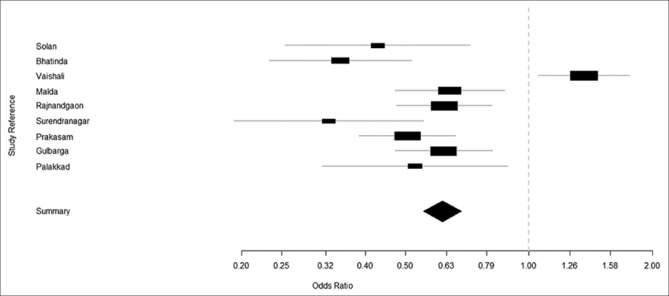
Prevalence of cataract blindness was higher in females compared to males in both surveys. The odds of cataract blindness for females did not change over time as observed in the surveys (1999-2001 and 2006-2007). Adjusted odds ratio from logistic regression analysis revealed that females continued to be at a higher risk of cataract blindness.
Sex differences continued in India in relation to cataract blindness despite the gains made by the national program.
在低收入和中等收入国家,女性患白内障致盲的比例高于男性。印度每隔7年进行了两项大规模的基于人群的调查,这些调查数据提供了评估白内障致盲性别差异趋势的机会。
从调查中提取数据以辨别白内障致盲的性别差异。进行多变量分析以调整混杂因素及其对白内障致盲性别差异的影响。失明定义为较好眼的视力<20/400,白内障盲人定义为视力丧失的主要原因是白内障的盲人。
在两项调查中,女性白内障致盲的患病率均高于男性。如调查(1999 - 2001年和2006 - 2007年)所示,女性患白内障致盲的几率并未随时间变化。逻辑回归分析的调整优势比显示,女性患白内障致盲的风险仍然较高。
尽管国家项目取得了进展,但印度在白内障致盲方面的性别差异依然存在。