Olivas-Quintero Sandra, López-Angulo Gabriela, Montes-Avila Julio, Díaz-Camacho Sylvia Páz, Vega-Aviña Rito, López-Valenzuela José Ángel, Salazar-Salas Nancy Yareli, Delgado-Vargas Francisco
a School of Chemical and Biological Sciences, Autonomous University of Sinaloa , Culiacan , Sinaloa , Mexico.
b School of Agronomy, Autonomous University of Sinaloa , Culiacan , Sinaloa , Mexico.
Pharm Biol. 2017 Dec;55(1):1473-1482. doi: 10.1080/13880209.2017.1306712.
Helicteres vegae Cristóbal (Sterculiaceae) (Hv) and Heliopsis sinaloensis B.L. Turner (Asteraceae) (Hs) are endangered and poorly studied plant species; related plants have been used against chronic-degenerative and infectious diseases. Therefore, Hv and Hs could be sources of bioactive compounds against these illnesses.
To determine the chemical composition and biological activities (antioxidant, antimutagenic and antimicrobial) of Hv and Hs leaves (L) and stems (S).
Methanol extracts (ME) of each plant/tissue were evaluated for their phytochemicals; phenolics (HPLC-DAD-ESI-MS); antioxidant activity (AA) (0.125-4 mg/mL) (DPPH, ABTS, ORAC and β-carotene discoloration); antimutagenicity (0.5 and 1 mg/plate) (Ames assay, tester strain Salmonella enterica serovar Typhimurium YG1024, 1-nitropyrene as mutagen); activity against human pathogens (1 mg/mL); and toxicity (0.01-2 mg/mL) (Artemia salina assay).
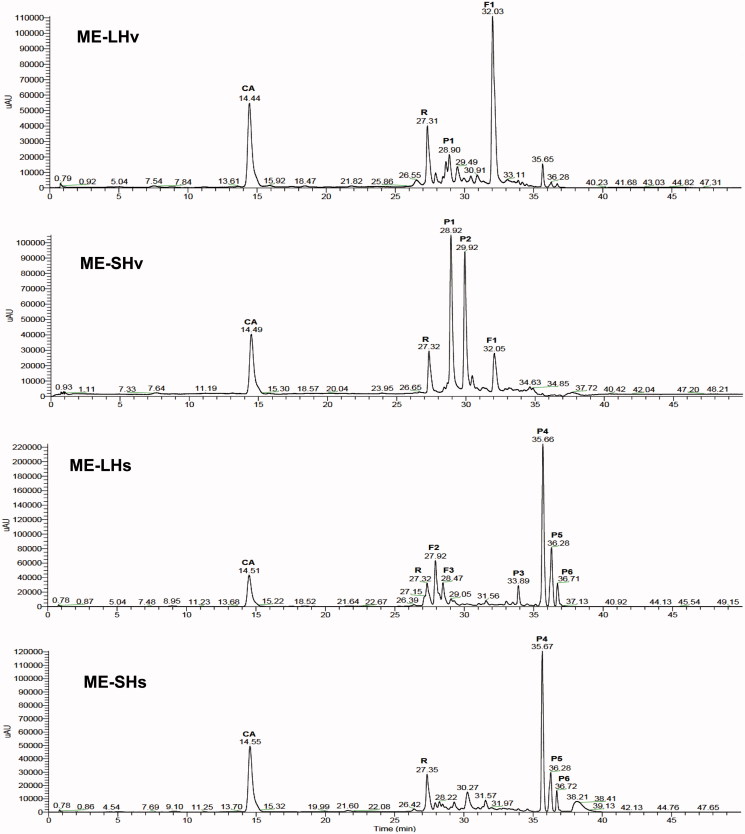
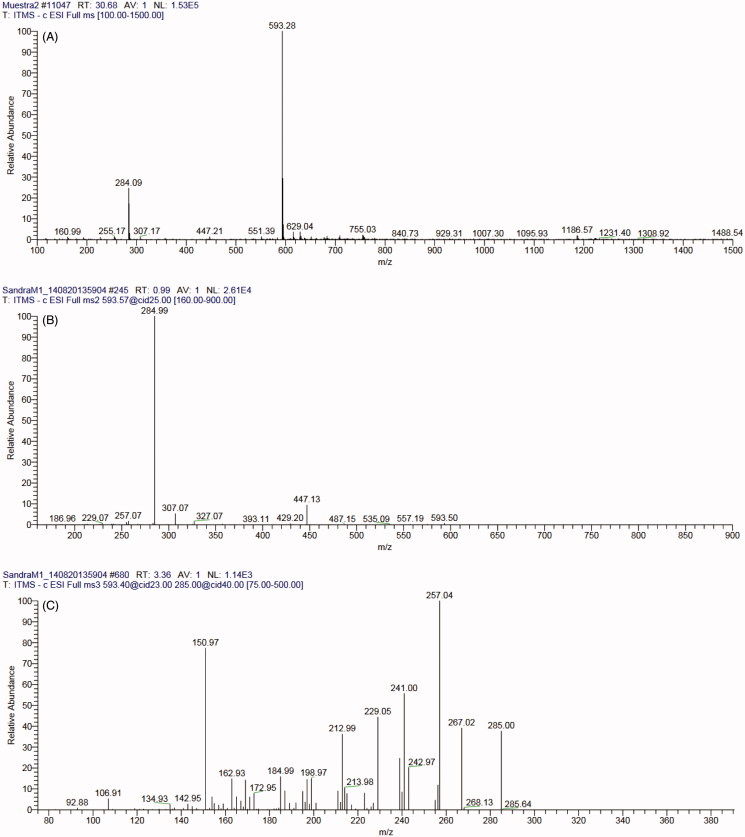
All ME showed flavonoids and triterpenes/steroids. The ME-SHv had the highest content of total phenolics (TP) (2245.82 ± 21.45 mg GAE/100 g d.w.) and condensed tannins (603.71 ± 1.115 mg CE/100 g d.w.). The compounds identified were flavonoids (kaempferol 7-O-coumaroylhexoside, and two kaempferol 7-O-rhamnosylhexosides) and phenolics [rosmarinic acid, and 3'-O-(8″-Z-caffeoyl) rosmarinic acid]. The ME-LHs showed the highest content of flavonoids (357.88 mg RE/g d.w.) and phenolic acids (238.58 mg CAE/g d.w.) by HPLC. The ME-SHv showed the highest AA. All ME were strong antimutagens (63.3-85.7%). Only the Hs extracts were toxic (ME-LHs, LC = 94.9 ± 1.7 μg/mL; ME-SHs, LC = 89.03 ± 4.42 μg/mL).
Both Hv and Hs are potential sources of preventive and therapeutic agents against chronic-degenerative diseases.
绒毛山芝麻(梧桐科)(Hv)和锡那罗亚向日葵(菊科)(Hs)是濒危且研究较少的植物物种;相关植物已被用于对抗慢性退行性疾病和传染病。因此,Hv和Hs可能是针对这些疾病的生物活性化合物的来源。
确定Hv和Hs的叶(L)和茎(S)的化学成分及生物活性(抗氧化、抗诱变和抗菌)。
评估每种植物/组织的甲醇提取物(ME)的植物化学物质;酚类物质(高效液相色谱-二极管阵列-电喷雾电离质谱);抗氧化活性(AA)(0.125 - 4mg/mL)(二苯基苦味酰基自由基法、2,2'-联氮-双-3-乙基苯并噻唑啉-6-磺酸法、氧自由基吸收能力法和β-胡萝卜素褪色法);抗诱变性(0.5和1mg/平板)(艾姆斯试验,测试菌株鼠伤寒沙门氏菌血清型鼠伤寒沙门氏菌YG1024,以1-硝基芘作为诱变剂);对人类病原体的活性(1mg/mL);以及毒性(0.01 - 2mg/mL)(卤虫试验)。
所有ME均显示含有黄酮类化合物和三萜类/甾体类化合物。Hv茎的ME总酚含量最高(2245.82±21.45mg没食子酸当量/100g干重),缩合单宁含量最高(603.71±1.115mg儿茶素当量/100g干重)。鉴定出的化合物为黄酮类化合物(山奈酚7-O-香豆酰己糖苷和两种山奈酚7-O-鼠李糖基己糖苷)和酚类物质[迷迭香酸和3'-O-(8''-Z-咖啡酰)迷迭香酸]。通过高效液相色谱法,Hs叶的ME黄酮类化合物含量最高(357.88mg芦丁当量/g干重),酚酸含量最高(238.58mg咖啡酸当量/g干重)。Hv茎的ME抗氧化活性最高。所有ME均为强抗诱变剂(63.3 - 85.7%)。只有Hs提取物具有毒性(Hs叶的ME,半数致死浓度=94.9±1.7μg/mL;Hs茎的ME,半数致死浓度=89.03±4.42μg/mL)。
Hv和Hs都是对抗慢性退行性疾病的预防和治疗药物的潜在来源。