Makhafola Tshepiso Jan, Elgorashi Esameldin Elzein, McGaw Lyndy Joy, Awouafack Maurice Ducret, Verschaeve Luc, Eloff Jacobus Nicolaas
Phytomedicine Programme, Department of Paraclinical Sciences, Faculty of Veterinary Science, University of Pretoria, Private Bag X04, Onderstepoort, 0110, South Africa.
Toxicology and Ethnoveterinary Medicine, Food, Feed and Veterinary Public Health, ARC-Onderstepoort Veterinary Institute, Private Bag X05, Onderstepoort, 0110, South Africa.
BMC Complement Altern Med. 2017 Sep 6;17(1):446. doi: 10.1186/s12906-017-1935-5.
Mutations play a major role in the pathogenesis and development of several chronic degenerative diseases including cancer. It follows, therefore that antimutagenic compound may inhibit the pathological process resulting from exposure to mutagens. Investigation of the antimutagenic potential of traditional medicinal plants and compounds isolated from plant extracts provides one of the tools that can be used to identify compounds with potential cancer chemopreventive properties. The aim of this study was to isolate and characterise the compounds responsible for the antimutagenic activity of Combretum microphyllum.
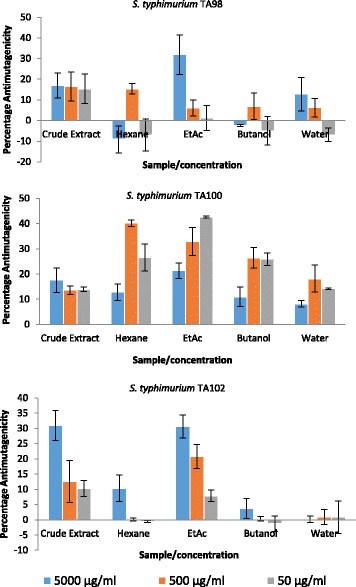
The methanol leaf extract of C. microphyllum was evaluated for antimutagenicity in the Ames/microsome assay using Salmonella typhimurium TA98. TA100 and TA102. Solvent-solvent fractionation was used to partition the extracts and by using bioassay-guided fractionation, three compounds were isolated. The antimutagenic activity of the three compounds were determined in the Ames test using Salmonella typhimurium TA98, TA100 and TA102. The antioxidant activity of the three compounds were determined by the quantitative 2,2-diphenyl-1-picrylhydrazyl (DPPH)-free radical scavenging method. The cytotoxicity was determined in the MTT assay using human hepatocytes.
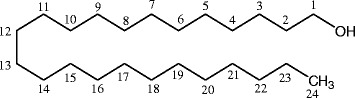
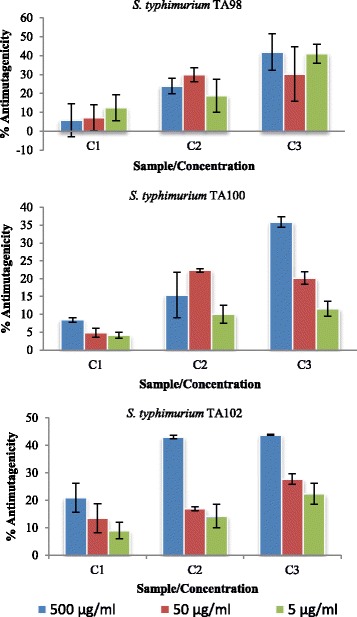
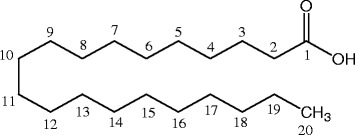
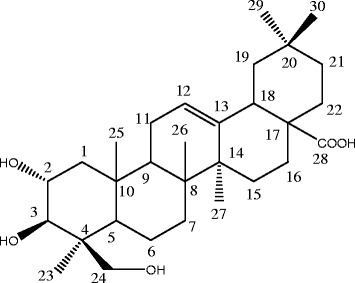
A bioassay-guided fractionation of the crude extracts for antimutagenic activity led to the isolation of three compounds; n-tetracosanol, eicosanoic acid and arjunolic acid. Arjunolic acid was the most active in all three tested strains with a antimutagenicity of 42 ± 9.6%, 36 ± 1.5% and 44 ± 0.18% in S. typhimurium TA98, TA100 and TA102 respectively at the highest concentration (500 μg/ml) tested, followed by eicosanoic acid and n-tetracosanol. The antioxidant activity of the compounds were determined using the quantitative 2,2 diphenyl-1-picryhydrazyl (DPPH)-free radical scavenging method. Only arjunolic acid had pronounced antioxidant activity (measured as DPPH-free scavenging activity) with an EC value of 0.51 μg/ml. The cytotoxicity of the isolated compounds were determined in the MTT assay using human hepatocytes. The compounds had low cytotoxicity at the highest concentration tested with LC values >200 μg/ml for n-tetracosanol and eicosanoic acid and 106.39 μg/ml for arjunolic acid.
Based on findings from this study, compounds in leaf extracts of C. microphyllum protected against 4-NQO and MMC induced mutations as evident in the Ames test. The antimutagenic activity of arjunolic acid may, at least in part, be attributed to its antioxidant activity resulting in the detoxification of reactive oxygen species produced during mutagenesis.
突变在包括癌症在内的多种慢性退行性疾病的发病机制和发展过程中起着重要作用。因此,抗诱变化合物可能会抑制因接触诱变剂而导致的病理过程。对传统药用植物及其从植物提取物中分离出的化合物的抗诱变潜力进行研究,为鉴定具有潜在癌症化学预防特性的化合物提供了一种工具。本研究的目的是分离并鉴定负责小叶风车子抗诱变活性的化合物。
使用鼠伤寒沙门氏菌TA98、TA100和TA102,通过艾姆斯/微粒体试验评估小叶风车子的甲醇叶提取物的抗诱变性。采用溶剂-溶剂分级分离法对提取物进行分离,并通过生物测定导向分级分离法分离出三种化合物。使用鼠伤寒沙门氏菌TA98、TA100和TA102在艾姆斯试验中测定这三种化合物的抗诱变活性。采用定量2,2-二苯基-1-苦基肼基(DPPH)自由基清除法测定这三种化合物的抗氧化活性。使用人肝细胞通过MTT试验测定细胞毒性。
对粗提物进行抗诱变活性的生物测定导向分级分离,得到三种化合物;正二十四醇、二十烷酸和arjunolic酸。在所有三种测试菌株中,arjunolic酸活性最高,在最高测试浓度(500μg/ml)下,鼠伤寒沙门氏菌TA98、TA100和TA102中的抗诱变率分别为42±9.6%、36±1.5%和44±0.18%,其次是二十烷酸和正二十四醇。使用定量2,2-二苯基-1-苦基肼基(DPPH)自由基清除法测定化合物的抗氧化活性。只有arjunolic酸具有显著的抗氧化活性(以DPPH自由基清除活性衡量),EC值为0.51μg/ml。使用人肝细胞通过MTT试验测定分离化合物的细胞毒性。在最高测试浓度下,这些化合物的细胞毒性较低,正二十四醇和二十烷酸的LC值>200μg/ml,arjunolic酸的LC值为106.39μg/ml。
基于本研究的结果,小叶风车子叶提取物中的化合物在艾姆斯试验中对4-硝基喹啉氧化物和丝裂霉素C诱导的突变具有保护作用。arjunolic酸的抗诱变活性可能至少部分归因于其抗氧化活性,从而导致诱变过程中产生的活性氧解毒。