Wei Kejin, Liu Hongwei, Ma Haiqiang, Yang Xiuqing, Zhang Yong, Sun Yongmei, Xiao Jinghua, Ji Yuefeng
School of Science and State Key Laboratory of Information Photonics and Optical Communications, Beijing University of Posts and Telecommunications, Beijing, 100876, China.
Guangxi Key Laboratory for Relativistic Astrophysics, School of Physics Science and Technology, Guangxi University, Nanning, 530004, China.
Sci Rep. 2017 Mar 27;7(1):449. doi: 10.1038/s41598-017-00531-y.
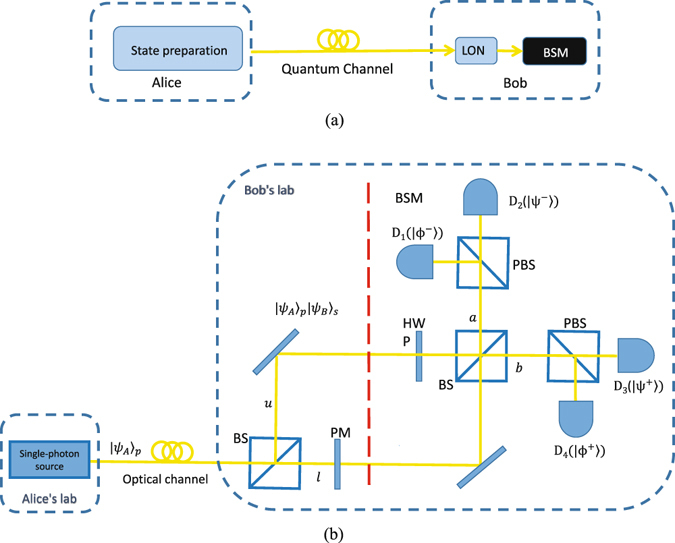
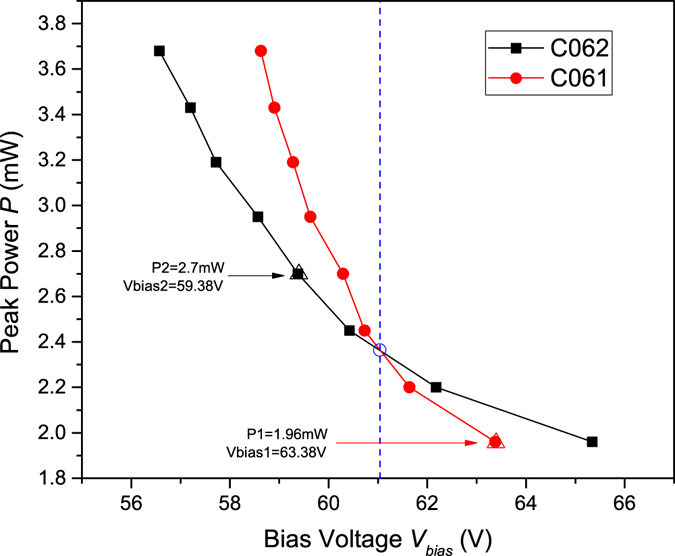
Recently, to bridge the gap between security of Measurement-device-independent quantum key distribution (MDI-QKD) and a high key rate, a novel protocol, the so-called detector-device-independent QKD (DDI-QKD), has been independently proposed by several groups and has attracted great interest. A higher key rate is obtained, since a single photon bell state measurement (BSM) setup is applied to DDI-QKD. Subsequently, Qi has proposed two attacks for this protocol. However, the first attack, in which Bob's BSM setup is assumed to be completely a "black box", is easily prevented by using some additional monitoring devices or by specifically characterizing the BSM. The second attack, which combines the blinding attack and the detector wavelength-dependent efficiency, is not explicitly discussed, and its feasibility is not experimentally confirmed. Here, we show that the second attack is not technically viable because of an intrinsically wavelength-dependent property of a realistic beam splitter, which is an essential component in DDI-QKD. Moreover, we propose a feasible attack that combines a well-known attack-detector blinding attack with intrinsic imperfections of single-photon detectors. The experimental measurement and proof-of-principle test results confirm that our attack can allow Eve to get a copy of quantum keys without being detected and that it is feasible with current technology.
最近,为了弥合测量设备无关量子密钥分发(MDI-QKD)的安全性与高密钥率之间的差距,几个研究小组独立提出了一种新颖的协议,即所谓的探测器设备无关量子密钥分发(DDI-QKD),并引起了极大的关注。由于将单光子贝尔态测量(BSM)装置应用于DDI-QKD,因此获得了更高的密钥率。随后,Qi针对该协议提出了两种攻击方法。然而,第一种攻击方法,即假设鲍勃的BSM装置完全是一个“黑匣子”,通过使用一些额外的监测设备或通过专门表征BSM,很容易被防范。第二种攻击方法,它结合了致盲攻击和探测器波长相关效率,没有得到明确讨论,其可行性也没有经过实验证实。在这里,我们表明,由于现实分束器的固有波长相关特性,第二种攻击在技术上不可行,而分束器是DDI-QKD中的一个关键组件。此外,我们提出了一种可行的攻击方法,它将一种著名的攻击——探测器致盲攻击与单光子探测器的固有缺陷结合起来。实验测量和原理验证测试结果证实,我们的攻击可以让伊芙在不被察觉的情况下获得量子密钥的副本,并且在当前技术下是可行的。