Kao Carol, Szymczak Wendy, Munjal Iona
Department of Pediatrics, Montefiore Medical Center, Albert Einstein College of Medicine , 111 E 210th St, Bronx, NY 10467 , USA.
Department of Pathology, Montefiore Medical Center, Albert Einstein College of Medicine , 111 E 210th St, Bronx, NY 10467 , USA.
JMM Case Rep. 2017 Feb 28;4(2):e005086. doi: 10.1099/jmmcr.0.005086. eCollection 2017 Feb.
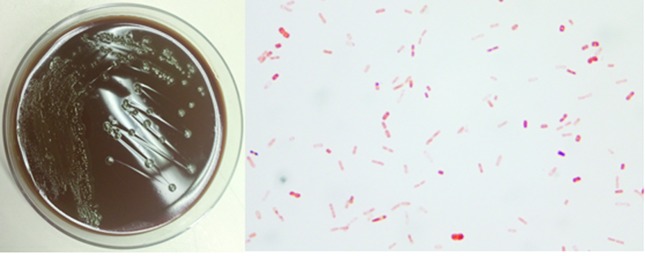
is an unusual organism to be isolated from cerebral spinal fluid (CSF) and there exists only one case report of meningitis from a neonate. species normally exist as part of the human upper respiratory tract flora and rarely cause invasive human disease. There are only a handful of case reports implicating the organism as a cause of endocarditis, bacteraemia, septic arthritis and endophthalmitis. Identification to the species level based on routine laboratory techniques has been challenging, with final identification often made through 16S rRNA sequencing. With the use of a newer diagnostic tool, matrix-assisted laser desorption ionization-time of flight (MALDI-TOF) MS, we were able to rapidly identify the organism and initiate appropriate treatment. We present a rare care of meningitis in a paediatric patient with an underlying cranial anatomical defect due to Crouzon syndrome. She had been admitted to hospital 3 months previously with meningitis and mastoiditis, and returned to the emergency department with meningismus. CSF culture grew . She was treated with ceftriaxone with rapid improvement and eventually was taken for endoscopic surgical repair of a right encephalocele defect. The use of MALDI-TOF MS allowed for the rapid identification of the organism. The patient recovered with appropriate antimicrobial therapy and eventual surgical correction. An underlying anatomical defect should be considered in all patients who present with meningitis due to this unusual organism.
是一种罕见的可从脑脊液(CSF)中分离出的微生物,仅有一例新生儿脑膜炎的病例报告。该菌种通常作为人类上呼吸道菌群的一部分存在,很少引起人类侵袭性疾病。仅有少数病例报告表明该微生物可导致心内膜炎、菌血症、化脓性关节炎和眼内炎。基于常规实验室技术将其鉴定到种水平具有挑战性,最终鉴定通常通过16S rRNA测序完成。通过使用一种更新的诊断工具——基质辅助激光解吸电离飞行时间(MALDI-TOF)质谱仪,我们能够快速鉴定该微生物并启动适当治疗。我们报告一例患有因克鲁宗综合征导致的潜在颅骨解剖缺陷的儿科患者发生的罕见脑膜炎病例。她3个月前因脑膜炎和乳突炎入院,此次因脑膜刺激征返回急诊科。脑脊液培养分离出该菌。她接受头孢曲松治疗后迅速好转,最终接受了右侧脑膨出缺损的内镜手术修复。MALDI-TOF质谱仪的使用使得能够快速鉴定该微生物。患者通过适当的抗菌治疗和最终的手术矫正得以康复。对于所有因这种罕见微生物导致脑膜炎的患者,都应考虑潜在的解剖缺陷。