Lee Chang-Ro, Lee Jung Hun, Park Moonhee, Park Kwang Seung, Bae Il Kwon, Kim Young Bae, Cha Chang-Jun, Jeong Byeong Chul, Lee Sang Hee
National Leading Research Laboratory of Drug Resistance Proteomics, Department of Biological Sciences, Myongji University Yongin, South Korea.
National Leading Research Laboratory of Drug Resistance Proteomics, Department of Biological Sciences, Myongji UniversityYongin, South Korea; DNA Analysis Division, Seoul Institute, National Forensic ServiceSeoul, South Korea.
Front Cell Infect Microbiol. 2017 Mar 13;7:55. doi: 10.3389/fcimb.2017.00055. eCollection 2017.
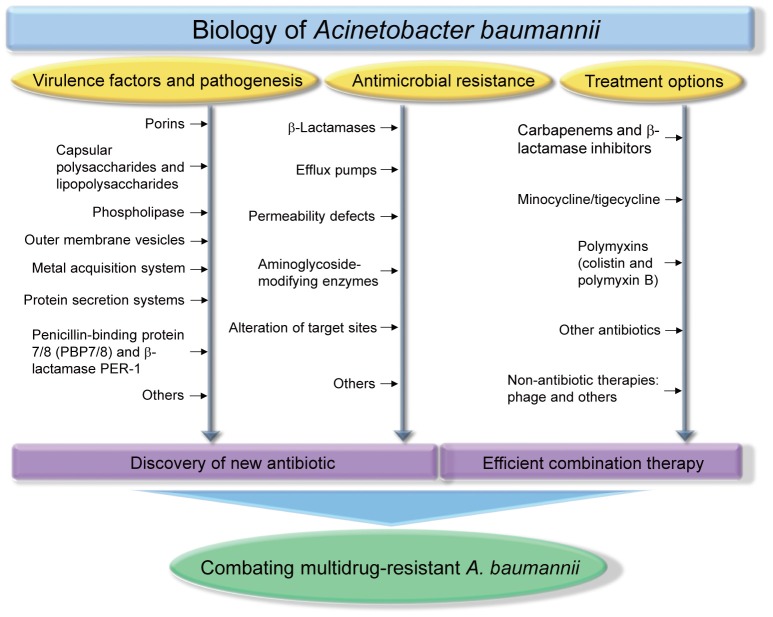
is undoubtedly one of the most successful pathogens responsible for hospital-acquired nosocomial infections in the modern healthcare system. Due to the prevalence of infections and outbreaks caused by multi-drug resistant , few antibiotics are effective for treating infections caused by this pathogen. To overcome this problem, knowledge of the pathogenesis and antibiotic resistance mechanisms of is important. In this review, we summarize current studies on the virulence factors that contribute to pathogenesis, including porins, capsular polysaccharides, lipopolysaccharides, phospholipases, outer membrane vesicles, metal acquisition systems, and protein secretion systems. Mechanisms of antibiotic resistance of this organism, including acquirement of β-lactamases, up-regulation of multidrug efflux pumps, modification of aminoglycosides, permeability defects, and alteration of target sites, are also discussed. Lastly, novel prospective treatment options for infections caused by multi-drug resistant are summarized.
无疑是现代医疗系统中导致医院获得性(医院内)感染的最成功病原体之一。由于多重耐药菌引起的感染和暴发很普遍,很少有抗生素能有效治疗由这种病原体引起的感染。为克服这一问题,了解该病原体的发病机制和抗生素耐药机制很重要。在本综述中,我们总结了目前关于导致该病原体发病的毒力因子的研究,包括孔蛋白、荚膜多糖、脂多糖、磷脂酶、外膜囊泡、金属获取系统和蛋白质分泌系统。还讨论了该病原体的抗生素耐药机制,包括β-内酰胺酶的获得、多药外排泵的上调、氨基糖苷类的修饰、通透性缺陷和靶位点的改变。最后,总结了针对多重耐药菌引起的感染的新型潜在治疗选择。