Lim Jongil, Chang Seung Ho, Lee Jihyun, Kim Kijeong
Department of Kinesiology, University of Massachusetts, Amherst, MA, USA.
Department of Kinesiology, San Jose State University, San Jose, CA, USA.
J Exerc Rehabil. 2017 Feb 28;13(1):48-54. doi: 10.12965/jer.1732920.460. eCollection 2017 Feb.
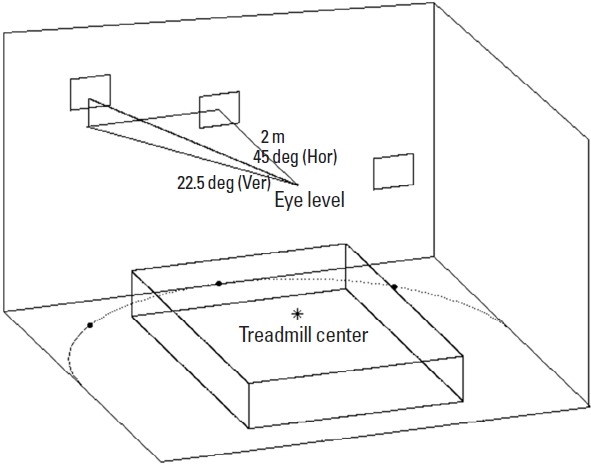
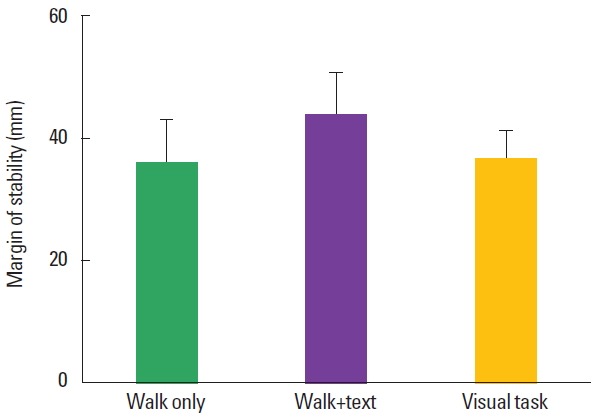
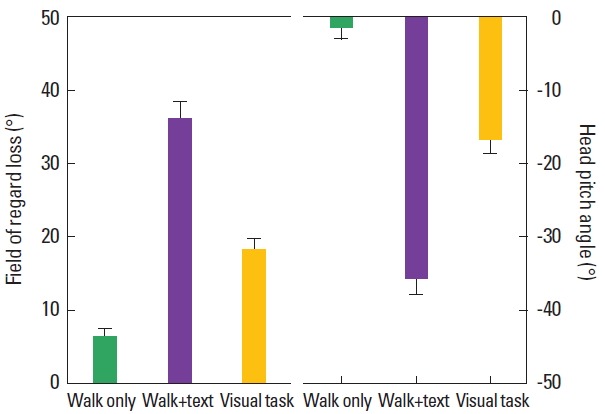
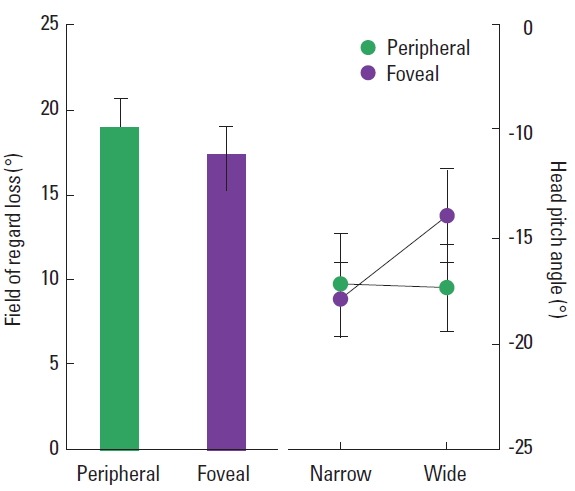
Mobile phone use while walking can cause dual-task interference and increases safety risks by increasing attentional and cognitive demands. While the interference effect on cognitive function has been examined extensively, how perception of the environment and walking dynamics are affected by mobile phone use while walking is not well understood. The amount of visual information loss and its consequent impact on dynamic walking stability was examined in this study. Young adults (mean, 20.3 years) volunteered and walked on a treadmill while texting and attending to visual tasks simultaneously. Performance of visual task, field of regard loss, and margin of stability under dual-task conditions were compared with those of single-task conditions (i.e., visual task only). The results revealed that the size of visual field and visual acuity demand were varied across the visual task conditions. Approximately half of the visual cues provided during texting while walking were not perceived as compared to the visual task only condition. The field of regard loss also increased with increased dual-task cost of mobile phone use. Dynamic walking stability, however, showed no significant differences between the conditions. Taken together, the results demonstrate that the loss of situational awareness is unavoidable and occurs simultaneously with decrements in concurrent task performance. The study indicates the importance of considering the nature of attentional resources for the studies in dual-task paradigm and may provide practical information to improve the safe use of mobile phones while walking.
走路时使用手机会导致双重任务干扰,并因增加注意力和认知需求而增加安全风险。虽然对认知功能的干扰效应已得到广泛研究,但走路时使用手机如何影响对环境的感知和行走动态尚不清楚。本研究考察了视觉信息损失量及其对动态行走稳定性的影响。年轻成年人(平均年龄20.3岁)自愿参与,在跑步机上行走时同时发短信并完成视觉任务。将双重任务条件下的视觉任务表现、注视范围损失和稳定性裕度与单任务条件(即仅视觉任务)下的情况进行比较。结果显示,在不同视觉任务条件下,视野大小和视敏度需求各不相同。与仅进行视觉任务的情况相比,走路时发短信过程中提供的视觉线索约有一半未被感知。注视范围损失也随着使用手机的双重任务成本增加而增大。然而,各条件下的动态行走稳定性并无显著差异。综合来看,结果表明情境意识的丧失是不可避免的,且与并发任务表现的下降同时发生。该研究表明在双重任务范式研究中考虑注意力资源性质的重要性,并可能为提高走路时安全使用手机提供实用信息。