Weaver R Glenn, Brazendale Keith, Chandler Jessica L, Turner-McGrievy Gabrielle M, Moore Justin B, Huberty Jennifer L, Ward Dianne S, Beets Michael W
University of South Carolina, Department of Exercise Science, Columbia, South Carolina, United States of America.
University of South Carolina, Department of Health Promotion, Education, and Behavior, Columbia, South Carolina, United States of America.
PLoS One. 2017 Mar 28;12(3):e0173791. doi: 10.1371/journal.pone.0173791. eCollection 2017.
Summer day camps (SDCs) serve 14 million children yearly in the U.S. and aim to provide participating children with 60 minutes of moderate-to-vigorous physical activity (MVPA). This study evaluated an intervention designed to increase the percent of children meeting this MVPA guideline.
Two-group, pre-post quasi-experimental.
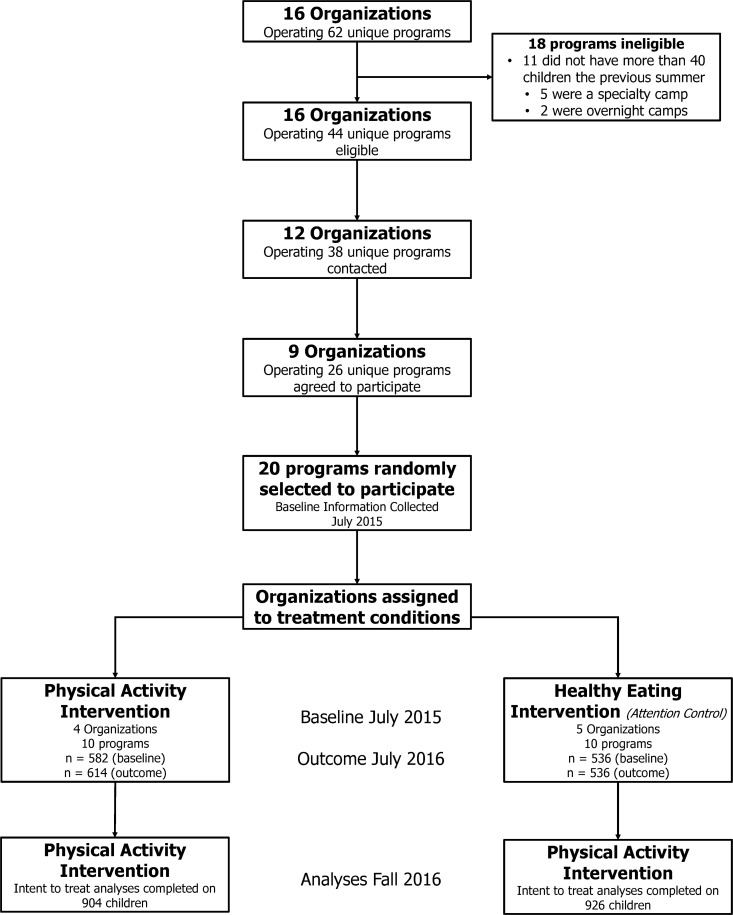
SETTING/PARTICIPANTS: Twenty SDCs serving 1,830 children aged 5-12 years were assigned to MVPA intervention (n = 10) or healthy eating attention control (n = 10).
The STEPs (Strategies to Enhance Practice) intervention is a capacity-building approach grounded in the Theory of Expanded, Extended and Enhanced Opportunities. Camp leaders and staff receive training to expand (e.g., introduction of activity breaks/active field trips), extend (e.g., schedule minimum of 3 hours/day for PA opportunities), and enhance (e.g., maximize MVPA children accumulate during schedule activity) activity opportunities. Camps in the comparison condition received support for improving the types of foods/beverages served.
Percent of children accumulating the 60min/d MVPA guideline at baseline (summer 2015) and post-test (summer 2016) measured via wrist-accelerometry.
Multilevel logistic regression conducted fall 2016 indicated boys and girls attending intervention SDCs were 2.04 (95CI = 1.10,3.78) and 3.84 (95CI = 2.02,7.33) times more likely to meet the 60min/d guideline compared to boys and girls attending control SDCs, respectively. This corresponded to increases of +10.6% (78-89%) and +12.6% (69-82%) in the percentage of boys and girls meeting the guideline in intervention SDCs, respectively. Boys in comparison SDCs increased by +1.6% (81-83%) and girls decreased by -5.5% (76-71%). Process data indicated intervention SDCs successfully extended and enhanced PA opportunities, but were unable to expand PA opportunities, compared to control SDCs.
Although substantial proportions of children met the MVPA guideline at baseline, no SDCs ensured all children met the guideline. This intervention demonstrated that, with support, SDCs can help all children in attendance to accumulate their daily recommended 60min MVPA.
ClinicalTrials.gov NCT02161809.
在美国,夏日日间营地(SDC)每年为1400万儿童提供服务,旨在为参与的儿童提供60分钟的中等到剧烈身体活动(MVPA)。本研究评估了一项旨在提高达到该MVPA指南的儿童比例的干预措施。
两组前后对照准实验。
设置/参与者:20个为1830名5至12岁儿童服务的SDC被分配到MVPA干预组(n = 10)或健康饮食关注对照组(n = 10)。
“增强实践策略”(STEPs)干预是一种基于扩展、延伸和强化机会理论的能力建设方法。营地领导和工作人员接受培训,以扩展(例如,引入活动休息/实地考察活动)、延伸(例如,每天安排至少3小时的体育活动机会)和强化(例如,在计划活动期间最大化儿童积累的MVPA)活动机会。处于对照条件的营地在改善所提供的食品/饮料类型方面得到支持。
通过手腕加速度计测量在基线(2015年夏季)和测试后(2016年夏季)达到每天60分钟MVPA指南的儿童比例。
2016年秋季进行的多水平逻辑回归表明,与参加对照SDC的男孩和女孩相比,参加干预SDC的男孩和女孩达到每天60分钟指南的可能性分别高出2.04倍(95%CI = 1.10, 3.78)和3.84倍(95%CI = 2.02, 7.33)。这分别对应于干预SDC中达到指南的男孩和女孩比例增加了+10.6%(78 - 89%)和+12.6%(69 - 82%)。对照SDC中的男孩增加了+1.6%(81 - 83%),女孩减少了-5.5%(76 - 71%)。过程数据表明,与对照SDC相比,干预SDC成功地延伸和强化了体育活动机会,但未能扩展体育活动机会。
尽管在基线时有相当比例的儿童达到了MVPA指南,但没有一个SDC能确保所有儿童都达到该指南。这项干预表明,在获得支持的情况下,SDC可以帮助所有参加的儿童积累每日建议的60分钟MVPA。
ClinicalTrials.gov NCT02161809。