Conolly Rory B, Ankley Gerald T, Cheng WanYun, Mayo Michael L, Miller David H, Perkins Edward J, Villeneuve Daniel L, Watanabe Karen H
U.S. Environmental Protection Agency , Office of Research and Development, National Health and Environmental Effects Research Laboratory, Integrated Systems Toxicology Division, Research Triangle Park, North Carolina 27709, United States.
U.S. Environmental Protection Agency , Office of Research and Development, National Health and Environmental Effects Research Laboratory, Mid-Continent Ecology Division, Duluth, Minnesota 55804, United States.
Environ Sci Technol. 2017 Apr 18;51(8):4661-4672. doi: 10.1021/acs.est.6b06230. Epub 2017 Apr 7.
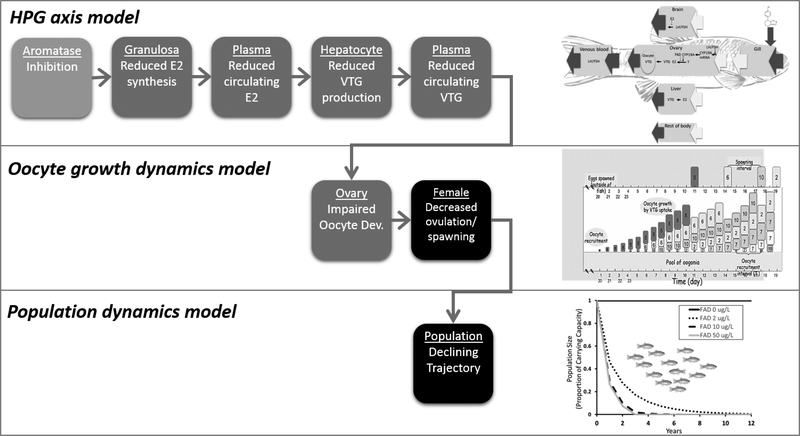
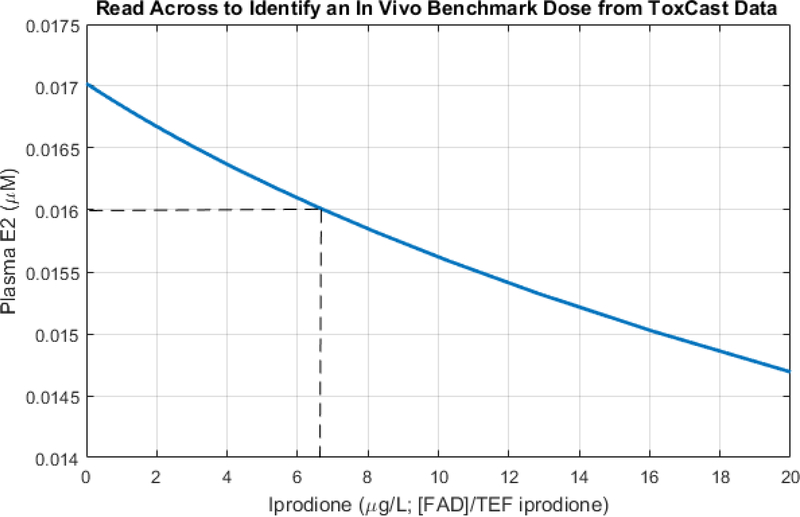
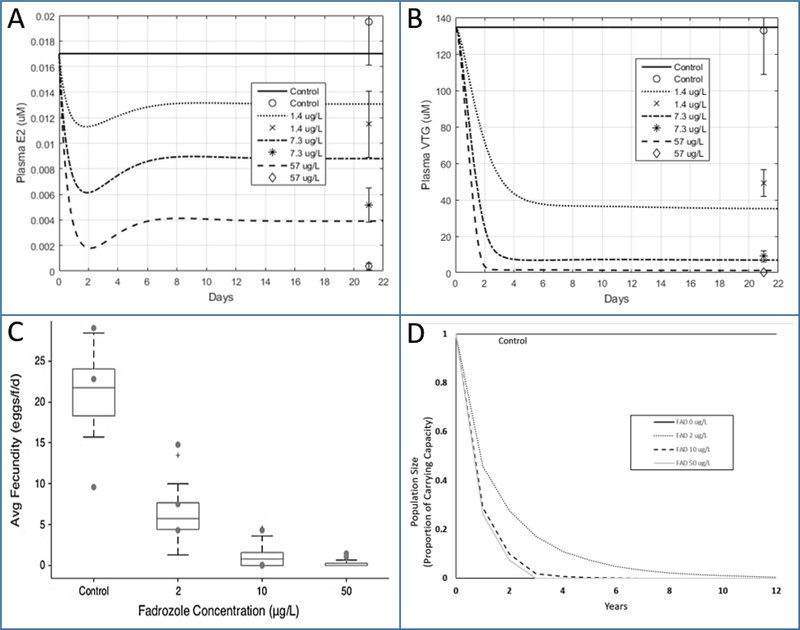
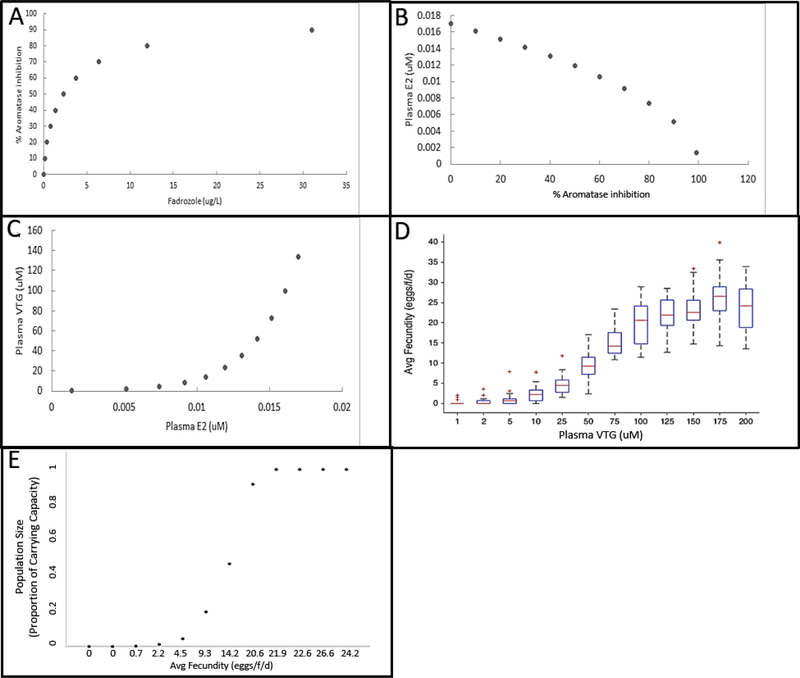
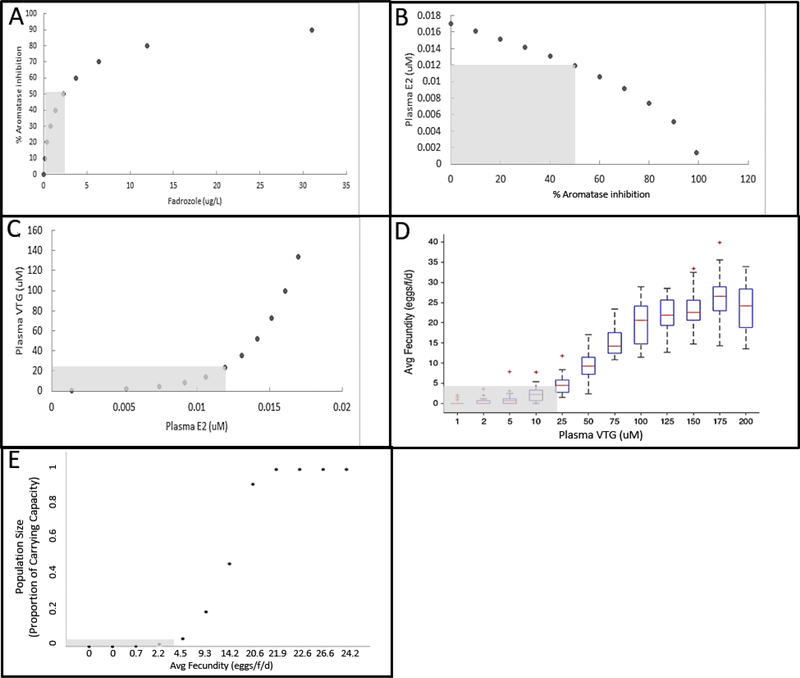
A quantitative adverse outcome pathway (qAOP) consists of one or more biologically based, computational models describing key event relationships linking a molecular initiating event (MIE) to an adverse outcome. A qAOP provides quantitative, dose-response, and time-course predictions that can support regulatory decision-making. Herein we describe several facets of qAOPs, including (a) motivation for development, (b) technical considerations, (c) evaluation of confidence, and (d) potential applications. The qAOP used as an illustrative example for these points describes the linkage between inhibition of cytochrome P450 19A aromatase (the MIE) and population-level decreases in the fathead minnow (FHM; Pimephales promelas). The qAOP consists of three linked computational models for the following: (a) the hypothalamic-pitutitary-gonadal axis in female FHMs, where aromatase inhibition decreases the conversion of testosterone to 17β-estradiol (E2), thereby reducing E2-dependent vitellogenin (VTG; egg yolk protein precursor) synthesis, (b) VTG-dependent egg development and spawning (fecundity), and (c) fecundity-dependent population trajectory. While development of the example qAOP was based on experiments with FHMs exposed to the aromatase inhibitor fadrozole, we also show how a toxic equivalence (TEQ) calculation allows use of the qAOP to predict effects of another, untested aromatase inhibitor, iprodione. While qAOP development can be resource-intensive, the quantitative predictions obtained, and TEQ-based application to multiple chemicals, may be sufficient to justify the cost for some applications in regulatory decision-making.
定量不良结局途径(qAOP)由一个或多个基于生物学的计算模型组成,这些模型描述了将分子起始事件(MIE)与不良结局联系起来的关键事件关系。qAOP提供定量、剂量反应和时间进程预测,可支持监管决策。在此,我们描述了qAOP的几个方面,包括(a)开发动机、(b)技术考虑因素、(c)可信度评估以及(d)潜在应用。用作这些要点说明示例的qAOP描述了细胞色素P450 19A芳香化酶抑制(MIE)与黑头呆鱼(FHM;肥头鲦鱼,Pimephales promelas)种群水平下降之间的联系。该qAOP由三个相互关联的计算模型组成,分别用于以下方面:(a)雌性FHM的下丘脑-垂体-性腺轴,其中芳香化酶抑制会减少睾酮向17β-雌二醇(E2)的转化,从而降低E2依赖性卵黄蛋白原(VTG;卵黄蛋白前体)的合成;(b)VTG依赖性卵子发育和产卵(繁殖力);(c)繁殖力依赖性种群轨迹。虽然示例qAOP的开发基于对暴露于芳香化酶抑制剂法倔唑的FHM进行的实验,但我们还展示了毒性当量(TEQ)计算如何使qAOP能够用于预测另一种未经测试的芳香化酶抑制剂异菌脲的影响。虽然qAOP的开发可能需要大量资源,但所获得的定量预测以及基于TEQ对多种化学物质的应用,可能足以证明在某些监管决策应用中的成本是合理的。