Bento-Torres N V O, Bento-Torres J, Tomás A M, Costa V O, Corrêa P G R, Costa C N M, Jardim N Y V, Picanço-Diniz C W
Faculdade de Fisioterapia e Terapia Ocupacional, Instituto de Ciências da Saúde, Universidade Federal do Pará, Belém, PA, Brasil.
Laboratório de Investigações em Neurodegeneração e Infecção, Instituto de Ciências Biológicas, Universidade Federal do Pará, Belém, PA, Brasil.
Braz J Med Biol Res. 2017 Mar 23;50(4):e5892. doi: 10.1590/1414-431X20165892.
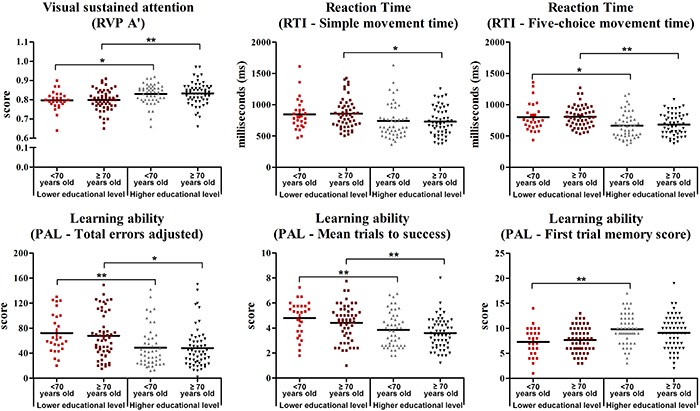
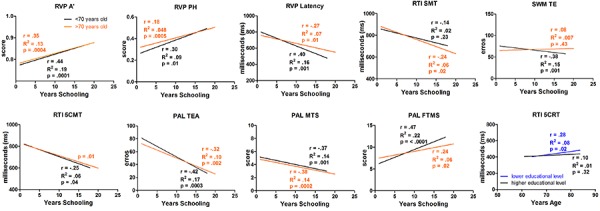
Few studies have examined the influence of a low level of schooling on age-related cognitive decline in countries with wide social and economic inequalities by using the Cambridge Automated Neuropsychological Test Battery (CANTAB). The aim of the present study was to assess the influence of schooling on age-related cognitive decline using unbiased cognitive tests. CANTAB allows cognitive assessment across cultures and education levels with reduced interference of the examiner during data acquisition. Using two-way ANOVA, we assessed the influences of age and education on test scores of old adults (61-84 years of age). CANTAB tests included: Visual Sustained Attention, Reaction Time, Spatial Working Memory, Learning and Episodic Memory. All subjects had a minimum visual acuity of 20/30 (Snellen Test), no previous or current history of traumatic brain/head trauma, stroke, language impairment, chronic alcoholism, neurological diseases, memory problems or depressive symptoms, and normal scores on the Mini Mental State Examination (MMSE). Subjects were grouped according to education level (1 to 7 and ≥8 years of schooling) and age (60-69 and ≥70 years). Low schooling level was associated with significantly lower performance on visual sustained attention, learning and episodic memory, reaction time, and spatial working memory. Although reaction time was influenced by age, no significant results on post hoc analysis were detected. Our findings showed a significantly worse cognitive performance in volunteers with lower levels of schooling and suggested that formal education in early life must be included in the preventive public health agenda. In addition, we suggest that CANTAB may be useful to detect subtle cognitive changes in healthy aging.
在社会经济不平等现象普遍存在的国家中,很少有研究使用剑桥自动化神经心理测试组(CANTAB)来考察低教育水平对与年龄相关的认知衰退的影响。本研究的目的是使用无偏差认知测试来评估教育水平对与年龄相关的认知衰退的影响。CANTAB能够在跨文化和不同教育水平下进行认知评估,且在数据采集过程中减少了考官的干扰。我们使用双向方差分析评估年龄和教育水平对老年人(61 - 84岁)测试分数的影响。CANTAB测试包括:视觉持续注意力、反应时间、空间工作记忆、学习和情景记忆。所有受试者的最小视力为20/30(斯内伦视力测试),既往或当前均无创伤性脑/头部外伤、中风、语言障碍、慢性酒精中毒、神经疾病、记忆问题或抑郁症状史,且简易精神状态检查表(MMSE)得分正常。受试者根据教育水平(1至7年及≥8年 schooling)和年龄(60 - 69岁及≥70岁)进行分组。低教育水平与视觉持续注意力、学习和情景记忆、反应时间以及空间工作记忆方面的显著较低表现相关。虽然反应时间受年龄影响,但事后分析未检测到显著结果。我们的研究结果表明,教育水平较低的志愿者认知表现明显更差,并表明早期的正规教育必须纳入预防性公共卫生议程。此外,我们建议CANTAB可能有助于检测健康衰老过程中的细微认知变化。